in Middletown.
Middletown company on cusp of emerging technology
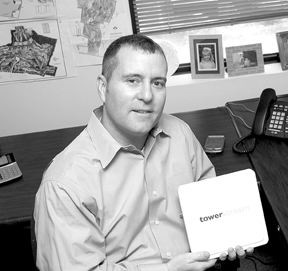
Jeff Thompson
Seifert Systems Invests in Energy Efficiency to Strengthen Operations
For manufacturers, energy is more than just another operating expense. It plays a critical role…
Learn More
Position: President and Chief Operating Officer of Middletown-based
TowerStream
Background: Prior to joining TowerStream, Thompson was founder and
vice president of operations for eFortress, a privately held Internet service
provider. Under Thompson’s leadership, eFortress became one of New England’s
largest service providers and after a successful liquidity event, he helped
eFortress’ growth to 20 markets across the country while overseeing technical
integration issues during nine other acquisitions.
Education: B.S. in electrical engineering from the University of Massachusetts
Dartmouth
Age: 39
Residence: Middletown
Jeff Thompson co-founded TowerStream with CEO Philip Urso in late 2000,
and in May 2001 launched a new model for delivering reliable bandwidth to the
commercial market in Providence. By leveraging second-generation multi-point
fixed wireless technology, TowerStream delivers an alternative to traditional
wire-line T1 connections via small receiving dishes installed on customers’
roofs that receive signals from regional hubs positioned on building rooftops.
The company’s first hubs were located at Regency Plaza and on the Hospital Trust
Tower.
TowerStream has since expanded into the dense business markets of Greater
Boston and New York City and just launched its product in Chicago, delivering
consistent broadband speed to customers with technology that can be installed
within days and can be easily upgraded. The company now employs 33 people and
has seen its revenues double every year since taking its product to market.
Q. That first year, once you had customers up and running, what was the
biggest obstacle you ran into? Did you have any growing pains?
A. Of course. WinStar and Telligent (two early fixed wireless broadband
telecom providers) had just gone Chapter 11 and it was tough economic times,
right after 9-11. Now, people request wireless Internet access. Three years
ago, if someone called me with the calls I get now, saying, “Um, we were told
we need a wireless backup circuit so we have true redundancy coming through
the roof and the radial wire through the ground,” – I would have been jumping
for joy. Three years ago, I had to convince them that wireless service is just
as good. … Even now (with people who haven’t heard about the technology), you
typically get the same questions. They ask about weather reliability and security.
It’s just as secure as a T1 and weather doesn’t affect it because it’s under
10 gigahertz. It’s pure physics, it’s the size of the sine wave. Under 10 gigahertz,
it’s tough to block the wave – you’d need something the size of golf balls coming
down at a steady rate. The bigger the sine wave the tougher it is to have a
steady rate. People have satellite TV, something like that’s in the 38-gig sine
range, and it has tiny sine waves. It doesn’t even need to be snow, it’s typically
fog or dense rain that starts mashing the size of the wave and messing with
the signal.
Q. Generally speaking, were those early customers tech-savvy people, or
just businesses that needed a steady and consistent bandwidth?
A. It was a little bit of both for our first customers, but I don’t
want to candy coat it all. A lot of people still come to us because of the low
cost. And because we have as service level agreement that guarantees it in writing,
a lot of people say, “500 bucks? Well I can try it, I have a 30-day money-back
guarantee, and if I don’t like it, you’re gone.” They try it, they like it,
they get an upgrade. So bottom line, cost really gets us in the door. Right
now, everybody wants to save money. People don’t like to talk about cost, people
don’t like to sell cost, but cost is very important to people.
Q. When you talk about second-generation wireless technology, what does
that mean to the service you’re providing?
A. First-generation technology basically connected you and that was
about it. And it had to be pure line-of-sight, unobstructed. … Second-generation
products do a lot of different things at the physical layer and can correct
things before actual Internet protocol is used. So everything’s corrected at
a much lower level, plus it has non-line-of-sight capabilities, which means
you don’t have to see the hub or our bay station. You can be behind the building.
We recently did a 3.5-mile non-line-of-sight shot in New York City that’s just
incredibly blocked and obstructed and the link is delivering five 9s of reliability
(a 99.999 percent reliability rate). So second-generation technology has really
made it better to deploy and made for a better quality of service. …
Q. So business density is at the top of your list as you look at what markets
are next?
A. Yes. If you look at our rollouts now, it’s changed from tier three
and four markets to Boston, Providence, New York City and Chicago. And we have
three or four cities we’re going to be rolling in right behind those. … We started
selling to Chicago this month and there’s some very strategic reasons why we’re
going to certain markets.
Q. In terms of growth in the markets you’re in right now, how much more
do you think you can grow?
A. I think we’ve just started. The Providence network might be at
10 to 15 percent capacity … and Providence is by no means just our test bed.
Providence is a great market for us. And one of the things we’ve been able to
do in Providence is a lot of the businesses here know that prices for Internet
access in Providence are much higher than they are in Boston because a lot of
the carriers, and the less expensive carriers like Cogent, aren’t here. What
we’ve been doing is building out our network and bring that aggressive pricing
down to Providence. … In the past two or three months we’ve brought a lot of
that Boston bandwidth down to Providence so we can resell it and give people
those price breaks.
Q. In terms of new technology, what’s next?
A. We’re the first carrier to join WiMax (a wireless networking standard
that offers greater range and bandwidth than Wi-Fi standards), we’re working
hand-in-hand with Intel and Proto and we’re the first carrier giving them a
lot of feedback on this new technology. As soon as the equipment becomes widely
available, it’s really going to spark this industry. …
The WiMax form is basically the standardization of our technology. Basically,
like Wi-Fi is 802.11, WiMax is 802.16. And they’re going to be two technologies
that work together. You’ll eventually start seeing TowerStream deploy WiMax-ready
type bay stations, where what we have right now is pretty close to standard
equipment. Late 2004, early 2005, we’ll start getting WiMax bay stations. We’ll
be one of the first to deploy it, we’re going to help with the testing, the
beta-end of the product, and then it’s going to be become standard. It’s going
to be weird, because you’re going to go from this being a very specialized,
niche business to the ultimate goal of WiMax is (for consumers) to walk into
a CompUSA and get customer premise equipment that can go into your notebook
and connect to TowerStream. … In the next few years we’ll hopefully have a lot
more markets up and we’re going to have a large WiMax network, just like Wi-Fi.
Q. How often is there a technical issue with wireless Internet?
A. Over the last three years we’ve learned a lot about how to do this
business model. There’s nothing proprietary to our software, we don’t make boxes
– but the knowledge that we’ve learned in the last three years is really what’s
special about TowerStream. Because we’re deploying a satellite digital architecture
with the four 9s (a 99.99 percent reliability rate) that guarantee to our customers
is something we had to learn how to do. If you talk about our network, one of
the things we say about the TowerStream network is that it’s a very quiet network.
Over (a) weekend there were zero customer tickets. We have over 600 customers,
there’s consistently a very low percentage of our customers having issues. Our
churn is very tiny, less than a half percent. Our customer retention is great
and that’s only going to be great if you’re doing a good job. And it’s because
the technology is fully banked. People think, “Is wireless unreliable?” It’s
not. We have links that are up for almost a year that have never been rebooted
because a customer has never rebooted them.
Q. You’ve mentioned a few times that air is ubiquitous, while fiber isn’t.
What has that meant to your customer base?
A. The architecture we’ve come up with, we did in Rhode Island. People
think of Rhode Island as a secondary market, but we built the same network in
Boston and in New York. We’ve built a ring architecture that goes pretty much
around the whole state so if any one point on our backbone goes down we still
have redundancy. We’ve built our network hundreds of feet in the air and people
like that now. They understand that whether someone digs up some fiber, or some
copper or a central office goes down – we’re up above all that and we don’t
depend in any way on Verizon. So when there’s an outage, our customers are up
and running. …