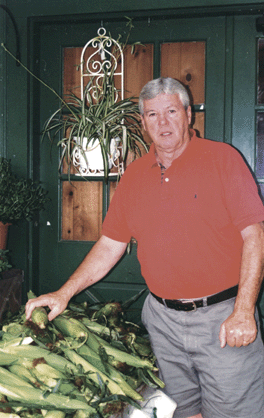
Cumberland business in 1990.
Company: Phantom Farm
Owner: John Hunt
Location: 2920 Diamond Hill Road, Cumberland
Employees: 16
Type of business: Farm products and associated goods
Annual revenues: WND
Come October, if you decide to get in the car some Sunday and do a little leaf peeping, you’d do well to head north to Cumberland.
Building a Strong Data Foundation in the Age of AI
Artificial intelligence (AI) has become a key priority in the boardroom and across management —…
Learn More
Not only will you find spectacular foliage, you’ll be able to drop in at Phantom Farm, one of the more appealing roadside stands in all of Rhode Island. Not only does it offer an unusually eclectic mixture of food and flowers, pumpkins and fudge, it has an intriguing ghost story to garnish the experience. Of that, more later.
Owned and operated by John Hunt of Lincoln, Phantom Farm is located on Diamond Hill Road, about a mile and a half south of its intersection with Route 120: a busy crossroad, to be sure, but one that belies the rural flavor of the neighborhood.
Phantom Farm, for example, is located on a 20-acre tract that’s been the site of extensive fruit orchards since colonial days. In point of fact, original settler William Blackstone was an apple grower, and, according to John Hunt, planted the state’s first orchard.
James Roberts set up the farm stand back in 1950, and sold it to building contractor Hunt in 1990. (Hunt remains in the contracting business, but shows up at the farm daily to manage the operation.)
Over the years, Hunt has supplemented his farm produce – corn, apples, peaches and pears – with flowers, fudge, the coffee and muffins he serves daily to a regular morning clientele; and the pies Phantom Farm folks have been baking for the past half century. The stand also houses a small gift shop.
And there’s more. In John Hunt’s words, “there’s a lot going on” outside the stand itself.
“We do hayrides and orchard tours and bring in cartoon characters to entertain the children,” he said. “Visitors are also given the opportunity to pick their own apples.”
Its bucolic charm notwithstanding, Phantom Farm is a demanding master. Its very survival calls for a lot of hard work and requires considerable cooperation from Mother Nature. This year, she was kind. Despite the drought, whatever rain fell did so at precisely the right time of the growing season. The result is a bumper crop of apples.
“It was a great pollination period, and the bugs were down.”
That was fortuitous, but sometimes Mother Nature can be grumpy. For example, the state’s last hurricane took down 45 percent of Hunt’s apples. Another time, no rain fell when it was needed, and the orchard produced a crop of small apples that had to be discarded.
“Those things hurt,” he said. “Every year, you worry. You worry about getting rain. You worry about frost hitting before you blossom. You don’t want rain during the pollination period. And you’re constantly monitoring the orchards for insects.”
On that last count, the farm has enjoyed critical support from the University of Rhode Island.
“They’ve been a great help,” Hunt said. “They tell us to see if the good bugs are eating the bad bugs. We introduced the good bugs.”
Ladybugs, he explained, are good. Leaf miners are bad.
Hunt puts out trays to collect bugs.
“This tells you how many good bugs you’ve got as compared with bad bugs. This tells you whether to spray or not.”
At harvest time, a hard-working Jamaican named Alfred Donald comes north to begin picking, a task he’s been carrying out for the past four years. The apple yield sounds like a Luther Burbank textbook: there are Macowns and MacIntoshes, Golden and Red Delicious, Baldwins and Cortlands and Empires. There are arcane varieties like Black Twig and Maiden Blush and Northern Spy and Rhode Island Greens.
These are the kinds of products that help attract a boom crowd to Phantom Farm during the fall of the year.
“We get a big jump in foliage season,” Hunt said. “We peak between mid-September and Christmas.”
During the winter, patrons still come by for coffee, muffins, and pie, and to browse in the gift shop. But for John Hunt, the cold weather is a time for maintenance and repairs. And for keeping his fingers crossed to fend off the bugs and bad weather that can plague farmers — and farm stand proprietors.
Oh, about that legend…
Back in colonial days, Hunt recalled, the neighborhood was divided into five farms. There were Indians about, but for a time they lived in harmony with the settlers and worked on the farms. It was during one of those serene interludes that a young colonial girl grew close to a young Indian boy.
“Then, something went wrong. The Indians became angry. The boy met the girl and warned her that his people were preparing to attack,” Hunt said.
The girl and her family fled, escaping the attack the boy had promised.
“When she returned, she went to her favorite tree – the place where she and the boy had been meeting. But he never showed up. It seems he was killed in the attack.”
Henceforth, legend has it, the girl, and later the woman, was often seen walking back in forth through the orchard, wearing ghostly white and searching in vain for her young friend.
“And that,” Hunt said, smiling, “is the legend of Phantom Farm.”
Dick Sherman is a contributing writer to PBN.