ITEM New Product Development in
Providence with a product.
From comfortable shoes to garden tools, firms tap the baby boomer market.
As the population continues to live longer and the baby boomer generation creeps
closer to old age, Rhode Island companies are looking to provide products the
burgeoning segment of the marketplace will demand.
Beyond Cash Donations: How New Forms of Giving Are Transforming Not-for-Profit Accounting
Evolving Funding Landscape for Not-for-Profits Not-for-profit organizations are being asked to do more with less,…
Learn More
“It’s a wide-open market, especially with the baby boomers aging,” said Sandy Leubner, associate director of the Rhode Island Geriatric Education Center. “You’re beginning to see the effects of that with more products addressing anti-aging or the effects of getting older a little more so than actually targeting the elderly.”
According to a 2002 report by the Association of Aging, Rhode Island is one of only nine states with more than 14 percent of its population over the age of 65. One-third of all Americans fall into the baby boomer bracket (born between 1946 and 1964), and more than 80 percent of Americans live beyond the age of 65.
Several Rhode Island startups are among the companies looking ahead to the massive demographic and economic shifts that will follow the naturally evolving population in the coming years.
Jason D. Harry, president and CEO of Providence-based Afferent Corp., is positioning his company to establish a leadership position in the emerging field of neurotherapeutic devices. More simply, Harry’s company is working to develop devices, instead of drugs, to treat the effects of aging – whether those are a loss of sensory performance, ranging from a person’s skin to the muscles, tendons and joints, to the more complicated aftereffects of a stroke.
A focus on the elderly market is only natural for Afferent, which is working in collaboration with biomedical and clinical researchers in developing products.
Harry said the product furthest along in development is vibrating shoe insoles that are continuing clinical tests. Both age- and diabetic-related nerve degeneration can affect a person’s balance, not giving a body enough information to balance. When an insole is turned on, random vibrations, undetectable to the human eye, add to the pressure signals and allow the foot’s nerves to sense weak pressures and make necessary adjustments for balance. The elderly population is a natural market to focus on for the future of the technology.
“These are not orphan products,” said Harry, of the potential for neurotherapeutic devices. “It’s a bit of a niche market for now, but it could grow to a very, very broad spectrum.”
Cautioning that the insoles are still years away from the market and likely to enter it with modest claims, Harry said the company would eventually be seeking approval from the U.S. Federal Drug Administration. More immediately, the company needs to work on making the technology affordable, establish a power source and cut down on the size of the lab’s 1-inch-thick prototypes.
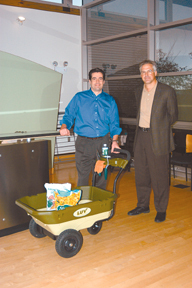
Also in Providence, ITEM New Product Development, along with a group of investors, took a new product – a “lawn utility cart” – to shelves in lawn, garden and home improvement stores about a year ago. The LUVcart is essentially a rechargeable power wheelbarrow, capable of hauling 250 pounds at 2 mph (the rate of walking), that retails for $349. A spinoff company, North Kingstown-based CartCraft, is now working to produce accessories and other powered vehicles for the line.
Stephen Lane, co-founder and managing director at ITEM, said his company was created around the concept of finding fresh ideas for established brands, identifying new lines of business to rejuvenate manufacturers and helping startups turn research into marketable products.
A few years ago, ITEM formed a group with the specific mission of identifying the needs and developing products for the aging populations. Lane said ITEM’s concept-to-supply development mindset was key to developing the LUVcart as soon as the team noted lawn and garden products was one of the key markets where there was huge growth potential. This year will be the product’s official rollout year, when significant placement is expected in a larger number of stores.
Lane said the trend in many categories is finally, at the very least, to be aware of older populations. He said “universal design” is becoming the standard, resulting in everything from large, clear buttons, to products with intuitive features.
“The trend of good design has been mainstreamed over the course of the last 10 to 20 years,” Lane said. “And when you’re designing an everyday-use product, you may as well give more people the opportunity to use it. … It makes good sense for the end user and it makes good business sense because the product can appeal to a broader customer base.”
ITEM is looking at a variety of products that could have applications to an older market. Among those are safety glasses the group is developing to be aesthetically pleasing, not necessarily trendy, and still made from modern materials for the aging work force. The group is looking at binoculars, a product whose design has stayed essentially the same over the years. Lane said he’s looking to develop a richer, more contemporary fit, feel and finish for binoculars used for bird watching, a favorite pursuit of the baby boomer generation.
“Those are the subtleties consumers look for and will choose your product over when all other things being equal,” Lane said.
Andrew Thacher is co-founder and CEO of Providence’s Integrated Collaborative Solutions Inc., which acts as a technology-holding company and is developing a model to realign the “rhythms of daily living” in nursing homes and assisted-living facilities to reconcile the clinical and nursing systems with the desires of residents. A key to the program is dining options, often the most important to residents, and according to Thacher, often the part of the day that tends to be overlooked.
Thacher said there’s no question a huge elderly population is going to continue to settle and thrive in the state and he believes the Internet will play a crucial role in the future of successfully dealing with the need for long-term care.
He said the Internet can aid virtual collaboration between formal and informal caregivers (possibly allowing for the elimination of some problems created by distance) and also opening the door for remote medical diagnoses and the control of medications.
“I suspect that, in the nearer term, that kind of technology could actually be available and affordable,” Thacher said. “The SMART homes (that companies like Intel are developing) are going to remain in the laboratories for a while.”
Back at the state’s geriatric education center (a consortium of local universities
and advocates), a variety of staff and faculty are working to improve the knowledge
and skills for health care and human service professionals dealing with the
elderly population. Leubner said that along with the considerations of long-term
care, the prevalence of falls for people over the age of 65 is a huge issue.