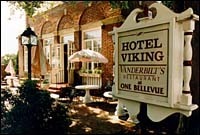
dozens of workers each summer.
(Tom Croke)
Rhode Island’s transition from that of a manufacturing-based economy to that of a service-based economy is complete. In fact, tourism is now by far the state’s fastest growing industry — trailing only the medical industry in terms of its size and scope.
According to the Rhode Island Tourism Division, the state’s tourism industry has generated revenues in excess of $2.5 billion in each of the past two years. Recent years have seen revenues climb by nearly 10 percent.
Seifert Systems Invests in Energy Efficiency to Strengthen Operations
For manufacturers, energy is more than just another operating expense. It plays a critical role…
Learn More
Statistics compiled by Professor Timothy Tyrrell of the University of Rhode Island’s Department of Resource Economics show that nearly 15 million visitors are traveling to the Ocean State annually for business, conventions or leisure. Of those visitors, about 14 million spend the day in the state, while about five million stay overnight.
In 1999, the Travel Industry Association of America reported that the number of visitors to Rhode Island increased at a rate nearly double the national average.
So what does it all mean to the Rhode Island economy?
Look around and the answer jumps out in the form of new hotels, restaurants, multiplex cinemas, and a mammoth mall now anchoring the downtown retail and entertainment scene.
Yes, Fidelity Investments has been a financial services success story — delivering on its promise to Rhode Island by bringing close to 2,000 jobs to Smithfield. CVS has added jobs at its corporate headquarters in Woonsocket. And there have been new high tech start-ups. But the bulk of new jobs in recent years in Rhode Island have been service related.
The service sector has been well served in the Ocean State.
Alisa Gallo, Rhode Island Director of the Local 217 AFL-CIO Hotel & Restaurant Employees Union, has seen first-hand an increase in opportunities for members of her union.
“I really feel our state is becoming a service economy and that there is an ongoing effort to promote tourism and the convention business,” said Gallo. “I do not see a real resurgence in manufacturing.”
While acknowledging projects such as Fidelity Investments, Gallo also points out that when it comes to new construction or the expansion of current facilities, more often than not the service industry is at the forefront.
“Any major project we see seems to be affiliated either with one of the colleges or with tourism,” she said.
Gallo said, for example, that Lincoln Park — with its additional slot machines and aggressive marketing efforts — has added many service jobs.
While a surging service sector means more jobs at hotels and restaurants, not everyone sees the rise in tourism as a positive thing for the Rhode Island economy.
Leonard Lardaro, a professor of economics at the University of Rhode Island, has mixed feelings. First, he said, the tourism industry has earned many of the accolades it may receive.
“There is no question that we have made the transition — we made it beginning back in the fourth quarter of 1987,” said Lardaro. “Tourism in Rhode Island has done extremely well. It has been a major success.”
But Lardaro also worries — worries that perhaps tourism is not the kind of industry around which to build an economy.
“It is a very cyclical industry, whether we like it or not,” he said.
Lardaro’s concern is that if in fact the more technologically-driven industries are in fact leading us into a new economy throughout the country, than Rhode Island would be better served by investing resources in that direction.
“Retail trade and tourism have dominated our job growth in recent years,” he said. “But in a recession — they don’t get you out fast enough.”
But for the people working in service industries, the money is right.
According to the Travel Industry Association of America, wages for service sector jobs have been rising in recent years. In fact, according to the organization, service sector earnings per hour are now more than the average for all private industry sectors, and have made significant inroads on other lower growth sectors – including manufacturing and construction.
Among the findings of the Travel Industry Association of America, are:
- Average hourly wages in the service sector increased 36.9 percent over the past ten years compared with a 32.2 percent increase in the hourly wage of all private employees.
- The transportation sectors of the travel industry, especially airlines, rank among the highest paying sectors in the U.S. economy.
- High compensation positions exist throughout the travel industry, contrary to popular perceptions. Corporate executives within the hospitality segments of travel earn significant salaries. Many operations positions offer high salaries as well. The average hotel general manager, for example, earns between $38,000 and $115,000 per year.
Dale Venturini, president of the Rhode Island Tourism and Hospitality Association, points out that hospitality and tourism has been a big part of the Rhode Island economy since the 1800s when so many flocked to Newport. Now, she said, the industry is an integral part of the new economy — offering a “quality of life” that helps bolster the economy by making the state a desirable location for professionals.
“It has always been a cornerstone of Rhode Island,” he said.
Venturini adds that the tourism and hospitality industry may make a bigger impact on the economy than some might think.
“What about the linen company that only delivers to the hotels,” she asked? “And what about business meetings? Where are they held? At restaurants. Where do the non-profits look to hold their meetings?”