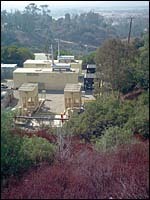
plant in California.
For years, a power plant at the Central Landfill in Johnston has been converting methane gas, emitted from rotting garbage, into electricity.
Now the New Jersey-based company that owns the plant, Ridgewood Power, is planning a multimillion-dollar expansion, spurred by new Massachusetts regulations that promote development of new renewable-energy sources.
Ridgewood already has an agreement with Rhode Island Resource Recovery Corp. to capture 60 percent of the gas emanating from the landfill, which it uses to generate 12 megawatts of electricity – enough to supply nearly 14,000 homes annually. Company officials were to be in Rhode Island last week for final negotiations with Resource Recovery to use the remaining 40 percent of the landfill’s methane gas.
Seifert Systems Invests in Energy Efficiency to Strengthen Operations
For manufacturers, energy is more than just another operating expense. It plays a critical role…
Learn More
“There’s an opportunity to put that additional 40 percent of gas to beneficial use,” said Martin V. Quinn, executive vice president and chief operating officer of Ridgewood Power.
Once that deal is completed, Ridgewood plans to spend 18 months and as much as $12 million to build new generation capacity at the plant. The expansion should result in an additional 7.5 to 12 megawatts of electricity, making it one of the largest landfill power plants in the country, according to the company.
Although the power now generated at the Johnston plant is sold to Narragansett Electric (via Pacific Gas & Electric Co.), the catalyst for the proposed expansion is the opportunity for new business in Massachusetts, according to Quinn.
Regulations recently released by the Mass. Division of Energy Resources will require electric companies to get at least 1 percent of their supply from renewable sources, starting Jan. 1. That percentage grows one-half percent each year to 4 percent by 2009.
To comply with the new law, electric companies in the Bay State, such as Massachusetts Electric and NSTAR Electric, must buy “renewable energy credits” from generators which use sources such as wind, solar or landfill gas. (The credits are in lieu of purchasing power directly from renewable generators, under the premise that renewable energy is being added to the grid somewhere).
Electric companies that fall short of that minimum standard will be fined 5 cents per kilowatt-hour they sell.
Under the Massachusetts law, Ridgewood and other renewable-energy suppliers get paid a premium: they charge the market price for the electricity they generate, and tack on an additional charge for the renewable-energy credit.
Those credits likely will be priced at less than 5 cents per kilowatt-hour, because anything higher than that would make it cheaper for companies to pay the fine instead of buying the credits. But even pricing the credits at 4 cents could double the plant’s revenue.
“We need some sort of premium price in order to make the economics work,” Quinn said.
Ridgewood estimates that the expansion – which likely will consist of a new building to house six large engines and six generators – will reap an additional $2.5 million to $4 million in annual revenue.
The expansion also means additional revenue for the state of Rhode Island, because Ridgewood pays the state-owned Resource Recovery a 15 percent royalty on revenue from the plant. The royalties already bring in more than $1 million for the state annually and Quinn estimates the expansion could add more than $600,000 to that amount.
What’s more, all the methane gas from the landfill would be captured for conversion to electricity, instead of spending money to channel the gas to a flare, where it is burned to avoid air pollution.
“The landfill is generating more gas than the plant can convert right now, and that puts us in the negative position of having to waste a resource,” said Sherry Mulhearn, executive director of Rhode Island Resource Recovery Corp. “Having additional capacity would be a win-win for everybody. It generates revenue for (the state) and the city of Johnston, and it takes waste and converts it into a useful product.”
Rhode Island lawmakers now are considering a piece of legislation, similar to the Massachusetts law, that would require electricity suppliers to have at least 3 percent of their portfolio come from renewable supplies by 2005. Although that proposal represents a potential market opportunity for Ridgewood and other renewable generators, the legislation did not play a factor in Ridgewood’s decision to expand the Johnston plant.
“That’s not something we’re counting on,” Quinn said.
Instead, the company is eyeing the Connecticut market, where the state is in the process of outlining regulations similar to the Massachusetts law.
Ridgewood, however, does plan to apply for renewable energy rebates from the Rhode Island Renewable Energy Collaborative. The collaborative has set aside $1.75 million for development of renewable projects, generated through a small charge on every electricity customer’s bill.
That fund has gone virtually unused, however, because of the dearth of renewable projects proposed in the region, according to Narragansett Electric, which is a member of the collaborative.