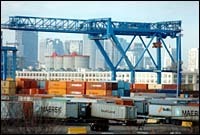
at port of Boston. (Tom Croke)
Ensuring that your products get to where they’re going — on time — is a critical element to any company exporting goods.
These days — as more businesses look to exporting to an international marketplace as a way to weather the storm of a sluggish economy — navigating the federal rules and regulations regarding trade is imperative.
Beyond Cash Donations: How New Forms of Giving Are Transforming Not-for-Profit Accounting
Evolving Funding Landscape for Not-for-Profits Not-for-profit organizations are being asked to do more with less,…
Learn More
That such rules are becoming more strictly enforced on today’s world stage was the consensus of shipping experts who conducted a workshop during World Trade Day 2001 at Bryant College in Smithfield last Thursday afternoon.
The panelists for the workshop, “Transportation Tips: Ensuring Your Products Arrive,” included Edward Lanfredi, a senior vice president at J.F. Moran Co., Inc.; Janet Reagan, export coordinator at Liberty International; and Mary-Lee Courtney, product manager with importing and exporting responsibilities at Tower Group International.
Lanfredi reminded his audience that there are many new government regulations — and it is clearly the responsibility of the shipper to know — and follow — them. In the 1960s and 1970s, he said, exporters enjoyed a freer reign than importers. But now the rules have caught up on both sides of the importing/exporting equation
“The government wants to control certain commodities,” said Lanfredi. “They’re not telling you that you can’t ship something, but they want to know about it.”
Lanfredi described a world stage with much opportunity – but also one that must be monitored closely. For example, he said, “end-user statements,” which must accompany goods, are being taken more seriously than ever by authorities. He said a company here in the United States could innocently ship a valve or metal product to a foreign country – only to have that country put it to use as a component for defense.
“If it is defense-related, you would always need a license,” he said. “These are the kinds of things our country needs to know. Do you really know that the company or person you are shipping a product to is going to be the end-user? It’s your responsibility to know that. I’m not trying to frighten you, but exporters need to know that they have a responsibility. You should be using end-user statements.”
U.S. Custom officials are doubling many fines and penalties, and in fact, all regions of the world are getting stricter. The latest example of being more stringent are packing requirements for goods heading to Europe.
Other words of wisdom from Lanfredi included:
- Maintaining accurate invoices is critical.
- When dealing with foreign countries, remember that when thing go awry, they don’t always get fixed so easily.
- A shipper needs to know when and by what method they are being paid. Not knowing up front can be costly in the long run.
- No shipment should leave this country uninsured — and some do.
- Weights and measurements must be accurate — again, the responsibility of the shipper.
Reagan described the freight-forwarder as a “travel agent” of sorts. She reminded the exporters in the audience that options for moving goods have become almost limitless. Reagan also recommended that shippers consider using major banks whenever possible, particularly those with branches or subsidiaries in countries to which you are exporting.
Despite the complexities of regulations and what seems to be a stricter approach to enforcing them on the part of government authorities, Reagan said companies that seek opportunity through importing/exporting should not be deterred.