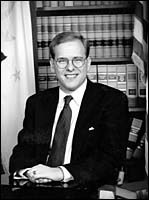
Name: Jim Langevin
Position: U.S. Congressman; Democrat representing Rhode Island’s Second Congressional District
Age: 38
Rhode Island's Market Has Changed. Developers, Builders, Investors and Sellers Must Change With It.
By Emilio DiSpirito IV License Partner | Engel & Völkers Oceanside Leader | The DiSpirito…
Learn More
Background: Langevin ran as a state delegate to Rhode Island’s Constitutional Convention in 1986 and served as its secretary. Two years later, he won election to his first term in the Rhode Island House of Representatives. In 1994, he was elected Secretary of State, the youngest person in the country to hold the office. In 1998 Langevin was elected to a second term, and in 2000 he successfully made a run for the U.S. House of Representatives. Langevin has also served on the board of directors of Rhode Island American Red Cross, PARI Independent Living, Tech Access, The Warwick Shelter and the Rhode Island March of Dimes.
Education: Undergraduate from Rhode Island College; master’s degree in public administration from the Kennedy School of Government at Harvard University.
Residence: Warwick
PBN: A little more than a year ago, you were embarking on the challenges of a new job. How has the transition been?
I think I’ve adjusted for the most part, but the job changes so rapidly that you always have to adapt. By way of example, originally, when I first campaigned for the office I campaigned heavily on the issues of health care, prescription drugs, education, protecting Social Security and Medicare.
Those were the values and principles that I espoused to talk about during the course of the campaign, and planned to make the primary forces of what I’d be doing in Congress. And certainly, those issues are still very important to me – they’re at the top of my agenda – but then, come September 11, the world changed for everyone and now I find myself being a wartime Congressman.
What are some of the particular issues that you’re dealing with?
Well, the military was going through a transitional phase. We were recognizing the fact that the military – the resources we were appropriating – were being spread increasingly thin…We had, since the time of World War II, designed our military in such a way as to be able to fight two major wars at the same time, basically with two superpower-type countries if we needed to.
We’re recognizing now that the world has changed to the extent that it is unlikely that we would have to deal with a two major theater war in the near future. We’re looking at a plan for the military so we could build one major theater war and then use forces for special operations, like we are seeing in Afghanistan.
As one of the smallest delegations in the capitol, how is Rhode Island received in Washington, D.C.?
The delegation has tremendous respect among our colleagues. Certainly it’s easier to get a delegation meeting together. Patrick (Kennedy) and I like to joke about that. We’ll go to an event and if we both show up, we’ll say ‘The entire Rhode Island delegation showed up for this reception’…We all work very well together. I’d say that we put partisan politics aside, and we genuinely like each other and get along.
You’ve known each other for a while too.
Yeah. Patrick and I actually got elected together in the same year to the Rhode Island legislature – 1988 – and we both served for six years there.
Small business is ‘big’ in Rhode Island, and you’re on the House Small Business Committee. How do you gauge Rhode Island’s dependence on small business?
Small business is critical to the success of Rhode Island’s economy and perhaps it’s an overused term, but it’s accurate that small business is the backbone of Rhode Island’s economy. It’s constantly on my mind.
Tell me about some of the issues you’ve been working on with respect to small business.
Certainly taxes are an important issue, making sure businesses are taxed fairly and can function effectively. Health care is another focus. We have the 7(a) loan program that the Small Business Administration provides. Federal contracting and procurement issues are a focus of what we do, and back to the taxes issue – and this ties in also with health care – the small business person, particularly a self-employed small business person, faces enormous challenges in being able to afford health care. I’m a co-sponsor of legislation that would offer 100 percent deductibility of health care to a self-employed worker . . .
Another thing we’re doing on health care is modeled on the RIte Share program here in the state. The RIte Share program was designed to pay the employee portion of the health care premium . . . If you’re a low-income worker, you’re just making minimum wage, for example, trying to provide for your family – even if your portion of the health care is $100 or $200 a month – it may not be something you can afford . . . We also want to take it a step further, and we’re asking for a demonstration that would pay for up to 50 percent of the health care costs for health care in the state for low-income people and companies that provide health insurance to low-income people.
So, for example, traditionally what will happen is a company will pay 30 percent of the cost of the health care premium and the employee will pay 20 percent. This pool of money that we would make available would cut up to 50 percent of the costs for companies that provide health care for low-income workers.
When does that come up for a vote?
It’s legislation that I’ve introduced – I’ve co-sponsored it – and now we’re trying to work through the process. Yes, being in the legislature, you have to learn patience. I learned that back in my days of (the Rhode Island) House of Representatives and as secretary of state. It took us several years, for example, to pass the new voting machines legislation. It took time for us to do all the study and analysis and get the facts and figures.
After the 2000 election, do you have similar hopes for election reform on a national scale?
I’m working in an issue at the national level already, trying to bring the benefit of our experience here in Rhode Island . . . so that other states and communities can benefit from the challenges that we faced in overhauling our entire state system of elections. We had, at one point, the oldest voting system in the country.
How long did that take?
It was about a five-year process.
What about on a national scale?
It’s designed to happen within a two- to four-year period, once the legislation is enacted. It won’t be in time for this election, but I hope, by the ’04 elections many states will have taken steps to overhaul their election systems.
Travel and tourism are so important to the Ocean State’s economy. With T.F. Green being a critical economic generator, how concerned are you about the airline industry?
We’re very concerned. That’s why we appropriated the $15 billion to the airline industry to get them back on their feet, get them flying again and get this economy mobilized. That was critically important. September 11 had a significant level of impact on the airline industry, which had ripple effects throughout the economy.
You were instrumental in getting the Job Corps here, and Rhode Island will soon have a new training facility. What kind of an impact can we expect that to have on the state’s workforce?
I think it will have a huge impact on our economy, training young people giving them the opportunity to succeed at whatever their goals and dreams may be . . . and incorporate that into the workplace. I think that will provide a huge labor pool of resources for the future.
Expectations for a container port at Quonset seem to be getting downsized. What do you see happening?
We need to see what happens with the EIS (Environmental Impact Study?), but I am very concerned about the environmental issues that are associated with developing Quonset. I’ve been a long-time member of Save The Bay. I don’t want to see the gains that we’ve made become eroded. I’m very concerned that the expansion of the port could damage the bay, and it’s our greatest natural resource and we have to do everything we can to protect it. That will be first and foremost on my mind. Certainly developing something that is consistent with the neighborhood and the capability to expand on that, making sure that we have an infrastructure that can handle a certain kind of expansion.
You recently urged Congress to continue funding the Assistive Technology Act’s loan assistance and grant programs. Do you feel a certain responsibility to issues like that? Is it added pressure?
It’s a pressure and a responsibility that I welcome. I recognize that I’m in a unique position to advocate for assistive technology-type programs and other issues that affect people with disabilities, because I live the issues every day. I know just in my own life, with a little help and assistance, how productive I’m able to be. I want to make sure that other people with disabilities have the same opportunities that I have had and that’s why I think government has a role to play in helping open doors for people – not giving people a handout, but a hand up.
Assistive technology helps to level the playing field and help people lead more independent, active lives as well as being an important part of the workforce. Seventy percent of people with disabilities are unemployed. That’s a huge untapped resource. I think it’s the biggest untapped potential resource we have right now in America.