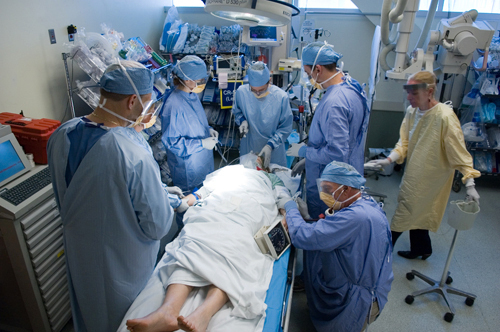
The injuries were, by definition, minor – all patients were evaluated, treated and released. And all were injured as drivers in a vehicle involved in a car accident. But treating patients who had been drinking cost more than four times as much – a median of $5,884 compared to $1,346.
Dr. Michael Lee, an emergency physician and researcher at the Injury Prevention Center at Rhode Island Hospital, analyzed 2005 ER patient data because he wanted to document whether alcohol inherently added to the cost of treatment, no matter how severe the injuries.
In an article in the October issue of the Annals of Emergency Medicine, Lee and two colleagues say knowing the cost might lead to “more aggressive policy interventions,” a valuable step because the impact of efforts to reduce drunk-driving fatalities “appears to have plateaued” in the last decade.
Plus cost is on everyone’s mind with health care reform, Lee said in an interview. If the extra costs with intoxicated patients aren’t medically justified, he said, “maybe we need to find a better way to assess and treat these people.”
Roughly 4 percent of ER patients are car-crash victims, though how many are intoxicated is harder to determine, the study says, because of inconsistent or incomplete reporting. It has been estimated to be a factor in as many as 1 in 8 car-crash injuries, or about 600,000 per year.
Typically, Lee noted, doctors rely heavily on patients’ feedback to evaluate their injuries. They’ll ask where it hurts, whether something is numb, whether they feel woozy. And they will look for signs like loss of balance, slurred speech, poor reflexes and lack of alertness.
If a patient’s drunk, though, all of that is much harder, Lee said. A serious injury might not hurt because alcohol is dulling the pain. Symptoms of head trauma may be indistinguishable from intoxication. And crucial questions may go unanswered.
So what do doctors do with these patients?
For starters, they order a lot more X-rays, CT scans and other imaging, the study found. While 70 percent of sober patients got imaged, for intoxicated patients it was 91 percent. And while the median imaging cost for sober patients was $438, for intoxicated ones it was $2,450, more than five times as much, suggesting that higher-end imaging was done for them.
Intoxicated patients also stay in the ER for a lot longer, 5.7 hours versus 2.4 hours for sober patients, the study found – partly to wait for the imaging results, but also “because, obviously, we have to wait until they’re sober,” Lee said.
Because of the study’s scope, it is limited in several ways, most of which the authors directly acknowledge in their article. The figures are only for Rhode Island Hospital, for example. And because only patients who were released are included, there’s no way to know whether for every drunk patient whose CT scan came out fine, two others had life-threatening injuries that would’ve been missed, more than justifying the extra effort.
Yet Lee acknowledged that some of those costs might be avoidable. “I think we tend to practice defensively,” he said. “Right now I don’t think we have a better way of doing it, but I think it’s important to know what the costs are, and maybe that will help us and lead us to find a better way to treat these patients.” •