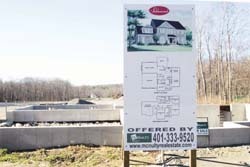
This plot of land in Lincoln will be turned into a single-family home development called Sableswood.
Families yearn for the suburban dream home
Efforts to curb sprawl across Rhode Island have been in full swing for the past half decade, with “new urbanist” ideals working their way into state and municipal planning policies and old mills being transformed into condominium complexes and “lifestyle centers.”
Seifert Systems Invests in Energy Efficiency to Strengthen Operations
For manufacturers, energy is more than just another operating expense. It plays a critical role…
Learn More
One goal of all this, advocates say, is to make optimum use of land in a state that they say has squandered so much.
But what has the burgeoning anti-sprawl movement meant for the traditional, single-family dwelling subdivision that birthed the landscape of suburban America?
On the surface at least, the movement is having an effect.
Figures released by the Rhode Island Builders Association this month show the state’s single-family home building permits, continuing their historic decline, are on track to reach their lowest full-year mark in at least 14 years.
Through September, the number of single-family permits issued was down nearly 15 percent from the same period last year.
Meanwhile, multi-family home construction has been showing strength this year, with 414 permits issued during the first half of 2006 – more than twice the number in the first six months of 2005. Not all builders have fully embraced the philosophy behind those projects, however.
“There’s some merit to it, but one size doesn’t fit all,” said Thomas McNulty, president of E.A. McNulty Real Estate and the new president of the builders’ association. Although multi-family developments have become more popular in recent years, he said, the single-family home development is still alive and isn’t likely to go anywhere.
“There is a tremendous need for them,” McNulty said. “The buying public is looking for that type of product.”
The anti-sprawl movement and more-restrictive zoning policies exist for good reason, supporters say, even if they sometimes do adversely affect developers.
From 1970 to 1995, the state’s population grew by 5 percent, but the amount of developed land throughout the state increased by 47 percent.
The state’s comprehensive plan, Land Use 2025, makes note of that figure and calls for a majority of the state’s future development to occur within its urban core – the communities around Narragansett Bay that are home to more than 70 percent of the state’s population.
To achieve this goal, communities have been given an array of tools, such as the historic tax credit program – which gives tax breaks to developers looking to retrofit an existing, historic structure.
Communities also have been purchasing land to designate as open space, preserving it from development. And their zoning restrictions, including those that require two or even five acres of land per house, also aim to deter development.
There are also impact fees and pacing ordinances, such as South Kingstown’s rule that no more than 352 dwelling units may be built in any two-year period.
But McNulty said the motivation behind those rules is less a concern for preservation than a fear of the impact a single-family-home development would have on the town’s budget.
In fact, a West Greenwich bond referendum last spring highlighted the issue.
In April, 98 percent of voters approved an $8 million bond that would preserve more than 1,500 acres of open space and, in turn, block a 168-home development. Town Administrator Kevin Breene told the PBN at the time that, though the town council was “property-rights oriented,” it wanted to avoid major budget hikes that would have eventually been passed on to the residents.
Roger Warren, executive director of the builders’ association, said the school-costs issue is the main factor in cities and towns’ stance toward single-family home developments. In the face of low interest rates, high demand and a booming housing market, he said, Rhode Island has bucked the national trend, sending single-family construction into a tailspin.
“In trying to figure out what happened, it’s the only thing that we can come up with,” Warren said.
But does the trend away from traditional subdivisions mean that they are dead?
Not at all, McNulty said, and Lincoln Town Planner Albert V. Ranaldi Jr. agrees.
In Lincoln, Ranaldi has aimed at making the regulatory process friendlier to mixed-use developments and building rehabs. He also has penned a “village zoning” proposal – which involves clustered, village-like development – that is currently before the town council.
Interest in multi-family projects has not been overwhelming, however, Ranaldi said, and most projects that come before the town are still primarily single-family subdivisions.
“I believe it’s what the market in this type of area wants,” Ranaldi said. “We’re a bedroom community, and I think people come to expect a front yard, a back yard and a garage area.”
Meanwhile, in East Providence, where an effort to redevelop the industrial waterfront has been widely praised, City Planner Jeanne Boyle said that multi-family redevelopment projects, not suburban-style subdivisions, are now the norm.
But for East Providence, which has been built out for the most part, it’s not so much a choice as a necessity. There isn’t much undeveloped land in the city, Boyle said, and much of the land that is available requires some degree of mediation.
“It’s complicated,” she said. “I think what’s necessary is … experienced and sophisticated developers doing them.”