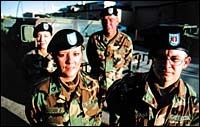
Mille Rodriguez, S/Sgt. Ronald
DePalma, Spc. Chris Mello
Stop & Shop stock worker Christopher Mello turned in his pricing gun for an M-16 rifle on Sept. 11.
Mello is among 70 members of the Rhode Island National Guard pulled from their jobs to serve their country in the wake of the terrorist attacks on the United States.
Seifert Systems Invests in Energy Efficiency to Strengthen Operations
For manufacturers, energy is more than just another operating expense. It plays a critical role…
Learn More
Instead of stocking shelves at a Newport supermarket, Mello spends eight to 10 hours a day guarding the gates of the Army National Guard 43rd Military Police Brigade in Warwick.
Among guardsmen activated were members of the 143rd Security Forces Squadron who have already been deployed. Meanwhile, more than 5,000 members of the guard and reserve are preparing to be called–if necessary– to serve in the war against terrorism.
For employers – whether it’s a supermarket chain or a two-person operation – the loss of a worker can be critical. The companies need to find additional help or shift workloads to other employees. It’s often difficult for a company to decide what route to take, because they don’t know how long the employee will be gone.
Depending on company policy, many businesses also feel the pinch if they continue to pay salaries to people now working for Uncle Sam.
“I’m feeling the effects, but you’ve got to move on. You can’t lay down,” said Dan Theroux, plant manager of Cap Co., a steel fabrication company in Providence. One of Theroux’s second-shift welders, John Thibert, has been on active duty since Sept. 11, serving as a military police officer at the 43rd.
Theroux had to hire a replacement to cover for Thibert while he is gone.
“Because of the workload we cannot go without. It was difficult finding someone of (Thibert’s) caliber, but what are you going to do?” Theroux said.
Many company heads yet to be impacted by losing an employee have started planning in case further guard and reserve members are called.
“The bottom line is we have to make our people available. We are in a different world since Sept. 11 and we have to work around it,” said Mark S. Hayward, district director for the Small Business Administration.
Hayward said he has received calls from several companies asking for advice about how to handle the loss of a key employee. Some companies’ owners are at risk of being activated.
Along with offering advice to help companies find temporary help, the SBA has low-interest loans available to cover costs incurred when an employee is called to duty.
“We try to make sure that they stay up and running,” said Hayward.
The military has done its part to make the process as easy as possible for employers. For example, employees must tell their employers of the possibility that they will be activated as soon as they know.
John Ricottilli, Rhode Island chairman for the Employers Support of the National Guard and Reserve, works with employers throughout the year to make them aware of the Uniform Services Employment and Reemployment Act, the law that protects the civilian jobs of members of the guard and reserve.
Ricottilli, who is also senior vice president of Taco, Inc. in Cranston, served 35 years in the Army reserve before retiring.
“The law says that all companies, regardless of size, must not let an employee go because of his service to the country,” said Ricottilli.
He added that an employee’s job is protected up to five years of continuous military service.
As for compensation to the employee, a company is not obligated to pay them under the law. Ricottilli said some companies pay employees the difference between their military pay and civilian pay. Some provide their full salary and others don’t pay anything.
Thibert, a sergeant in the military police, has 17 years of service, so his military pay is actually higher than his pay at Cap Co. He doesn’t miss his civilian paycheck.
That’s not always the case.
“I can see how that could be a problem for someone just out of basic training,” said Thibert, who spent more than three months in the Persian Gulf during Desert Storm.
Aside from supporting employees while on active duty, companies need to be prepared for their return.
David Unsworth, a supervisor at the Veterans Administration Hospital in Providence, would not expect VA hospital employee Millie Rodriguez to jump seamlessly back into her job after active duty.
Rodriguez, a staff sergeant at the 43rd, has left her job in the medical records department to help with security at military facilities and T.F. Green Airport.
“You need an orientation period. They will need to readjust to civilian life,” Unsworth said. He added that the length of that readjustment depends on the length of active duty.
Rodriguez, who also went overseas during Desert Storm in the early ’90s, said the interruption of her home life and work is minor when she considers her mission.
“I do this for one reason, and that is to protect my country,” she said.
(Photo by Brian McDonald)