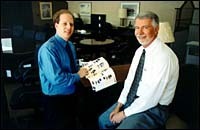
of National Office Furniture.
(Tom Croke)
There’s more to furnishing an office than picking out the right desk.
In fact, today’s office furniture industry in Rhode Island is just as much about service and design as it is about the traditional desk.
Seifert Systems Invests in Energy Efficiency to Strengthen Operations
For manufacturers, energy is more than just another operating expense. It plays a critical role…
Learn More
“This industry is getting very competitive,” said Jim Maguire, a principal at Office Concepts in Providence. “Furniture is just the starting point. Today it’s about service, relationships and reliability. We have become consultants for our customers.”
Jon Weiss, owner of National Office Furniture in Providence agreed.
“Everything today is computerized,” he said. “We can work with a client type and in five minutes they can see what their new office will look like. It’s about service.”
Nationally office furniture production is a $12 billion industry that has experienced a 30 percent growth in the past decade according to Csil Milano, a furniture market research institute
In addition, Csil Milano found that there has been a dramatic change in the U.S. office furniture market over the last 15 years. The change, an industry report said, is that in the past there were large companies buying complete system furniture to fit large-sized working spaces with structured offices. Now, the trend is more smaller companies, each having different requirements for office furniture.
In essence, there is a greater need for small moveable furniture with focus on functionality and ergonomics.
“Companies want flexibility,” Maguire said. “Their functions change on a regular basis and if their furniture can’t also change they become stagnant. Companies are becoming nimble and flexible and they expect the same of their furniture.”
As a result some local furniture companies are positioning themselves to meet the needs of smaller niche markets. Weiss said his company has always concentrated on the “budget and middle markets.”
“You have a few of the bigger companies here in Rhode Island, but for the most part it’s the small to medium sized business that we serve,” he said.
And like the clients they serve, many of Rhode Island’s furniture dealers are small themselves — with less than 50 employees.
“I think many of these places started when people like myself were working for other people and realizing that we could do it on our own,” said Phyliss Connara, president of Office Direct in West Warwick. “Some of us have grown while others have chosen to stay small. But even the smaller firms, like myself have the ability to do 100 workstations.”
And while they may be competition for each other, all three owners agree they don’t compete with the large superstores like Staples and Office Max.
“When stores like Staples first came on the scene there was some concern,” Weiss said. “I think that people were fooled by the price. But I think people are realizing that the quality isn’t there and the price isn’t that much different. I am constantly hearing ‘I went to a superstore and I have learned my lesson, I should have come here first.'”
Where Weiss has seen an increase is with home office furnishings.
“The home office sector has just exploded over the last few years,” he said. “You see it with a lot of two income families, one of the parents wants to stay home and work, and with flex time a lot of people are getting hooked up a home.”
What’s ironic, Weiss said, is that like corporate clients, customers furnishing their home office are also looking for flexibility.
“These offices are second and third bedrooms,” he said. “They need their furniture to be flexible when it comes to size and color. They have a nook or cranny that they want to fit something in and we have to help them.”
As for the slowing economy, local furniture retailers aren’t yet concerned.
“I have been in business for 11 years,” Connara said. “I opened my business when the banks were closing even though people told me not to. I don’t listen to the chatter; it’s not healthy.”
What is healthy, all agree, is the industry itself.
“Every year this business gets more competitive,” Weiss said. “The key is to stay on top of things, offer good prices and provide excellent service.”