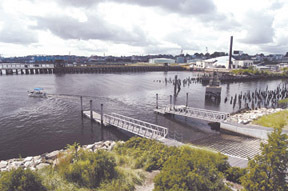
on Narragansett Bay.
Several business sectors harmed by a battered Narragansett Bay
Fish and clam kills. Algae blooms and noxious fumes. Raw sewage
spills. Nitrogen and phosphorous.
Beyond Cash Donations: How New Forms of Giving Are Transforming Not-for-Profit Accounting
Evolving Funding Landscape for Not-for-Profits Not-for-profit organizations are being asked to do more with less,…
Learn More
It’s all taking a hefty toll on Narragansett Bay. This has been a year plagued
with environmental messes that have left residents angry, officials scurrying
to clean up and a state wondering how it all could have happened.
“This has been the worst summer in memory in the Narragansett Bay – there
were beach closures, fish kills, toxic fumes that forced people to move away
from their homes and now sewage spills,” said Curt Spalding, executive director
of Save The Bay. “If we see this continue, our perception of Narragansett Bay
will change and our quality of life as we know it will change.”
Each year, 15.8 million people visit Rhode Island, according to the Rhode
Island Economic Development Corporation. Tourism and hospitality results in
$4.6 billion in annual revenue, with $2.6 billion just from out-of-state tourists.
Rhode Island is known for its beaches and coastline, and people in industries
dependent on Narragansett Bay are concerned how this could impact them.
“The industry in general is very concerned,” said Ralph Boragine, president
of the Rhode Island Seafood Council. “Seemingly the conversation always heads
toward, ‘the bay is getting cleaner all the time,’ and what’s happening is the
opposite of that.”
This summer, a combination of natural causes and pollutants caused an algae
bloom – micro-organisms that, when they died and decayed, dissolved all of the
oxygen in the water. Suffocated, millions of menhaden – and then a week later,
millions of softshell clams – died in Greenwich Bay, and were washed into Conimicut.
Spalding said this is the result of at least eight years of neglect, and an
attitude of “what can the bay do for us?”
Fish kills are fairly common, Boragine said, but a softshell clam kill is
rare, and proves that something has gone terribly wrong in Narragansett Bay.
“The industry has been complaining for a long time – we’re on the bay every
day,” he said. “Something is seriously wrong here. Shellfishing is one-fifth
of what it used to be. Whatever goes wrong in the fishing industry concerns
them not this year, but one or two years from now. What’s happening now will
be amplified down the road.”
The real estate industry, which has thrived in the last decade as Rhode Islanders
and others flocked to South County to buy homes, would also be impacted. Homes
in the Edgewood section of Cranston, as well as commercial real estate in Providence
(on the river) and a large number of homes in South County would be affected,
according to Sal Moio, president of the Rhode Island Association of Realtors.
Millions of gallons of combined sewer overflow (a combination of sewer and
stormwater) goes into the bay each year – from faulty equipment, excessive rain
and inadequate septic tanks. A sewage spill from a facility in Cranston last
month dumped 5,500 gallons of sludge into Pawtuxet River and another from a
facility in Massachusetts, caused by a power outage, leaked an estimated 1 million
gallons of untreated sewage into the Blackstone River, which flows into the
bay.
“It’s amazing how one minute can turn around years of work,” Dale Venturini,
president and CEO of the Rhode Island Hospitality and Tourism Association, said
of the spill in the river. “Our waterways (whether rivers or ocean) are very
important to people all over the state, regardless of their use.”
Whether it’s for recreation, livelihood or marketing, Narragansett Bay plays
a large role in daily life in Rhode Island, Venturini said.
“We’re very concerned with anything that happens in the bay,” she said. “We
boast that we have some of the best seafood in the country and world, and when
you hear bad things about it, that sends out a bad vibe.”
The state Department of Environmental Management has suggested there may be
a larger phenomenon at work that is contributing to these incidents. According
to a DEM report issued shortly after the fish kill, the event was not an isolated
one – they have been occurring for years in different areas of the bay. While
the fish will decay and be buried and the smells dissipate, the long-term effects
are hard to identify.
“The levels of metal and chemical pollutants are much lower now,” said Chris
Deacutis, an oceanographer with the Narragansett Bay Estuary Program at the
University of Rhode Island. “But we really haven’t done anything until now about
nutrients. There is just no (efficient) way to remove them.”
So is the bay really dying? Boragine says yes. Spalding says no – it’s suffering.
“We don’t know what chlorine does, and we don’t have a good handle on the
flushing out of Narragansett Bay – it sure doesn’t flush out (pollutants) as
fast as we thought,” Boragine said. “Winter flounder has been closed (to fishing)
since 1989, and it’s in worse shape now than it was before.”
Deacutis said it’s more of a hyperbole, and things were much worse 100 years
ago. Assumptions that the bay flushed out nutrients efficiently were wrong –
tides differ; weak neap tides don’t mix water and flush out pollutants as well
as stronger spring tides, he said.
“We’re certainly at a turning point, and we’re in a precarious situation where
we’re starting to make a downturn again,” Deacutis said. “No one knows why.
It’s a scientific mystery.”
Spalding said the answer is obvious: nitrogen is polluting the bay, and something
needs to be done – better management of fishing resources, habitat restoration
and pollution reduction are a start.
Deacutis said that the state needs to devote more funding to research the
cause of the pollution and ways to remedy it.
“We need a nitrogen-reduction strategy (to be put together) within six months,”
he said. “We need a new permit for Fields Point” in Providence, which is currently
pending. “And we need nitrogen limits on all sewage plants north of Prudence
Island.”
Plants in other states have already done it, and there are a few plants in
Rhode Island – such as the one in Cranston – that already have nitrogen limits,
Spalding said.
“We know we’re impacting Narragansett Bay, we know that nitrogen is the leading
cause, and we have a good idea of where it’s coming from (Fields Point),” he
said. “If nothing is done, the problems will get worse as the population increases.”
“To me, the bay is symbiotic of everything we do in this state,” Venturini
said. “If you’re a native Rhode Islander, there is such a deep-rooted connection
to the water. It’s in your heart and soul.”