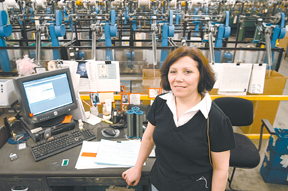
a supervisor position at Hope Global.
A crank was the most technical piece of equipment Cidalia Teixeira saw as a
braid attendant at Hope Global back in 1983. Coming from the Azores with limited
English ability, this was welcome news since it didn’t take a heavy skill set
to get her through the doors and into a position at the Cumberland-based textile
business.
“Now with technology, everything is completely different,” she said. “It used to take me a week to produce 32 pounds of braid. It takes about 8 hours today.”
In order for Teixeira to keep pace with changing technology, like the introduction of an Oracle computer system, she has gone through several training programs. The aim has been to sharpen her language skills and handle computers, which were new contraptions when she started.
Beyond Cash Donations: How New Forms of Giving Are Transforming Not-for-Profit Accounting
Evolving Funding Landscape for Not-for-Profits Not-for-profit organizations are being asked to do more with less,…
Learn More
Today, she takes classes at the Community College of Rhode Island and has been promoted four times within Hope Global to her newest position as supervisor.
Training programs have been instrumental in teaching veteran workers like Teixeira the skills needed to remain in the manufacturing industry.
TrainRI Manager Melissa Punchak said classes in this area have been, and continue to be, the focus of much of the training her organization teaches.
“To remain competitive, manufacturers and their workers need to be more technically suave,” she said.
At TrainRI, a branch of the Rhode Island Manufacturers Association, 300 individuals signed up for courses in September – its highest enrollment jump ever, she said.
Although technical skills are becoming a fundamental necessity in the workplace, the majority of veteran workers who need the training are, like Teixeira, not originally from the United States. The high number of immigrants in the manufacturing industry requires English as a second language and other literacy courses.
Punchak said between 50 percent to 60 percent of those attending classes are of immigrant origin and about 60 percent are over the age of 40.
Robin Smith, director at the Center for Business and Industry at Bristol Community College in Fall River, said literacy courses have been identified as needs by local manufacturers in her area.
“It was identified that these skills are needed since immigrants make up a lot of the work force in this area of the state,” she said. “The aim is to improve production and communication skills.”
The Southeastern Massachusetts Manufacturing Consortium, which is made up of 10 large and small manufacturers including the Acushnet Co. in Fairhaven, has received state grants to pay for classes at the community college.
Since the consortium was formed two years ago, Smith said a large number of people have been exposed to post-secondary courses through these classes, which she says often take place at a company’s facility.
“They are given the opportunity to be exposed to higher education and that can lead to an interest in higher learning,” she said. “For many, this is the first time they’ve associated with BCC.”
Dorothy Mattiello, human resources director at Hope Global, said training is an essential part of her company’s work environment.
About 80 percent of its product line is engineered textiles for the automotive industry, a niche market that requires new designs every year. Also, the marketplace demands Hope Global not be afraid of technologies that speed efficiency.
“Change doesn’t come easy for everyone,” she said. “A worker may have been on one machine for so many years that it is part of their workplace identity. It defines them and how well they’ve done on their job.”
Since the company has a “promote from within” policy, and since many of its workers are immigrants, multi-focused training programs have been used to keep up with technological changes.
Some are in-house programs run by company “super users,” which train co-workers on computer programs or creating labels. Others are aimed at getting workers like Teixeira into the community college system and TrainRI to receive training to help them move up the corporate ladder.
“The training and development is a strategic move,” she said. “Our CEO (Cheryl Merchant) wants a well-trained work force because they will take ownership in their job.”
Manufacturers like Teknor Apex Co., headquartered in Pawtucket, are a little different from the average manufacturing company in that they have few immigrant workers. But, the need for technical training is still a priority.
Doreen Chabot, director of human resources and training at Teknor Apex, said the corporate offices recently switched to a software program to allow the company to go paperless.
It was quite a jump from the traditional way senior management did business and required a step-by-step approach to training. The first concept to get across was that change is not bad, Chabot said.
“We had workers with a high level of seniority that have been doing their job the same way for a long time,” she said. “Change can make people nervous … and we needed to give people a confidence boost, an attitude boost.”
The company is making use of techniques taught in the book “Who Moved My Cheese” by Spencer Johnson to get comfortable with the idea of change in the workplace.
“It’s been very successful,” she said.
Teknor Apex, a producer of plastic and rubber, has about 100 employees who have been with the company for more than 35 years. The company has about 660 employees in Pawtucket, a location in Attleboro and locations across the country and Singapore.
TrainRI’s Punchak said much of her program is structured around the immigrant population. Students from other countries start out with English as a second language as this is the prerequisite program that leads to other courses.
She said some of the more popular classes involve developing entry-level computer skills and simple math. Learning becomes more advanced with classes in blueprint design and computer programs like Excel.
“The investment some companies have made into their employees is phenomenal,”
she said.