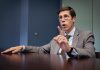
Name: Vincent A. Cianci, Jr.
Occupation: Mayor of the City of Providence. The longest sitting mayor in the city’s history.
Backround: First elected mayor of Providence in 1974, at the age of 33, winning reelection in 1978 and 1982. Elected again in 1990, and reelected in 1994 and 1998.
Education: Bachelor’s degree in government from Fairfield University, Master’s in political science from Villanova University, and law degree from Marquette University School of Law.
Age: 59
Family: Divorced, the father of one daughter, and has two grandchildren.
Residence: Providence
Mayor Vincent A. Cianci, Jr.: ‘We’ve become a much more sophisticated community as far as business is concerned.
Seifert Systems Invests in Energy Efficiency to Strengthen Operations
For manufacturers, energy is more than just another operating expense. It plays a critical role…
Learn More
PBN: From Your perspective as mayor of the city, where are we in terms of the economy and where are we going?
CIANCI: We have brought ourselves to the point in this city where we can participate in a much larger way economically than we ever thought before. I think that the leadership in the business community thinks more globally, and has more confidence in the city as a business center. I think we’ve raised our self esteem to a point where we actually believe we can participate. And we’ve become a much more sophisticated community as far as business is concerned. I’m not saying that we have reached the levels of other areas of this country, because of a lot of reasons that still prevent us from developing businesses as we’d like. But I think we’re moving in the right direction, so I’m looking forward to a better economy in the future.
Do you think we’ve come far enough on a state level legislatively to create a better business climate?
No, I don’t. I think the state income tax situation is such that it prevents us from developing like we’d like to develop. I think we made a move in the right direction on the tangible taxes, but I think we could have accelerated that.
I also understand that when Moody’s recently rated the state, there was some provision for the state to abandon its auto excise tax relief program if it appeared its finances were not as projected?
I’ve heard that also. I’ve also heard that it was too much to bite off. But you are not going to develop business in this state unless you can have almost a tangible tax that goes away, because it’s very, very destructive to develop businesses unless you can have a tangible tax reduction.
We attract business here because we have been able to give out tax stabilizations, which are available to everybody in the city if they develop jobs. By helping out companies like Resolutions Travel, Boston Financial, Excel Manufacturing, and the list goes on, we’ve been able to create jobs for people who live in the city of Providence. The biggest tax stabilization plan we ever gave was the mall. That was a $142 million commitment by the taxpayers of the city, because we’ve foregone taxes for a number of years. It’s not as if they don’t collect taxes. They do collect taxes at the mall, but they are paying the infrastructure – because that’s a tough site. In one generation we’ve been able to recapture an entire part of our economy, that’s the retail that left when I first became mayor and while I was mayor. Those kinds of incentives are necessary if you’re going to create jobs. I believe in them.
You’ve mentioned certain priorities you have as mayor.
There are five things that I do as mayor in this city, and they’re all interrelated.
Number one is you have to have a safe city. I think you are going to be impressed with the prime numbers at the end of the year (1999). In certain areas we’ve gone down, in certain areas we’ve gone up, but quality of life areas for crime are down. We’ve never had more police officers on the street, nor have we had more equipped vehicles and more equipment in the police department, and we are building a brand new police station; in fact, we’ve acquired all the land, and we’ll begin construction imminently to build that, new state of the art
The Fantasies site
Yes, we own that now, because we condemned it and we own it (the Dean Street location of the Fantasies club that has moved elsewhere in the city.). They’re out of there.
The second thing is to create affordable housing. Just because the economy is robust that does not mean there aren’t any people who are being neglected. Because it’s such a great economy, there are more people competing for available housing and because of that it is driving the price of housing up, so therefore some people are left homeless. The U.S. Conference of Mayors did a study that shows we actually have more homeless and more hunger in America than we did in 1993. We find there are more people on the lower end of the totem poll economically.
There are different categories now. You have unaccompanied minors. You have more women with families who are homeless. You have working poor who are homeless. The causes are substance abuse, mental illness, domestic violence, all those things which cause families to break up and cause people to be jobless and homeless, and lack of skills and lack of literacy. That’s what causes homelessness. So we work in every one of those areas.
I just created an early intervention childhood task force, which is going to produce a blue ribbon report, which we’ll follow through on. We have a literacy task force. All those are important if you are going to attack the causes of why cities in America today have these problems.
You can treat the after-effects, but you’ll treat the after-effects for generations. Unless you treat the causes you’ll never solve the problem.
The third thing that I have to do is to create jobs and we’ve done that, hopefully by tax stabilizations and by bringing people here by raising the quality of life and attracting and getting business to come here. People want to come here now. And we’re creating jobs. Our computer tax is down to zero. If you apply for a computer tax break you pay no taxes on hardware or software, that’s why we have all those computer companies in the Foundry and in the Jewelry District.
Number four, the next thing a mayor’s got to do is create an environment where people want to come. That’s why we moved rivers and railroad tracks. People say why do we have great restaurants in this city. Twenty years ago we started a restaurant program. We have 126 restaurants the city has a position in, everything from Capriccio’s to Camille’s to the Eclectic Grill to
What do you mean by a position in the restaurants?
We’ve had that for years. It’s a model program. We give second mortgages to restaurants. Every one of them has it. The last person a banker wants to see is a restaurant owner. So we make it possible for a restaurant to open and stay open, by nurturing them and by loaning them money. We make 4 percent, 5 percent, 6 percent. We have a better ratio than Fleet Bank as far as foreclosures are concerned.
We create the environment by having skating rinks, changing the traffic patterns, building an intermodel transportation center, working in the neighborhoods – where most of our money is spent. South Providence is much different, Washington Park, Elmwood, Armory are much different than they were 25 years ago. Those places are on the grow, and we’ve done 141 parks by reinvesting money, a $50 million bond issue, plus the Providence Plan, where we took the tax money from the Narragansett Electric Co. at the time. And we made a very serious public policy decision not to reduce taxes but to invest it in the infrastructure of the city. And that has been leveraged into something very appropriate, because we’ve been able to do miles of roads, miles of sidewalks. We’ve been able to do 141 parks, raise the level of our Roger Williams Park to one of the 10 best zoos in America. We did that with community development money. Now we’re at the point where we have to do four new parking garages and three new hotels, which we’re on track.
The most important thing, the fifth, you are not going to keep anybody in the city unless you have a school system that works, that people have confidence in. That’s the biggest economic development project we have facing us. We’ve built a school system the size of East Providence’s in the past four years by adding 320 classrooms. We’ve gotten involved in reform, we’ve had an intergalactic search to get the best principal available. We’re supporting her. We had the teachers’ contract in place by the time she got here. Professional development; we brought them on levels of increased pay so we have a program they agree with, so they will be mid-level in a few years. It will catch up so they will be the highest paid teachers around later.
Then, of course, we are building state of the art schools. We never celebrate the good things that go on. When you celebrate the cockroach of the week that they might find a cockroach in a school somewhere. But we never celebrate the fact that the Hope High School chess team a few couple of years ago won the national championship. We don’t celebrate the choices we have in education.
We want to make sure kids live in a safe neighborhood, walk to school, go to a safe school. Our school system has got to work, because people want to live here.
Where are the parking garages?
We just announced – the governor and I – announced at the Garrahy complex (1,000 cars). The other hopefully where the Travelers Aid building is. We’d like to level that building. We’d like to put the movie theaters that the mall has committed to building with the private sector. Six screens plus four hundred parking spaces.
Where would Travelers Aid go?
Travelers Aid would go to the YMCA and then the YMCA would expand its facility on the East Side, build a new YMCA in South Providence and use our community centers to distribute their other services.
The third garage would be the present existing garage, Majestic, that would take the McDonald’s, abandoning the street coming down (Aborn Street) and adding 400 cars there. There’s also another plan, on the back burner, to build a garage over here (behind City Hall), but that was consistent with building the theaters on the Journal lot, but that’s not going to happen. But remember that parking lot on (Joe) Paolino’s land is very viable because of URI and Roger Williams. There’s still another one that’s possible on Snow Street.
You mentioned the three hotels?
The first one is the Marriott that will be finished shortly. The other one is the Marriott Renaissance. We met with Mr. Goldfarb early on in the process.
The Masonic Temple?
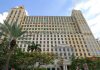
Yes. That would be a 356-room hotel, but that would likely be the most luxurious hotel in the city. And that would be combined with the Veterans Auditorium and make use of that space and be connected almost like a music hall. Plans are terrific. They’ve been approved. Now we’ll be in Washington taking an appeal on the tax credits. There are people who say the building shouldn’t qualify for historic tax credits. We believe we can change that. The other hotel is — when we finish the police station, which is going to be erected, JR’s Fast Lane. We own all that land now. That will take about 13 months to build, state of the art facility, police, fire, courthouse. And there will be a 500 car-parking garage there also. That’s all paid for.
Another hotel, once that’s finished, there will be an Embassy Suites Hotel built on the site of the (current) police station. That’s pending. I don’t want to let the cat out of the bag for the developers, but financiers in Toronto have given letters of intent to finance the project. That’s going to happen. If they don’t build it someone else will. It’s a gorgeous site.
How are efforts going for the arts district?
We also empowered artists, because artists make things happen, and whether it’s symbolic, or whether it’s functionary or whatever it is, we’ve been able to start an arts district here that’s known all over the country. This is the only place where artists don’t pay tax on royalties, on sales or on income. We just got the Smith Building finished. We have the Alice Building, the Peerless, the Gorman, we’ve got those building, where we will be able to fill those buildings with people. The whole idea when we built this mall was to make it symbiotic, both architecturally and also symbiotic functionally with the rest of the city. That’s why we supported Trinity, just gave them $2.5 million, the money that we had that Fleet owed us we got back 1981 – 82. Fleet owes us $2.5 million. It’s due in 2010, 2008. I gave that to Trinity so they could put it in for their endowment. We built their conservatory.
The Providence Performing Arts Center, back in the ’70s, they wanted to knock that down, Dario and those guys. Went there and put that group together and the city has got maybe $6 million invested in there. That’s economic development. We put $2.5 million in the Civic Center, but that makes this a district, supported AS220 in a very big way. The Black Repertory Theater, we’re putting them in the old Welfare Building.
I guess we made the right choices back when we got involved in historic preservation and decided we’d move rivers. Our city changed, I think, in the third quarter of 1978 from a blue-collar city to a white-collar city. That was significant. It wasn’t a great thing. Manufacturing had moved out. Same old problem on the end of every single energy pipeline, high cost of utilities, unions, a lot of problems, a lot of problems. But I think the unions have come around a lot more than they had in those days.
I’ll tell you the difference in being mayor. What’s the difference in being mayor in the ’70s and 2000? The difference is in those days mayors were social workers. They were social workers. We were involved in food stamps. We were dealing with police departments, putting in walking patrols. Trying to get people into public housing. Getting Section 8 housing. So you were basically a social worker. Today, government is more professional, number one, and number two, mayors are more entrepreneurial, so we’re always constantly in the works, like the three cities program. We have to have a vision for the next 10 years. That’s all entrepreneurial. Working with the veto and tax stabilization stoppages. That’s entrepreneurial. Dealing with Boston Financial, dealing with Excel to get them to consolidate all their operations in Providence. Bringing AAA in. That’s entrepreneurial, 450 jobs.
Low key, we’ve developed over 2,500 jobs here over the last few years, using tax stabilization, computer tax. I’ll tell you the jobs. Excel has about 350 over there, 400 or more at AAA, Resolutions, those are the companies we’ve gone after. Instead of having the animosity that’s – I know the public believes the colleges and universities ought to pay taxes, and I believe they ought to make some contribution too. I signed an agreement with Gregorian several years ago to start this HELP coalition. They contribute millions of dollars a year, but on subjects they want to contribute to. They are great assets to this community. Without them our economy would not be what it is.