What happened to Providence’s once-bustling Chinatown? It’s a forgotten story of prejudice – and perseverance.
By the time Charles Chin arrived in Providence at the age of 4 in the mid-1950s, a new Chinatown was developing in the city.
Gone were most of the Chinese laundries that in 1900 totaled 109, many located around today’s Empire Street. Often targets of discrimination, the laundries gradually gave way to automated, white-owned businesses.
By the 1950s, restaurants such as Port Arthur, the Ming Garden and others along Westminster and Weybosset streets – and the businesses that supplied them – became the signature Chinese presence in the city.
They served workers from nearby businesses and department stores and patrons who flocked from the suburbs to the city’s many movie theaters.
Besides the food, a mix of Chinese and American fare, some of the restaurants featured live entertainment and served as social centers for the close-knit Chinese immigrant community.
[caption id="attachment_217260" align="alignright" width="185"]

TARGETED: The Yick Song Wah Chinese Laundry on the East Side was one of many that were scattered in and around Providence in the early 1900s. Although there were more than 100 in the city at the time, the hand laundries were often targets of discrimination and eventually gave way to automated, white-owned businesses.
/ COURTESY JULIEANNE FONTANA[/caption]
“We were the first carpoolers,” said Chin, whose father served in the Air Force and fixed watches in the city for many years before himself joining the restaurant industry. Few Chinese immigrants had cars, recalled Chin, so out of necessity the few who had them would routinely transport the rest.
“Work hard, assimilate, learn the language,” were the lessons most Chinese immigrant families passed on to children and newcomers, said the 68-year-old Chin, who today owns Asia Grille in the Lincoln Mall. “There was discrimination and prejudice, but we got through that.”
WHY DID IT DISAPPEAR?
Today, however, there are few visible signs of this once-bustling Chinese community in the city.
Where Ming Garden made its home from 1941 to 1986 – at 141-143 Westminster – now stand a Dunkin’ Donuts, CVS Pharmacy store and Capitol Chiropractic office. Webster Bank, Au Bon Pain, AlphaGraphics and FedEx offices occupy 100 Westminster, near No. 106, where Mee Hong set up shop for many years.
About a mile northeast stood the Port Arthur – New England’s first dine-and-dance establishment. Its former site is near No. 129 Weybosset, where a sandwich shop, UMelt, now offers a different kind of fare.
And two blocks north, near where The Salon nightclub and bar is now located, was Luke’s Chinese, at 59 Eddy St., behind City Hall. The building added a second establishment, the Luau Hut, in the 1950s.
By the 1970s, however, the city’s second Chinatown era was fading.
“[Chinatown’s disappearance] simply paralleled the decline of the center city as a retail and entertainment destination, and the concurrent moves of the middle class to the suburbs,” said John Eng-Wong, a Brown University visiting scholar. “Chinese restauranteurs followed or perhaps moved in concert with their customer base.”
Chin’s family was an example of this. His late father, Lem Bond Chin, operated the popular The Islander Restaurant in Warwick with a relative for many years, before selling it in 2000.
Eng-Wong, along with Robert Lee, a Brown associate professor of American studies, and Brown graduate students Julieanne Fontana and Angela Feng last year joined forces to collect the memories and stories of Providence’s Chinatown through a collaborative, multipronged project that culminated earlier this year with, “Providence’s Chinatown.” A weekslong celebration through May included an R.I. State Archives exhibit, community discussion and a guided, downtown walking tour complete with window displays. The project also launched a website and interactive map, where community members can insert pins in the area where Chinatown once existed and share their recollections, adding to the narrative.
“People came to Providence because they had family connections here … what we call chain migration,” said Eng-Wong. “Once you had an anchor in the community, they could orient you to neighborhoods with services, help you get a job. They went into business.”
This network approach didn’t only exist within the city but up and down the East Coast.
[caption id="attachment_217261" align="aligncenter" width="696"]

SOCIAL DESTINATION: The Chin Lee Restaurant at 193 Westminster St. in Providence was a social destination that hosted many events, including for bowling teams, the Rotary Club and wedding rehearsal dinners.
/ COURTESY JULIEANNE FONTANA[/caption]
Providence’s first Chinatown lasted roughly from the 1880s to 1914, when many of the structures that housed the laundries along today’s Empire Street were razed for a road-widening project.
Relatively little had been documented in one place about this early period of Chinese immigration and business presence in the city, say the organizers. Through family stories and research, including newspaper articles, they were able to document some of the presence and struggles of this early wave of Chinese immigrants.
A mistrust of the Chinese population became evident to the researchers, illustrated with practices such as requiring there be no curtain of any kind between Chinese restaurant dining rooms and kitchens, for example, in the early part of the century, Fontana said.
Eng-Wong said that restaurant booths used to have curtains around them that could be drawn by patrons, a practice that became prohibited as well.
“There was fear of there being something illegal … a targeting of the Chinese population, with a feeling they could be a danger to the larger community,” said Fontana.
Main concerns in Providence were opium – which was legal when prescribed by a doctor during that time – and gambling. Eng-Wong said that the Chinese were “fond of gambling,” and said there were also many immigration raids in the Empire Street area.
A 1909 New York City case, in which a white woman was found murdered above a Chinese restaurant, prompted widespread reverberations and new local ordinances.
“It was a national story,” impacting Providence’s Chinatown businesses as well, said Eng-Wong. “The common fear was that young white women would be taken down the wrong path if they knew Chinese men.”
Feng said that a 1905 business directory from the state archives offers further perspective into the general view of the Chinese business community at that time.
“For the Chinese laundries and other businesses, there were no [business] names listed at all, implying that if you are American, you could have your business’s name and address. But it was like the Chinese [business] names were unreliable,” said Feng. “They had a street number only.”
[caption id="attachment_217265" align="aligncenter" width="696"]

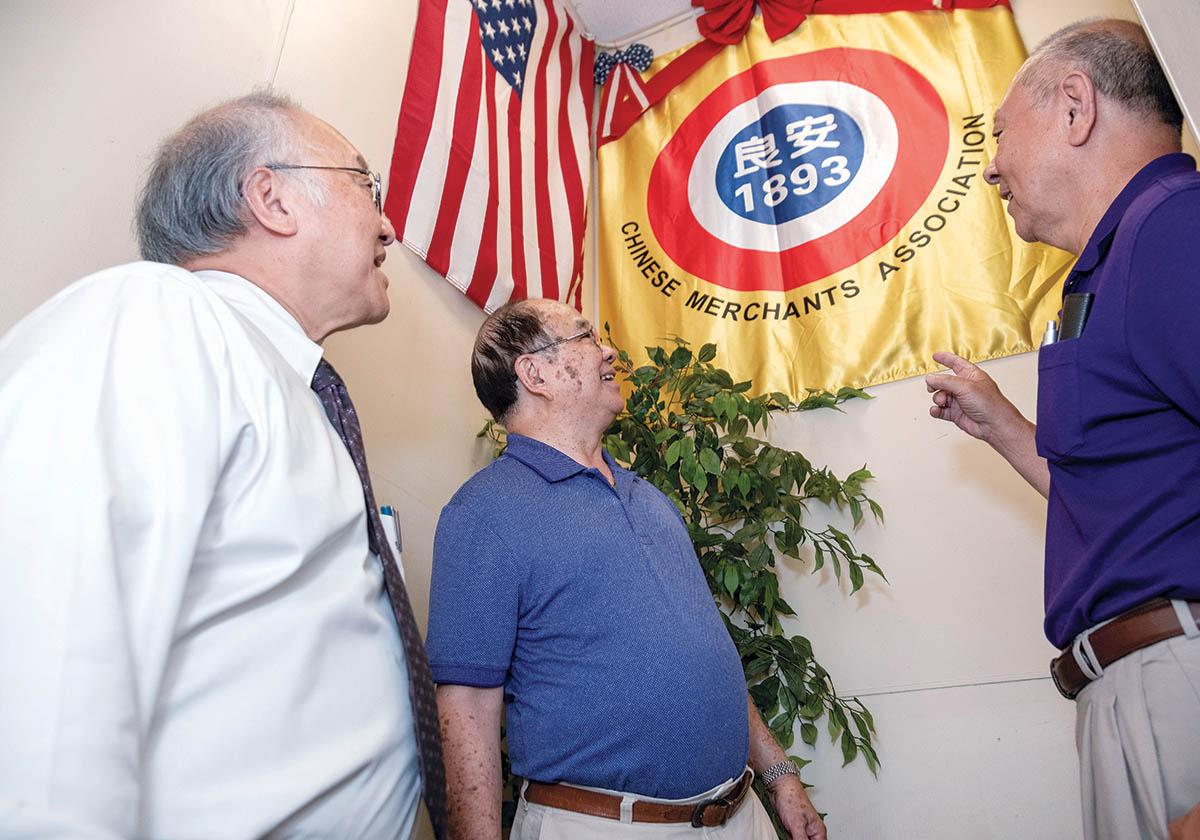
LONGSTANDING ASSOCIATION: Charles Chin, right, president of the On Leong Chinese Merchants Association on Pontiac Avenue in Cranston, meets with Peter Kwong, press relations officer of the association. The Rhode Island chapter of the association was established in 1911 and is still active today.
/ PBN PHOTO/MICHAEL SALERNO[/caption]
ADAPT TO SURVIVE
But the Chinese, like other immigrant groups, adapted to the changes.
The 1882 Chinese Exclusion Act was designed to limit the number of Chinese immigrating to the United States, but it also played a role in the boom of Chinese-owned restaurants in Providence and other cities in later decades.
Amendments to the law prevented Chinese laborers who left the U.S. from coming back, as well. Merchants – owners of businesses – could stay; but workers, or laborers, had to return to Asia.
“The primary discrimination was against laborers,” said Eng-Wong, “but merchants could come and go. The problem is that all Chinese were harassed, it didn’t matter if they were legitimate or not.”
Starting a Chinese-owned restaurant meant that business documents had to be witnessed by a white person, perhaps a neighbor, said Feng and Fontana, a sign of the times.
“Chinese witnesses were suspect,” said Eng-Wong.
But Chinese business owners found a loophole in the law.
The Chinese business model was reverse-engineered around migration, and merchants’ ability to come and go between continents.
“They would pool money to set up a restaurant,” said Lee. “One year, one person was named owner, another a manager, another a worker,” said Lee. “Then they would rotate, so that the owner could go to China and see his family. When he comes back? He’s the manager,” and so forth.
Chin said that this was often a five- or 10-year plan, where men would work here, returning to China to pick a bride and have children, save money to bring them out, and due to the strength of the U.S. dollar “be able to live a very good life [in the U.S.] as long as they worked hard.”
Restaurants, in turn, helped create demand for the laundries.
But laundrymen were considered “workers,” and had to stay put. “That, in part, is why we had so many restaurants after 1913 or so,” Lee said – for the mobility and ability to rotate merchants that they offered, which laundries did not.
The Tows emerged as a prominent Providence Chinatown business family, along with the Lees, the owners of the Chin Lee Restaurant. He Gong “Charlie” Tow is credited with helping other newcomers looking to start American restaurants.
MERCHANTS ASSOCIATION
Immigrants would learn English at Beneficent Congregational Church on Weybosset Street, about a quarter-mile from the Port Arthur, as part of their acclimation, said Eng-Wong. The church also helped Turkish and Armenian immigrants in learning the language.
“They took everyone in,” said Chin of the church, “non-Christians, Buddhists … they helped us assimilate and made sure we had a strong moral compass, welcomed us.”
[caption id="attachment_217264" align="aligncenter" width="696"]

IN BUSINESS: The On Leong Chinese Merchants Association holds its national convention at the then-Sheraton-Biltmore Hotel in Providence in this 1947 photo. The association had chapters in numerous East Coast cities during the early- to mid-20th century. The Rhode Island chapter still exists and helps members with job training, housing and other services.
/ COURTESY ANGELA FENG[/caption]
When it came to business matters, the Rhode Island chapter of the national On Leong Chinese Merchants Association – established in 1911 – provided advocacy, mediated disputes and found employment for members. It was one of the smallest such associations, but took a leadership role nationally, said Feng, and is now one of the oldest chapters.
The Rhode Island chapter now has about 70 members, said Chin, its president. It’s located on Pontiac Street in Cranston.
According to Lee, the national association served a bigger purpose in linking East Coast Chinatown communities to one another, for mutual strength and support.
“Our purpose was to revive and recover this broader perspective,” said Feng of the exhibit and related events.
“[Chinatown in] Providence tends to get overshadowed by Boston and New York — even in Asian studies,” Lee said. “But I learned that Providence played a significant role in bridging those communities.”
The Chinese Exclusion Act was repealed in 1945. “After World War II, the new target was the Japanese,” said Fontana.
WHAT’S LEFT?
While Providence’s Chinatown enjoyed a relatively brief rebirth after the war, there are few physical signs left today.
[caption id="attachment_217263" align="alignleft" width="300"]

POSITIVE IMPACT: Charles Chin, president of the Rhode Island chapter of the On Leong Chinese Merchants Association in Cranston, said “Providence’s Chinatown,” a project by Brown University faculty and graduate students that gathered memories and stories of the historic community, had a positive impact on the local Chinese community.
/ PBN PHOTO/MICHAEL SALERNO[/caption]
Chin said downtown Providence’s urban transformation included demolition of many of the old Chinatown buildings.
But there is still a Chinese-American community of approximately 3,000 to 4,000 in the state, he estimated, most with family ties to southern China.
The Chinese business community, he said, is “mostly restaurant-centric” in Greater Providence, along with a mercantile group that finances trade opportunities.
Beneficent Congregational Church continues to play an important role in the lives of many Chinese immigrants and their families, says Chin.
Personal connections through the church also contributed important family stories to the Providence Chinatown project.
East Greenwich’s Irene Luke Hope is an archivist for the church, where she met Robert Lee and John Eng-Wong. She contributed personal items to the Chinatown project tied to her family, which opened Luke’s Chinese restaurant in the early 1950s.
“I told my story, I shared photographs. I had a lot of mementos,” she said. “There was never any history done on the Chinese” in Providence.
Chin’s association works to provide services, including some job training, looking out for the elderly and helping provide connections to newcomers, including an upcoming annual picnic at Roger Williams Park in Providence Aug. 3-4.
The Brown project, he said, has had a positive impact on the local Chinese community.
“It allowed younger people to reconnect with the past and renewed respect for those immigrants” who paved the way for them, he said.