It’s a statistic that has forced state officials to put a plan for the future into action – a plan that calls for dredging of the Providence River, a moratorium on any more removal of storage tanks, and the repeal of the state’s inventory tax.
“There are a host of things that need to be done,” said Peter Lombardi Jr., executive director of the Oil Heat Institute of Rhode Island, which represents heating oil dealers on issues of safety, oil tanks, environmental concerns, and the safety of trucks and distribution.
Seifert Systems Invests in Energy Efficiency to Strengthen Operations
For manufacturers, energy is more than just another operating expense. It plays a critical role…
Learn More
“You can’t jeopardize the health and welfare of people by letting this problem continue,” he said.
According to Lombardi, at its height, the state could store close to 350 million gallons of oil, which has been consistently decreasing each year. An additional 25 million gallons was lost last winter alone.
“Prior to last winter we used to have a good safety net in place,” Lombardi said. “But that safety net has been jeopardized because of a lack of storage.”
“We’ve lost 250 million gallons,” of storage space, said Sen. John Celona, a North Providence Democrat. “It’s a significant problem.”
It’s a significant problem not only for Rhode Island, but also for southeastern and western, Massachusetts, which also gets much of its oil from Rhode Island’s reserve.
“Forty percent of what comes here goes to Massachusetts,” said Janice McClanaghan, chief of energy and community services for the state Energy Office. “There are only a few ports in the New England area, and we are one of them.”
Storage woes
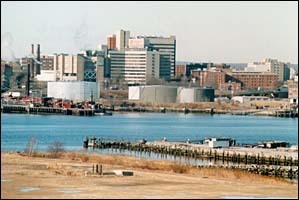
The storage areas, called “tank farms,” are now located in Providence, East Providence, and Tiverton.
McClanaghan said many of the state’s older tanks have been abandoned or closed because of high costs, or environmental concerns.
According to Lombardi many of the cost issues stem from an inventory tax placed on all storage tanks, a tax only the state of Rhode Island imposes.
“The cost of operation for these tanks has gone up tremendously,” he said. “No one else has an inventory tax like this state and it costs owners of these tanks four or five cents a gallon.”
The state inventory tax is being phased out over the next seven years, but officials agree the process isn’t moving fast enough. Though the taxation level has been frozen for three years, it’s an additional price storage tank owners don’t need to pay in other states.
“My belief is the inventory tax is a significant deterrent to companies staying here,” Celona said. “If they can store it somewhere else and not be taxed on it, they are going to do the financially prudent thing.”
Lombardi agreed. “When you are competing with other states, the playing field isn’t level. Though the tax is frozen, it’s still a tough number.”
The inability of oil company tankers to reach the storage facilities is another problem, officials agree. According to Lombardi, many of the companies are forced to send tankers to New York, and then ship the oil by barge to Rhode Island, making transportation dependent upon clear waterways.
“We need to really think about dredging the port and bringing ships back here,” he said. “It would make it safer and more reliable to transport the product.”
Environmentally, McClanaghan and Lombardi said many of the state’s tank farms are riddled with pollution problems, another issue owners don’t really want to deal with.
“These terminals have been around for so long that there is a certain amount of contamination,” Lombardi said. “The cost is so astronomical to fix, it’s cheaper to close the terminals.”
A time-stuck solution
For almost two years, Lombardi has been working with state and local officials on a contingency plan that he hopes will solve the state’s shortage issues, but he knows it’s not going to happen overnight.
“We’ve been working on this four-point plan for two years,” he said. “We are not saying that we need to relax environmental issues, but I know that there are certain things that can be done to make it less expensive to store oil here.”
At the top of his list are the dredging of the Providence River and the repeal of the state’s inventory tax, which he said aren’t like to happen for at least five years.
Lombardi said the state is working on more immediate solutions like a moratorium on the removal of any more storage tank facilities. The moratorium has been passed by the Senate and is expected to be heard in the House when the General Assembly convenes again in January.
“We need to stem the tide of removing any more tank farms,” he said. “There are different things happening along the state’s waterfront but we can’t have those plans impacting the state’s storage supply.”
This could be bad news for Providence Mayor Vincent A. Cianci, Jr. who announced plans last year to redevelop a portion of Allen’s Avenue — which houses 45 percent of the state’s oil — as part of his “New Cities” development. The proposed plan called for the area to be transformed into light industrial and residential.
With forecasters calling for an especially cold winter, and oil prices expected to increase at a cost of 50 cents per gallon over last year, according to the Energy Office, officials agree that all they can do now is wait.
“If we could store more oil, we could buy if off season and keep the prices down,” Celona said. “If we get hit with an early cold winter this, we are going to be in trouble. Everything revolves around energy and it’s an issue we can’t afford to put on the backburner.”