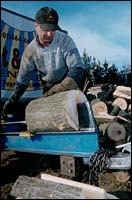
Robberson, owner of Right
Equipment and Best Tent
and Party Rentals.
Not everyone is bemoaning the rise of home heating oil – wood suppliers and wood burning stove dealers are experiencing a surge in business.
Gary Robberson, owner of Right Equipment and Best Tent and Party Rentals in Johnston, started cutting wood as a way to keep his employees busy during what had typically been his off-season. But this year, with oil prices rising and a cold wind blowing early, the wood cutting business has played a more prominent role.
Beyond Cash Donations: How New Forms of Giving Are Transforming Not-for-Profit Accounting
Evolving Funding Landscape for Not-for-Profits Not-for-profit organizations are being asked to do more with less,…
Learn More
“There is just more of a demand for it now,” he said. “When oil was cheap it just didn’t pay to burn wood, but when oil gets up over a $1 or a $1.20 it does pay to burn it. With the threat of the cost of oil doubling, people are calling constantly to get wood.”
Bill Labelle, owner of Stovepipe Fireplace Shop on Warwick Avenue in Warwick agreed, saying his store has seen increased interest in wood burning stoves.
“There is a theory here,” he said. “And it’s not the cost of fuel per BTU versus wood. Instead it’s the idea that most people have a living room or a family room that they spend most of their time in. As a result they end up heating their entire house to make that one room comfortable. If you have a wood burning stove then you can simply heat that one room to a comfortable temperature and often times that heat spills over into other rooms.”
With home heating oil costing close to $1.60 a gallon, and more increases expected, both agree it’s unlikely the newfound interest in burning wood will end any time soon.
“What has happened is that it has gotten colder earlier this year and stayed relatively cold,” Labelle said. “Last year people were on the golf course in December, and I don’t think that’s going to be happening this year.”
According to those in the industry the cost of a cord of wood ranges anywhere from $125 to $175. With the average consumer using three-to four cords during a winter season, Labelle said the cost savings is immediately apparent.
“If you buy four cords of wood at $125 then you are looking at a bill of close to $500 for the season,” he said. “People that heat their home with oil, are expected to pay close to $1,000 this year, and that’s just keeping the temperature between 60 or 65 degrees – that’s pretty chilly.”
But like every other economic trend – the success of the industry is about supply and demand, and already suppliers are having a hard time meeting the demand. According to Robberson, there is a shortage of seasoned wood, or wood that can be burned right away.
“A lot of people are running out,” he said. “I had some guy come in the other day that has a winter place in New Hampshire. He can’t get seasoned wood there, so we loaded up the back of his truck and he took it up.”
Robberson said there is a lot of available “green wood” or wood that hasn’t dried out yet, but it isn’t helpful because consumers can’t burn it for at least three months.
“If you have seasoned you can throw a piece of green wood in, but you can’t burn it by itself.”
Adding to the problem, as a result of mild winters over the last few years, the Rhode Island Department of Environmental Management had stopped its wood cutting program, which allowed local wood retailers to bid on lots available to be cut.
“What used to happen was we would mark 20 lots, each producing between three and eight cords,” said Thomas Bourn, deputy chief of Forest and Environment at the state DEM. “People would bid on those lots and then have two months to cut. But what has happened over the last two years as people have shifted back to oil, is that many lots haven’t even been bid on. So we decided to discontinue the program.”
As a result of rising oil prices and falling temperatures, Bourn said the department is looking into restarting the program – but, he added, it wouldn’t be until next year at the earliest.
“If we started now, the wood wouldn’t be burnable until next year,” he said. “There are discussions going on about restarting the program, but we still can’t say if we will or when.”
Either way Bourn doesn’t dispute that there is an increased interest in using wood, but he said there has been no indication there is a “severe” shortage yet.
“We haven’t gotten any calls from people desperately looking for wood,” he said. “Firewood dealers have their steady customers, and I am sure with the high price of oil they will see some increase.”