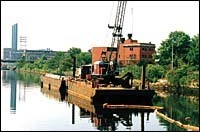
(Al Alexio)
After more than two decades of indecision, Rhode Island officials are ready to deal with the issue of dredging — and they are doing it as a united front.
Representatives from state and environmental agencies have joined with local legislators in support of numerous bills that, if passed, could create a basic infrastructure for a dredging management program in Rhode Island.
Seifert Systems Invests in Energy Efficiency to Strengthen Operations
For manufacturers, energy is more than just another operating expense. It plays a critical role…
Learn More
“The level of energy is the greatest it has ever been,” said Topher Hamblett, director of advocacy at Save The Bay. “Most of what has been proposed are the pieces, that when put together, could craft the solution that would go a long way in helping local marinas as well as the Providence River.”
With bills ranging from creating a director of dredging at the Coastal Resource Management Council, to amending the state Department of Environmental Management’s rules for the oversight and disposal of dredge material, to developing a comprehensive plan for a beneficial use of the material – the General Assembly appears to have taken a great interest in the future of dredging in the state.
“The amount of dredge material that needs to be removed is enough material to cover four football fields and rise vertically to a height of the Empire State Building,” said Rep. Joseph McNamara, a Warwick Democrat. “Most of this material is a clean sandy sediment that in my eyes, should be visualized as a potential resource rather than a hazard waste.”
McNamara has proposed two bills pertaining to dredge material this session. One would create a comprehensive plan for the beneficial use of dredged material and the other would provide for the exemption from liability for use of dredge material by third party.
“The first part of the solution is to reclassify this material,” he said. “We have to look at the big picture and the big picture is setting up the infrastructure for beneficial use of this material.”
Grover Fugate, director of the Rhode Island Coastal Resources Management Council agreed.
“This is an extremely important topic,” he said. “Dredging is something that hasn’t been conducted in 25 or 30 years and as a result we have quite a backlog. It’s important to the state to maintain the marine economy and this is a big part of that.”
Fugate said that not since the Marine Infrastructure Act in 1996 has there been such an interest in dredging.
Fugate, Hamblett, as well as representatives from DEM, the House and Senate policy councils, and the Rhode Island Marine Trade Association have been working together since the start of this legislation session to help grow interest in these bills.
“The most significant thing that has happened, is that all of these agencies have come together and are working closely and diligently toward a common goal,” Hamblett said. “There is more energy in the legislature, CRMC and DEM for solving this problem now. People are thinking creatively, but at the same time appreciate how time sensitive it is.”
In fact, the Untied States Army Corp of Engineers is expected to release its Environmental Impact Statement in regard to dredging the Providence River Channel in June or July.
“We want to make that project as environmentally sound as possible,” Hamblett said. “It’s very important for the General Assembly to demonstrate to the Army Corp the development of a larger program.”
According to Hamblett, that larger program could mean alternative uses for the materials, including reuse in construction projects, brownfield revitalization, and the renourishment of local beaches.
“We need to treat this as a natural resource, not as a problem,” McNamara said. “This could bring economic benefit to our state and we need to change the mindset that people seem to have.”
Fugate agreed.
“There is definitely an education process to this,” he said. “There is always a lot of apprehension when you haven’t done something for 30 or 40 years. It’s something that the public needs to be educated on so they can get over the apprehension.”
And while the Providence River is an important project, Fugate said much of the legislation is aimed at helping marina owners – many of whom are experiencing a loss of business as a result of their inability to dredge. Curren
tly, state law requires that all marina owners apply for a permit to dredge through the CRMC and in most cases the permit requires the marina owner to find an off-site dumping spot.
“We have to look at marinas separately because they have a different needs,” he said. “The corps has a greater volume of material and can afford to do greater testing. They can do things private marinas can’t do.”
And with only two months before the close of this legislative session, officials are confident that many of the proposed bills will pass.
“Everyone involved thinks that we can accomplish a great deal in the next two months,” Hamblett said. “But even after the legislative session is concluded we have all agreed to continue working hard to develop a long-term, cost-effective, reliable program for the management of dredge material.”