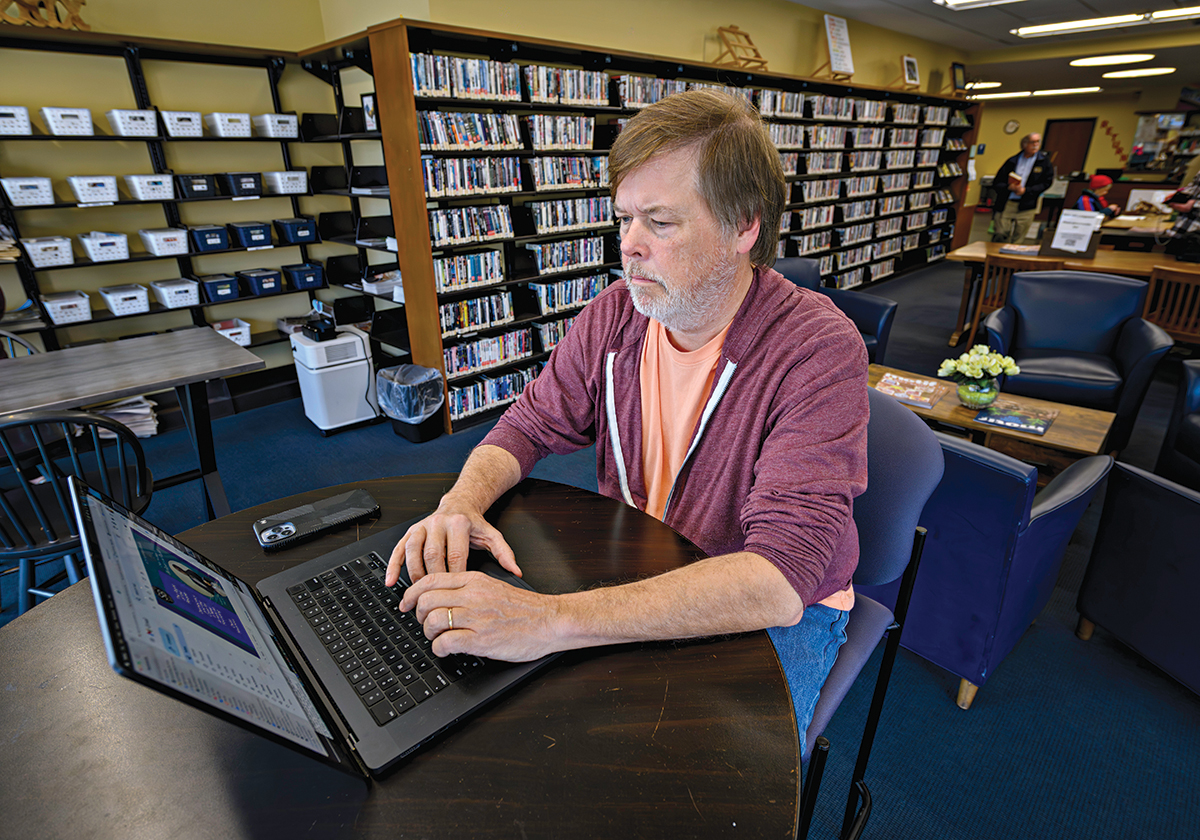
Tapping away at his laptop at the Rochambeau Library in Providence, Steve Ahlquist doesn’t look the part of a pioneer.
He began reporting on Rhode Island politics more than a decade ago, first for the blog Rhode Island’s Future, then for the digital publication Uprise RI, and now independently for himself on Substack, a popular online platform that allows writers to publish their own newsletters.
Ahlquist is one of many feeling their way through an ever-changing landscape of journalism in the 21st century, a place of shrinking print subscriptions, newsroom cuts and buyouts, broadcast station consolidations and a constant push toward digital media, all of which are dramatically reshaping how Ocean State residents both receive and share the news of the day.
Traditional news faces a fierce battle from blogs, social media and podcasts as many nonprofit startups challenge established for-profit models, while questions also swirl about sustainability, profitability and depth of coverage.
Those interested in Rhode Island activism, local politics, homelessness, or civic issues know Ahlquist, who has written extensively on issues that don’t receive broad coverage at larger news outlets.
He often uses the library on Providence’s East Side as a one-man newsroom of sorts when he needs to get out of the house to concentrate.
But Ahlquist worries about the sustainability of the model used by many of today’s independent journalists, himself included.
“Journalism needs to find a solution to the collapse of journalistic options that doesn’t rely on people who are basically medieval monks, religiously compelled to perform their duties for a small cot and a bowl of soup,” Ahlquist said.
[caption id="attachment_510320" align="aligncenter" width="1024"]

MELDING MEDIA: Jim Hummel, right, hosts a taping of the public affairs TV show “A Lively Experiment” with guest journalists Ted Nesi, left, and Nancy Lavin. The studio is part of Ocean State Media, the entity formed from the merger of Rhode Island PBS and The Public’s Radio merged in 2024.
PBN PHOTO/TRACY JENKINS[/caption]
‘LOCAL NEWS CRISIS’
For years, Rhode Islanders have regularly turned to long-established news outlets – The Providence Journal, WJAR-TV NBC 10, WPRI-TV CBS 12 and a host of smaller community papers – for reliable local coverage. From city council votes and high school sports scores to waterfront development deals and coverage of high-profile trials, legacy media outlets have shaped the conversations heard at coffee shops and grocery stores.
In a small state like Rhode Island, where decisions impacting local businesses, real estate, schools and families can have an immediate impact, the importance of keeping communities informed has never been higher.
Will this evolution create voids in coverage, leaving many without a go-to source for daily news, particularly in smaller or underserved communities? Or, in the end, can this offer residents an even richer and deeper understanding of the news and its impact on their daily lives?
“The local news crisis is grounded in changes to technology and culture, chiefly the collapse of advertising revenue caused by the shift from print to the internet,” said Dan Kennedy, professor of journalism at Northeastern University. “The situation was made much worse by the corporate chains and hedge funds that moved in and bought local newspapers, taking revenue that could have been invested in journalism and business-side innovation and instead using it to pay down debt and enrich the owners.”
USA Today Co. – the new name for Gannett Co., for example, has shut down many of its weekly newspapers in the area and replaced a lot of local news with broader mass consumption coverage from around the region with the intent of getting more “impressions,” the number of times ads were shown to viewers, which leads to higher ad revenue.
It’s a development that has led to the founding of a number of digital startups that hope to fill the gap.
USA Today still owns several local dailies, including The Journal, which has seen its weekday print circulation drop to under 20,000. The company has offered employee buyouts as it increasingly leans on automation and centralized production.
Many question how much impact ownership structures – corporate versus nonprofit board versus independent – influence editorial decisions and priorities in local news coverage.
Sinclair Inc.-owned WJAR-TV NBC 10 recently acquired the nonlicensed assets of WLNE-TV ABC 6, allowing Sinclair to operate both stations locally and signaling a consolidation of the two news operations.
Betty Cotter, a lecturer at the University of Rhode Island’s Harrington School of Communication and Media, says an additional risk with consolidation is the politics of the remaining owners.
“You have Sinclair [Inc.], an openly partisan company, owning not only WJAR but now ABC 6 as well,” Cotter said. “Nexstar Media Group [Inc.] seems to have taken a hands-off approach at Channel 12. But look at what’s happening at The Providence Journal. The paper looks like every other [USA Today] paper, has cut back on local arts coverage and is no longer the major player it once was. The Journal and some weeklies in the state no longer run editorials. This is such a misguided decision based solely on the premise that they don’t want to offend advertisers. Failure to have a robust opinion page is directly connected to a lack of substantive debate in the public square.”
One of the locally owned holdouts has been the Warwick Beacon, which John Howell purchased in 1969 and sold in 2024 to Joy E. Fox.
Howell, who still serves as Beacon editor, acknowledges that there have been plenty of challenges in recent years for the company now called Beacon Media RI LLC, which also publishes the Cranston Herald, Johnston Sun Rise and the shopper Coventry Reminder.
The Beacon’s print circulation has declined from 11,000 about 25 years ago to 5,000 now, Howell says, in part because younger people consume content on their phones instead. The newspaper printed twice a week until the COVID-19 pandemic, when the near shutdown of the economy and social events made it difficult to fill the paper with ads and its bread-and-butter community news. It’s a weekly now.
He takes solace in local digital news outlets such as environment-centric ecoRI News that have “discovered a niche to cover and be the expert,” he said.
At the same time, he’s certain community newspapers such as the ones published by Beacon Media will continue to endure, both in digital and print. At the very least, the Beacon continues to publish weekly editorials and op-eds.
“It’s about being relevant to the community … about always being a place for the local community to communicate,” he said. “And there will always be a place for print. I’m not sure what it’s going to look like [in the future], but there will always be a place.”
A FRESH WAVE
And it is questions revolving around coverage that remain front and center for many, particularly in smaller and underserved communities.
Cotter says town council and school committee meetings are going largely uncovered and candidates for town boards and the legislature face little scrutiny from local reporters.
“If no one is keeping track of what the government is doing, how can we expect voters to know enough to participate in civic life?” she said.
According to research by URI, there are nearly 70,000 people in Rhode Island living in what are known as “news deserts” – mostly rural towns in the southern and northwest corners of the state with a single part-time reporter or none at all.
Looking to fill the gap, URI recently launched the Community News Lab, a group of students and a faculty editor who produce stories, photos and video for local news outlets such as the Rhode Island Current, The Public’s Radio, or smaller community weeklies that desire local coverage but lack the staffing.
The lab covers five rural communities near URI’s Kingston campus in South Kingstown and four beats: agriculture, education, the fishing industry and the environment. Participating students receive college credit, not pay. The only costs associated with the news lab, according to Cotter, were initial equipment purchases – TV monitors, laptops, a printer and high-end cameras.
So far, stories produced by the lab have appeared in The Westerly Sun, The Kent County Daily Times, The Narragansett Times and the Standard-Pendulum.
“We have more reporters than most of the newsrooms in Rhode Island right now, and even though they are students, they are finding stories that otherwise might go unreported,” Cotter said.
As some traditional newsrooms struggle, a fresh wave of digital-first outlets have stepped in.
Unveiled in 2023, the free, nonprofit Rhode Island Current focuses on mission-driven reporting covering policy and government with three reporters. Similar niche outlets include ecoRI News (environment), ConvergenceRI (health and science), The Providence Eye (local news) and Salve Regina University-based Ocean State Stories (highlighting underreported issues).
[caption id="attachment_510321" align="aligncenter" width="1024"]

KEEPING WATCH: Debbie Schimberg, founder of The Providence Eye, has made the news site work for two years with a team of volunteers and one paid staff member. She is looking to raise $100,000 to hire an additional paid staffer.
PBN PHOTO/MICHAEL SALERNO[/caption]
Debbie Schimberg remembers that when she arrived in Providence as a Brown University student in 1980, the media landscape wasn’t complicated. She read the Journal and the alternative weekly NewPaper, which changed its name to the Providence Phoenix in 1993 and closed in 2014.
Two years ago, the self-described social entrepreneur launched The Providence Eye, a nonprofit website focusing on local news of interest to Providence-area residents. “In conversation with other people, everyone was lamenting that there wasn’t something like community journalism in Providence anymore,” she said.
Now Schimberg relies on a team of volunteers to produce content, ranging from community calendars and obituaries to food reviews and investigative stories. Making the finances work has proved to be a challenge.
She said Providence Eye uses a “multi-pillar approach,” accepting individual donations, business sponsorships, community events and, soon, advertising. The organization, which has a board of directors, is in the midst of a campaign to raise $100,000 by the end of the year in reader donations and a matching fund.
“You can’t depend just on philanthropy,” Schimberg said. “There is so much competition [for funding].”
Still, Schimberg is confident about the future of media outlets such as hers.
“This is hyperlocal information and the more partnerships we can create, the more community events we can facilitate, the more impact we can demonstrate, the more invaluable we become,” she said.
She is also buoyed by the sense of camaraderie among the upstart news sites, with some sharing of stories across outlets. “It used to be about who got the scoop,” Schimberg said. “Now we’re actively working on ways of working together.”
DIGITAL FIRST
In an effort to pool its resources and strengthen its prospects in the future, Rhode Island PBS and The Public’s Radio merged in spring 2024.
Pam Johnston, CEO and president, says the combined outlet – now named Ocean State Media – is fully unified with shared systems, goals and purpose.
“That alignment is most visible in our content strategy: we no longer have ‘radio stories’ or ‘TV stories,’ ” Johnston said. “Every story is developed with a multiplatform mindset – optimized for audio, video, digital and social – so we can reach and engage audiences wherever they are.”
A public media organization, Ocean State Media had relied heavily on federal funding, but the elimination of that funding this year has left a $1.1 million shortfall – or 10% of its annual operating budget – this fall.
Ocean State Media instituted voluntary buyouts and pivoted more to other sources of income.
“As we evolve, we are leaning into philanthropy and major giving, where we see a growing interest from local donors to invest in the future of Rhode Island’s civic and information ecosystem,” Johnston said. “We’re also expanding through live events and community partnerships to deepen connection. Our long-term goal is financial resilience – reducing reliance on any single source while growing broad-based support among individuals, organizations and institutions.”
Johnston says the biggest investment has been in digital-first storytelling – short-form video, newsletters, podcasts and social media – where the nonprofit is seeing the fastest growth and the greatest opportunity to reach new viewers.
Ocean State Media’s audience on YouTube has grown by 26% since June and by 63% on Instagram, according to Johnston, thanks to a 300% increase in the “social videos” the organization is creating.
Meanwhile, Johnston says Ocean State Media is “deepening engagement” through newsletters, in-person listening sessions and local events.
“We believe that when people feel seen and heard by their local public media organization, they are more likely to support it – not just as consumers but as co-creators of civic life,” she said.
MULTIPLE MODELS
Many outlets have closed or downsized; others have looked to expand.
The free monthly Smithfield Times announced it was permanently shutting down in December 2024, northern Rhode Island dailies The Call, of Woonsocket, and The Times, of Pawtucket, merged in late 2023, becoming the Blackstone Valley Call & Times, and The Associated Press closed its office in Providence in November 2023.
Conversely, in 2019, The Boston Globe launched Globe Rhode Island to capitalize on the retreat, hiring a team of reporters who had extensive experience at other local news outlets.
The Globe established a bureau in Providence and, more recently, reached a collaborative arrangement with WPRI-TV.
Lylah Alphonse, editor of Globe Rhode Island and Globe New Hampshire, says developing trust among Rhode Island readers is critical.
“We try to build and maintain trust by covering the news that matters most to Rhode Islanders, reminding people that our reporters understand the importance of community coverage because they live in the communities they’re covering and are directly impacted by what happens here,” Alphonse said. “We try to demonstrate that we’re part of the fabric of this state.”
Recognizing that a critical component of community health is strong civic journalism and local news, the Rhode Island Foundation asked URI to research the subject a few years ago.
When the results revealed that less than one-quarter of Rhode Islanders said they had a great deal of trust in the information they get from state and local news media, the foundation made support for local journalism one of its community priorities.
In five years, the foundation says it has supported several local nonprofit news organizations with more than $1 million in grants, including general operating support for entities such as The Public’s Radio and ecoRI News.
The funding included seed money to establish a statewide “news collaborative,” which is still in development. With participants including the East Greenwich News, The Providence Eye and the Rhode Island Current, plans call for the production and sharing of news and civic information. There will also be the opportunity for outlets to try new methods of gathering and disseminating news.
“Providing resources to innovate and test models will ensure the community has access to information while media entities develop sustainable structures for news gathering and delivery, given changing news consumption patterns,” said David N. Cicilline, CEO and president of the Rhode Island Foundation. “The initiative also aims to enable member organizations to address the workforce needs of local newsrooms by creating a systematic training program for students and community members to become journalists.”
Together with Newport’s van Beuren Charitable Foundation, the Rhode Island Foundation was recently awarded a chapter of the national Press Forward initiative, a nationwide program intended to strengthen democracy by revitalizing local news.
“Winning a Press Forward chapter gives Rhode Island access to a nationwide network of organizations focused on coordinating action and investing resources to revitalize local news and enhance access to trusted and reliable information,” Cicilline said.
At the moment, Northeastern University’s Kennedy doesn’t think there’s any one right model to ensure local news organizations survive.
A well-organized nonprofit that raises money and hires staff has worked for many, and so have one-person newsletters that are “more passion projects than they are viable sources of income,” Kennedy said.
“The local news crisis is being solved – more or less – in the affluent suburbs, many of which now have independent startups that are doing a better job than the legacy newspapers they replaced,” he said. “What I would like to see in future years is a blossoming of independent news in urban communities of color and in more rural areas, which have had it much harder in coming up with solutions to the lack of reliable local journalism.”
Ahlquist is one of the “passion project” journalists.
He says he feels an obligation to his readership and doesn’t worry about converting them into subscribers.
“I tell people that I need money to live … and that if you can afford to send me money, that would be great,” Ahlquist said. “Everything I put online is available free. I believe that it would be wrong to write about issues like poverty and homelessness and then turn around and tell the person experiencing homelessness I just wrote about that he can read it for $8 a month.”