Short recession. Strong recovery.
That was the prediction for the Rhode Island economy delivered by Lawrence K. Fish, chairman, president and chief executive officer of Citizens Financial Group, to 1,000 members of the state’s business community at the 134th annual dinner of the Greater Providence Chamber of Commerce.
Rhode Island's Market Has Changed. Developers, Builders, Investors and Sellers Must Change With It.
By Emilio DiSpirito IV License Partner | Engel & Völkers Oceanside Leader | The DiSpirito…
Learn More
Fish’s 15-minute talk covered a lot of ground. And when it was over, his message to the business community – to all of Rhode Island – was clear. Expect and prepare for some rough going – but be assured, there is light at the end of what will surely be a dark tunnel.
Fish delivered some good news – and some bad news.
The bad?
“GDP (gross domestic product) turned negative in the third quarter of this year – the first time since 1991,” said Fish. Unemployment rates are rising. Business investment, particularly in steel, aerospace, computers and heavy machinery, has been falling since the end of last year. Who do you know that isn’t deferring capital expenditures? It won’t be official for awhile, but to the surprise of no one in this room, I think it’s safe to say we’re in a recession.”
On a positive note, however, Fish suggested that this recession should not mirror its predecessor of 1990-1991.
“While GDP has fallen along with business investment, and unemployment has risen, other indicators tell a much less somber story,” said Fish.
He added: “Housing starts, building permits and the sales of existing homes have remained strong, to date; personal consumption – while down some – is still in positive territory. Gas prices are dropping out of the stratosphere, Detroit is getting us to buy cars, the consumer price index remains at a very low level, productivity is strong, banks are solid, credit is available, and – blessedly for those of us who remember the bad old days of 1990 – our landscape is not dotted with see-through buildings.”
Fish was also quick to point out that the horrific events of September 11 alone did not trigger our present economic malaise.
“Even before September 11, we were experiencing a slowdown serious enough for the Federal Reserve to cut interest rates more than a half-dozen times since the start of the year as a way to use monetary policy to counter the collapse of the high tech, dot-com and telecommunication sectors,” he said. “Fortunately, consumer spending – which accounts for about 60 percent of our economy – remained robust and kept us out of a recession.”
Fish said that while the indicators may vary, there is really only one conclusion to reach.
“We are, as I said, in a recession,” he said. “Many economists, including those at the Fed and the New England Economic Pro-ject, think it will be shallow and short-lived with a sharp recovery. Inventories are low; we’re not experiencing inflation; the Fed has signaled it will cut rates again, if needed; and so far, the war on terrorism is costing less than many expected.”
Fish predicted that the economic downturn would continue through the rest of this year and into the first half of 2002. Specifically, he said, he expects to see unemployment in Rhode Island to climb to between six and even percent. He also expects continued slow business investment, and plentiful liquidity. And Fish believes inventories will begin to be rebuilt early next year.
Fish’s short recession, strong recovery scenario, however, is built on some significant assumptions, he said.
First, said Fish, the country can not afford additional assaults on consumer confidence – such as another dramatic terrorist attack, which could “reinforce our vulnerability and rekindle our fears and anxiety about the future.”
The second assumption, he said, rests on the Federal Reserve’s determination to manage monetary policy aggressively, and on the Congress and the White House compromising on an effective fiscal stimulus package.”
The third major assumption, he said, is that the U.S. continues to enjoy 1.5 to 2.5 percent annual gains in productivity.
“This last assumption – forecasting our gains in productivity – is the most challenging because we don’t know the effect of unproductive massive investments in all forms of security,” said Fish. “Nor has anyone measured to what extent our way of life and of doing business has become less efficient because of the extra time we spend going into an office tower, getting through airport security lines, driving our cars into underground garages – I’m sure you can add to the list”
Fish concluded his keynote address on an up-note, emphasizing that our economy will again prosper.
“We have lived through a terrible time,” he said. “But in the end, it will be remembered as one more event that defines our character, our principles, our values. As we uphold those qualities, I am absolutely confident they will drive us toward economic recovery and continued prosperity.”
Several business people honored as part of the evening’s program, Chamber Chairman Mark J. Formica, vice chairman of Citizens Financial Group, presented four awards for excellence in business and community leadership:
The Small Business Leader of the Year Award was presented to The INSCO Group, of Lincoln. The company was founded in 1941 and today generates $40 million in sales and employs 100 people. Chairman Edmund M. Mauro, Jr. and the Mauro family were also honored for their leadership in creating the Button Hole golf course for inner city youngsters in Providence.
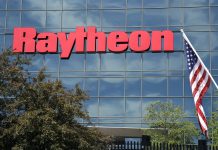
The Manufacturer of the Year Award was presented to the Raytheon Company in Portsmouth.
The Ambassador of the Year Award was presented to Judith Coppola, sales manager at the Holiday Inn Downtown.
In addition, Fred C. Lohrum, outgoing chairman of the Chamber’s board of directors, was honored for his two years of service in leading the business community’s government affairs and economic development efforts.