When the old Interstate 195 soon comes tumbling down, local planners say it will symbolize a new era in the city of Providence that will set the stage for development in that area. But much work – and debate – lies ahead, as city and state officials, private interests and residents have their say on the best uses for approximately 39 acres (including 19 acres planned for parking and streets).
Gone are the days of viewing zoning as mutually exclusive puzzle pieces of residences, commercial buildings and industrial uses that cannot be mixed and matched, say City Planning Director Tom Deller and Director of Future Planning Bonnie Nickerson.
The city sees room for a host of activities on the land to be freed up by the I-195 relocation project that will start coming on the market within the next two years or so. Deller said the potential development options, which run the range of residential construction to setting aside land for universities, needs to be diverse because the relatively small city has little land, just 18 square miles, and must maximize use of any new land that opens for development.
But not before a long process that will involve officials from the R.I. Economic Development Corporation (EDC), the city, the R.I. Historical Preservation & Heritage Commission and the R.I. Department of Transportation (DOT), which will own the land once the highway is gone. And residents will also surely voice their opinions.
“I think during this part of the process, the learning curve, the healthy public debate is important,” Deller said.
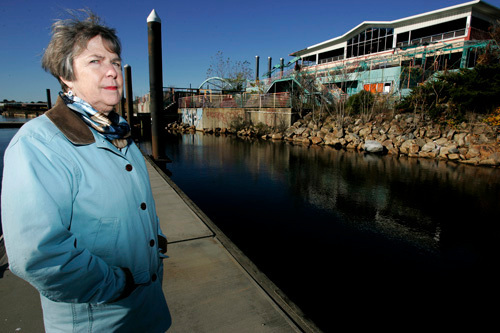
That discussion has already started at India Point, where the DOT is readying to put the vacant Shooters nightclub property on the market. A spokesman said the department is trying to schedule time before the R.I. State Properties Committee, which must approve the sale.
There has been no shortage of ideas of what to do with the 1.37-acre parcel of waterfront property squeezed between a tugboat operator and India Point Park.
The City Plan Commission last month passed a neighborhood plan that would allow residential development at the site, despite objections from a neighborhood group that wants to see the land developed for public use. The group, the Head of the Bay Committee, has proposed a center with room for public events, offices for nonprofits, a shoreline diner and a marina capable of berthing ferries.
Deller said the neighborhood plan is merely a guide, and does not exclude the potential for public use. Nor, he said, does residential development, if it occurs, tie the parcel forever to that use. He points out that the city has dramatically changed during the last century and even moved railroad lines and a river.
“I think that there’s this belief that we do something and we stop,” Deller said. “I think the reality is a city is a living organism. It changes, it expands, it contracts.”
EDC spokeswoman Meaghan Wims said the agency had no position yet on what should be developed on the property that could be sold in a matter of months. The agency, she said, was waiting for the city to further its planning documents before commenting on the Shooters site or other areas being freed up by the highway project.
“The R.I. Economic Development Corporation will evaluate proposals for the sale or lease of the former Shooters nightclub based on what would be the highest and best possible use of the property, from an economic-development and property tax-generation standpoint,” Wims said.
Deller and other officials said Shooters was a unique parcel that may not serve as a perfect barometer for how the unloading of other highway land may go. But it represents the first piece likely to reach the market and the first time for the city and state to demonstrate the sale, planning and development process.
An agreement between the DOT, EDC and city puts the EDC in the lead position for developing an overarching plan for the I-195 land. The EDC plans to hire a managing director to guide the disposition of the land.
Deller said he expected the three agencies to meet and draft an updated agreement that further clarifies the roles of the three departments. In September, the EDC released a report by a consultant that said much of the land should be developed for a mix of uses, and Brown University and Johnson & Wales University should have a chance to acquire some of the land to help build a knowledge-based economy.
Separately, a 1996 agreement between the state and the federal government requires projects built on the former highway land downtown to pass muster with the R.I. Historical Preservation & Heritage Commission because the area falls within historic districts. Alternatively, the federal government told the city it could have the commission sign off on basic guidelines and eliminate the need for case-by-case review.
The document will eventually find its way into the city’s Comprehensive Plan. The three-inch thick guide to city planning is by no means the end of the debate. Some proposals regarding the I-195 land may require changes to the zoning ordinance, which must be amended by the City Council. Changes to ordinances that involve the waterfront, like the area where the former Shooters sits, could spark particularly passionate debates, said Bill Klein, director of research and advisory services at the American Planning Association, a professional organization for planners.
“There’s always this tension on waterfront property that exists almost everywhere, particularly in urbanized areas,” he said.
Klein said there is no firm agreement among planners about whether utilizing areas like the erstwhile Shooters property for residential development creates greater economic waves than turning it into a public facility. Every case is unique and Klein said many cities today strive for a compromise where developers are provided incentives to maintain public access to the shoreline.
To strike the right balance, many cities are doing as Providence is, moving away from zoning practices that call for a distinct separation of uses. But when city officials float concepts that oppose traditional uses of the area, neighbors complain, said Robert Thompson, an associate professor in the marine affairs department at the University of Rhode Island.
“It’s very natural that people get upset,” said Thompson, who teaches urban waterfront planning. “I think you want people to think passionately about their neighborhoods. Now you’re dealing with waterfront property, so that’s ratcheting it up a notch. … This is a very unique parcel.” •