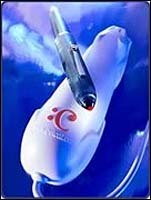
:CueCat intersect in artist's
rendering of concept.
Lack of curiosity may be killing the :CueCat.
In second quarter financial reports, area companies (A.T. Cross and The Providence Journal’s parent company Belo Corporation among them) that have been implementing the technology — which instantly links users to long URLs (Uniform Resource Locators) by scanning a barcode in a magazine or newspaper — are reporting losses.
Seifert Systems Invests in Energy Efficiency to Strengthen Operations
For manufacturers, energy is more than just another operating expense. It plays a critical role…
Learn More
And Digital:Convergence Company, the Texas-based creator of :CueCat has experienced layoffs this year and has, according to the company’s Vice President of Corporate Communications Peter Eschbach, shifted to “maintenance mode.”
:CRQ technology uses embedded cues, which look like product codes, to create an instant link from the printed page to targeted online information.
Writing instruments manufacturer A.T Cross Company had developed and marketed the CrossConvergence Pen to scan Digital:Convergence barcodes, as a means for readers to store URLs when away from their computers. The URLs could then be downloaded to a PC for use.
Last month, A.T. Cross announced that it recorded a pre-tax loss provision of $5.9 million in the second quarter ended June 30, 2001 relating to the company’s investments in Digital:Convergence and NeoMedia Technologies, Inc. Consolidated revenue for the quarter declined 3.9 percent to $27.3 million.
“We’re all obviously disappointed,” said John Ruggieri, A.T. Cross chief financial officer and president of the company’s computing group. “We still think there’s something there – linking print to the Internet. It’s a very easy way to link consumers to a space that is sometimes very difficult to navigate, but we’ll see.”
The company has offered the pen through its Web site since December 2000, and to its corporate clients since last April.
Ruggieri said A.T. Cross would continue to pursue similar technology with other companies.
In June, Belo Corporation announced it expected to write down substantially all of its remaining $33 million investment in Internet-related companies. The largest part of this relates to Digital:Convergence.
Texas-based Belo publishes three daily newspapers in addition to The Providence Journal: The Dallas Morning News, The Press-Enterprise (Riverside, Calif.) and the Denton Record-Chronicle (Denton, Tex.), all of which use :CRQ. Belo Interactive’s new media businesses include 35 Web sites.
Repeated attempts to contact Belo Interactive were unsuccessful.
Eschbach deflected criticism directed at the product in online news services like ZDNet, such as the necessity of reading sitting next to a computer in order to utilize :CueCat.
“It’s a set of training wheels basically to let people know that this can be done – linkage from printed materials to Internet addresses,” he said. “This technology is not designed for techies – it’s designed for my mother-in-law who is still trying to figure out the microwave. If you’re reading an article that you’re interested in and it says ‘For more information, go to’ What are you going to do? You’re going to walk over to your computer.”
Eschbach said RadioShack Corporation, a Digital:Convergence partner that wrote off a $30 million investment in the company, offers a wireless solution to address that situation as well.
Eschbach would not reveal the specific number of employees laid off by Digital:Convergence, but insisted the current staff was adequate to handle the company’s existing accounts.
“Business is picking up,” he said. “We are getting calls on a daily basis. Things are kicking in on the business end.”
Kaplan’s College Catalog 2002, SAT & PSAT 2002 and ACT, 6th Edition books will use :CRQ technology to link college-bound students directly to online resources such as additional test material on kaptest.com, college applications, financial aid services, test registration information, and the “Best College Web Sites” as chosen by a national survey of high school guidance counselors.
Two dozen magazines, including YM, Parents, Child, Fitness and Homestyle use :CRQ technology to link readers to additional information related to stories.
In March, Verizon Information Services distributed one million SuperPages directories equipped with print-to-Web :CRQ technology in the Greater Dallas area. SuperPages advertisers have the option of purchasing a ‘cue,’ which resembles a bar code, to place within their advertisement. Because of SuperPages deadlines, Eschbach said, the Providence edition of the book features cues only in its “Community Magazine” section.
At NBC affiliate WJAR Channel 10, where the technology has been relegated primarily to feature segments on the news, “we’re keeping it manageable for people – what we feel they are going to go to our Web site for,” said Lauren Bacigalupi, vice president of advertising and promotions for the station.
That includes segments on health, finance and cooking, she said.
Channel 10 viewers are notified by a tone that information is being downloaded from television to their computer. Viewers must have the cabling that come with the :CueCat kit to utilize this service, which the station began offering last fall.
“There was a huge push in the beginning, but I think everybody is watching to see what’s going to happen with Digital:Convergence before they do anything else,” Bacigalupi said. “I think it’s been hard for people to catch on to this – you have to have the computer and the TV in the same room.”
Bacigalupi said that while the technology has not been met with rave reviews, the station had not received any complaints.
“We distributed thousands and thousands of them but there’s no way to track how many of them are being used,” she said.