PBN 2025 Manufacturing Awards
OVERALL EXCELLENCE AT A SMALL MANUFACTURER: AVTECH Software Inc.

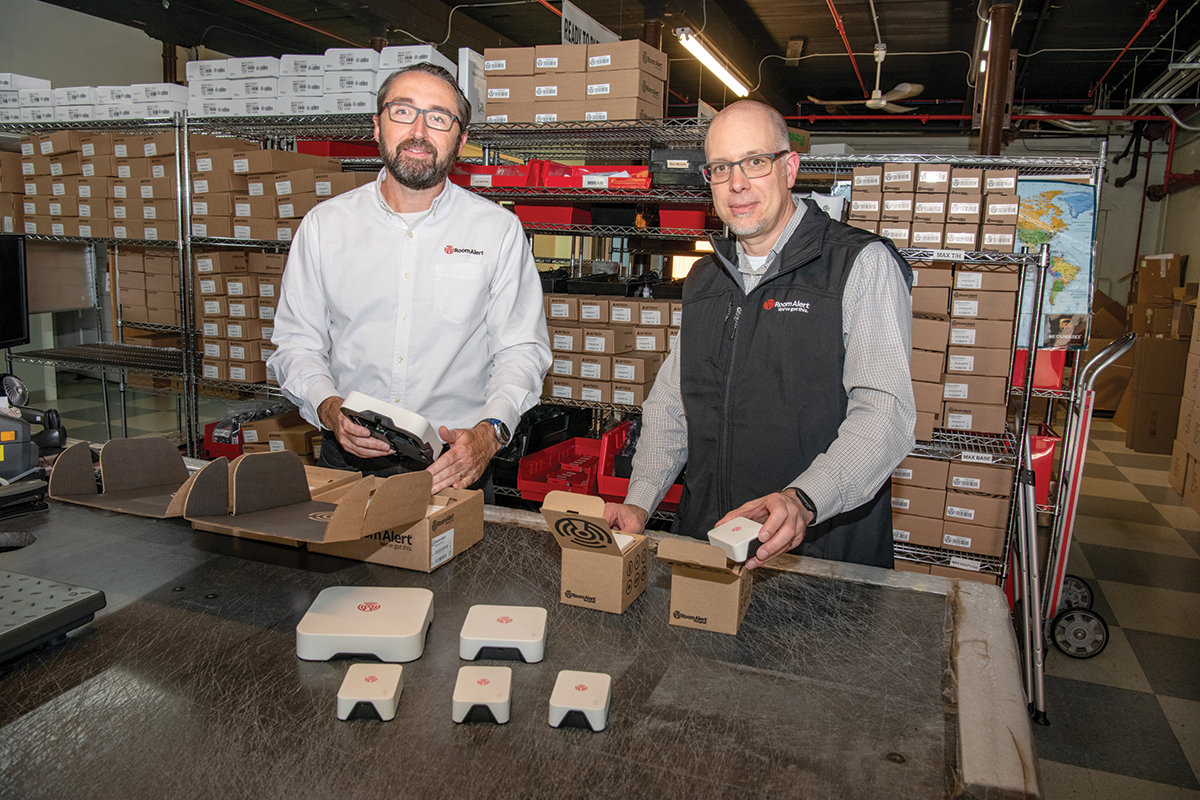
Rick Grundy, CEO and president of AVTECH Software Inc., is proud of the company’s legacy and innovation, as it has expanded the reach of its environment monitoring platform, Room Alert.
AVTECH, based in Warren, manufactures Room Alert at its facilities in Pennsylvania and Rhode Island. The platform, which has been sold since the 1990s, tracks temperature, humidity, smoke, flooding, motion and power status in server rooms, warehouses, data centers and more. The monitors can use both built-in and external sensors and send alerts quickly.
Room Alert is used by educational institutions, government agencies, hospitals, information technology departments, warehouses and more. Clients need to prevent equipment damage while also protecting staff from environmental hazards, Grundy said. AVTECH therefore focuses on safety of both buildings and people.
AVTECH has invested in Room Alert so it can perform general safety monitoring, essentially taking an older building and upgrading its technology.
The company launched Room Alert Max earlier this year, which adds wireless capabilities, a particular benefit for installation. Grundy is especially interested in offering it in tandem with the existing product for current customers.
“We’re really looking at both the changing global landscape, including how we can get our products into customers’ hands overseas easily and affordably,” Grundy said. “Our day-to-day is really sustaining that growth and building out our team to support our customers in every corner of the world, wherever they may be.”
Companies can install Room Alert in places such as warehouses where there is wired cable and add Room Alert Max for areas that are wireless.
“Room Alert Max, for us, was a way to capture all those spaces and areas of a facility where maybe they had our product previously but weren’t able to get them there because they didn’t have that infrastructure,” Grundy said.
Room Alert Max also allows for more-detailed monitoring of systems such as heating, ventilation and air conditioning systems to both prolong the life of the equipment and reduce energy consumption.
The company is seeing growth in the U.S. in the military and government, as well as the telecommunications space.
“What we’ve seen over the past couple of years is that global organizations such as [the World Health Organization, and the European Union Occupational Safety and Health Administration], they kind of adopt a lot of the same policies, so we see our customers purchasing our products for heat safety, for monitoring, for compliance to protect staff here in the [United] States,” said Russell Benoit, marketing channel manager. “And then about a year after we started seeing the push, we started seeing it internationally as well.”
Climate is a big driver of Room Alert, Benoit said. The economy is increasingly digital, which he sees as a growth opportunity. For every hotel where patrons have been interacting less with the front desk, the guest experience goes down when the air conditioning goes out. Proactive monitoring is better than reactive recovery, he said.
“Temperature, heat index, those tend to be the biggest drivers initially for purchases of our products,” Benoit said. “It’s really great to take a lot of things we’re learning here domestically and be able to share them with our channel partners worldwide.”
Room Alert allows for monitoring various spaces in different ways, such as monitoring air quality in one area or safe working conditions in employee spaces elsewhere.
“I think the majority of the market still thinks about building temperature or building environment as the thermostat on the wall, without really understanding that there’s a lot of variability as you go throughout the building,” Benoit said.
Grundy also mentioned that since many businesses and industries are now working in a hybrid model, Room Alert allows companies to have knowledge of areas where people may not physically be working.
“Maybe they might not have employees there anymore, but that also means they don’t have eyes and ears to see if something might be happening like a water leak,” Grundy said. “We’re seeing a huge call for our products from that type of application as well.”