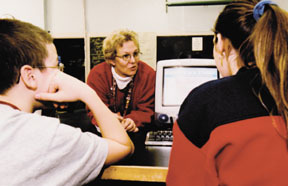
in computer lab at Woonsocket Middle School.
Cox Communications is seeking state approval to construct a telecommunications network that would replace a disjointed system that exclusively serves Rhode Island’s 39 cities and towns.
The proposal is a slight twist on a two-decade-old Rhode Island law that required the state’s cable companies to construct two separate cable lines – one for residential use and another just for municipalities.
The municipal network, which is called an I-net, was supposed to serve all municipal buildings including schools, hospitals, fire stations, and was to have up to 21 channels. But since original construction on the lines following the passage of the rule in the early 1980s, the state’s regulators had generally ignored it.
Seifert Systems Invests in Energy Efficiency to Strengthen Operations
For manufacturers, energy is more than just another operating expense. It plays a critical role…
Learn More
That was until December of 2000 when Cox Communications presented the Division of Public Utilities and Carriers its own plan – a “virtual B-line” network that would connect not only buildings within each municipality, but also could connect municipalities statewide.
And unlike the first municipal line which only provided video service, Cox’s new proposal allows for municipalities to have access to other telecommunication functions using the company’s existing broadband network, including high-speed Internet access, video and data transmission.
“What this does is bring the 20-year-old concept forward into the 21st century,” said John Wolf, vice president of government and public affairs for Cox Communications. “And it does it in a way that brings tangible benefits to users without adversely impacting cable ratepayers.”
The DPUC is expected to make a ruling on the change sometime in February.
“We have been working on this issue for the last two years,” said Eric Palazzo, the state’s top cable regulator with the DPUC. “We have been negotiating in good faith and our number one priority was to find the best way possible to resolve the matter. We have to be as cognizant as possible of providing the best service possible without raising the rates.”
According to Palazzo, Rule 7.3, which requires the creation of an institutional network, was created in the early 1980s when the state first began regulating the cable industry.
Over the last two decades that separate municipal network was built only in some service areas and never completed in others, Palazzo said. He added that in the years since then many of the state’s cable companies never upgraded the systems they had created.
“When Cox took over various systems, they acquired what was left of this B-line,” he said. “In some cases the system had gone foul over time. That got us to a point in 1999 when there was a hodgepodge system, and the division decided that they wanted to get it functioning again.”
For Cox, the process of updating and in some cases rebuilding this municipal-specific line was cost prohibitive. In 2000, the company petitioned the DPUC to let them use their main line to provide the same services, but using their existing line. They call it the broadband virtual B-cable line.
Under the proposal Cox would use its fiber optic network to connect all the institutions that the rules require using digital technology rather than the analog technology that is being used today. In addition, the new service will allow the buildings to exchange both video and computer data free, and at about twice the speed of a standard modem.
Schools and municipalities wanting more speed could pay for additional services, Wolf said.
Mark Scott, vice president of Cox’s Business Services division, said the new system would provide municipalities with free access to technology they now have to pay for.
“We are taking a step beyond the old B-loop,” he said. “Originally, each community had its own B-loop and they were the only ones that could access it. With today’s technology they will be able to interconnect statewide.”
For some municipalities, like Cumberland, the updated B-loop isn’t about expanded bandwidth, or Internet access, but more importantly it provides students with more technological opportunities.
“The thing that I am interested in is getting access to a channel so that the kids can run their own programming,” said Jonathan Gallishaw, director of technology for Woonsocket public schools. “I think that with the updated system all the services that we use will be enhanced.”
Not everyone is as excited as Gallishaw. According to Palazzo, there are opponents to Cox’s plan, including Full Channel Television, a smaller Rhode Island cable company based in Warren.
“There were several legitimate concerns about the original proposals,” Palazzo said. “The original proposal was presented in December of 2000. Since then the proposal has been the subject of negotiations and discussions, including six public hearings. We had to sort through 20 years of history and legal findings.”
The agreement reached between the DPUC advocacy section and Cox is being reviewed. A decision on whether to approve or reject the agreement is expected in February. If approved, Cox officials say they will immediately begin introducing the plan in three demonstration areas.
“The world used to be small and restricted,” Scott said. “It has gotten much bigger and we feel that our new proposal best reflects that.”
For the complete current issue, visit our subscription Web site, or call (401) 273-2201, ext. 227 or 234.