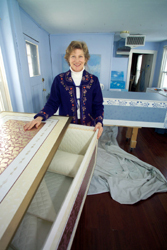
Denise Baxter displays one of her custom-designed and painted coffins at Blue Light Coffin Co. The wooden boxes, lined with upholstery, are sometimes mistaken for hope chests. The colorful coffins go for about $1,800. "To me, creating these is spiritual work," she says.
North Scituate artist uses caskets as canvas
Window-shoppers who drop in to Denise Baxter’s North Scituate shop often have a mistaken impression when they compliment her on the merchandise she has displayed.
Beyond Cash Donations: How New Forms of Giving Are Transforming Not-for-Profit Accounting
Evolving Funding Landscape for Not-for-Profits Not-for-profit organizations are being asked to do more with less,…
Learn More
“People walk in and say, ‘Oh, look, hope chests,’” Baxter, 57, said. It’s a simple mistake to make.
The sunny interior of the shop reveals large, hand-painted items that do look like they could be hope chests. But the merchandise at the Blue Light Coffin Co., which opened in September on Danielson Pike, is designed for more than one use.
Baxter, an artist, said she was unexpectedly inspired last spring to move her painting skills to a completely different canvas – one that allows the deceased to make a statement of individuality in their passing.
“All of a sudden, in April, I was at a meditation retreat and meditating access (to) a higher state of consciousness,” Baxter said. “The entire idea just fell into my head, complete.”
The idea is to take simple wooden coffins and paint the exterior in a rainbow of colors.
The designs now in Baxter’s shop are her own, but she is slowly taking custom orders from customers who know exactly what they want their coffin to look like.
“One woman came in, and she ordered one with butterflies,” Baxter said. “I like being able to give people the opportunity to have something on it that’s very special to them.”
For people who enjoy planning ahead and being prepared, Baxter is marketing her latest works of art as coffins people can buy long before they need them. They can be kept in the home as a useful, decorative item like a hope chest, window seat or coffee table before they’re needed for their final purpose. On two sides, a series of small holes filled with a wooden peg can be popped out and heavy nautical rope threaded through when the coffin is needed for its final use.
Baxter, who painted on canvases for years and found a measure of success as an artist, knew she wasn’t ready to start her new venture when she dreamt it up.
“I’d never done decorative painting,” she said. “And I’d never painted so much as a wall, so I had to learn to paint on wood.”
Despite her lack of expertise in the area of custom-painted coffins, she was determined to make the venture fly. So she enrolled in decorative painting classes at the Rhode Island School of Design, and found much of what she already knew transferred to her new art form.
“I knew I was going to do this whether it made sense or not,” Baxter said. “The purpose is to provide an alternative that is very special and also simple and more economical and more wonderful for the earth.”
One of the main reasons Baxter said she was determined her colorful coffins be marketed is that many people spend between $5,000 and $7,000 on a coffin at a funeral parlor – a markup she says is nearly 250 percent. Her designs go for approximately $1,800.
The interior of the coffins are lined with a simple cream or white upholstery, which Baxter also fashions.
“I had to re-learn how to use my sewing machine,” she said with a smile.
The coffins start as plain wooden boxes fashioned by two fine finish carpenters in East Providence and Smithfield. Baxter said it usually then takes her 10 days to complete the painting and finish the coffin – though she always has some ready for immediate use.
Simplicity is a cornerstone of the philosophy of Baxter’s work, which she calls “spiritual.”
“The tradition in the early part of the 1900s was wooden, handmade coffins,” Baxter said. “Many people who come in here remember that and love it.” People who recall that tradition also remember the tradition of holding wakes in private homes, she said.
By state law, funeral directors are required to accept whatever coffin is provided unless it is too poorly made to use.
And in Rhode Island, people may serve as funeral director for their family members or loved ones, needing only a death certificate from a physician and a $10 permit to transport the body.
Baxter added that embalming a body is almost never required and that people have the freedom to prepare the bodies of a deceased person – or they may hire a funeral home to provide the service.
Private citizens are also permitted to transport the body of a loved on to a church, funeral parlor or cemetery.
Blue Light coffins, Baxter said, fit into most minivans or station wagons. And by law, funeral directors are not permitted to raise prices for other services if someone brings a coffin to use there.
“There’s a movement in the United States for people to reclaim the process of caring for our own dead,” Baxter said.
In Baxter’s shop, housed in a narrow, 200-year-old building that locals have told her formerly housed a funeral parlor, simplicity reigns.
The highly polished wooden floors gleam, giving the coffin-shaped building warmth.
In the front of the store, Baxter’s finished work is displayed on simple wooden carts. Two of her paintings, inspired by Nepalese cremation ceremonies, adorn the walls.
Another piece of the concept that motivates Baxter is that the coffins she builds are good for the earth.
Many coffins sold in funeral homes are made of tropical hardwoods, bronze steel or copper, she said.
“It’s an opportunity to use something that’s more natural to the earth,” Baxter said, adding that millions of gallons of embalming fluid and steel and other coffin materials are put into the earth annually.
Baxter’s coffins can be constructed without nails, a requirement to be admitted into some cemeteries. Others can be built exactly to the customer’s specifications.
Her enterprise is maintained individually, free of any associations with area funeral homes.
Additionally, Baxter said she is not a member of any religion, but she accepts all of them.
“To me, creating these is spiritual work, but I don’t need other people to feel that way,” Baxter said.