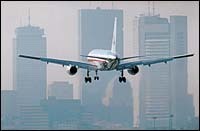
in Boston, but their numbers are falling as Green's rise.
An anticipated increase in air travel will have a significant impact on the nation’s secondary airports, T.F. Green included, according to a specialist in airport finance.
“Air travel is expected to double in the next 15 years,” said Bijan Vasigh, a professor at Embry-Riddle Aeronautical University in Daytona Beach, Florida, whose specialty is airport finance. “Therefore, there is a significant need for airspace. The reason that the secondary airports are becoming more important is that the major hubs cannot expand. The secondary airports are not as congested.”
Beyond Cash Donations: How New Forms of Giving Are Transforming Not-for-Profit Accounting
Evolving Funding Landscape for Not-for-Profits Not-for-profit organizations are being asked to do more with less,…
Learn More
According to statistics recently released by The Rhode Island Airport Corporation, traffic at T.F. Green Airport was up last month from a year ago. Total passengers served by the airport last month rose just over 6 percent from a year ago, from 478,741 passengers in October 1999 to 507,518 last month.
The most recent statistics available from Boston’s Logan International Airport are for August 2000. The airport served 2,613,909 passengers during that month, a slightly lower figure than in August 1999 — 2,624,733, a 0.4 percent decrease.
Vasigh said shorter waits, less expensive parking and minimal delay time are among the advantages to flying out of a secondary airport. In some cases, secondary airports are the preferred choice among airlines as well.
“Generally speaking, Southwest Airlines chooses secondary airports to fly out of,” he said. “Secondary airports are becoming more and more valuable to the airlines. Secondary airports are now competing with major hubs.”
Southwest Airlines dominated jet flight travel at Green in October 2000, with 154,677 total passengers and a market share of 33.8 percent.
Southwest is followed by U.S. Airways with 134,963 passengers (29.5 percent), Delta Airlines, with 54,726 passengers (11.9 percent), United Airlines, 32,695 passengers (7.1 percent), Continental Airlines, 27,911 passengers (6.1 percent), and American and Northwest airlines, each with 5.8 percent, or 26,753 and 26,445 total passengers respectively.
When Southwest arrived at Green Airport a couple of years ago, the airport’s fares dropped dramatically, making it among the cheapest from which to fly in the nation. Adding to the airport’s appeal has been the opening of a new, more convenient terminal, and additional parking facilities.
Vasigh likened the relationship between Logan and Green to that of two Florida airports — Orlando International Airport and Orlando Sanford Airport. Sanford is about 45 minutes away from Orlando and is growing fast. Like Green, Sanford is a smaller airport whose passengers experience fewer delays when traveling and less traffic to fight on the way there.
“Many passengers really like that type of convenience,” Vasigh said.
But with advantages come the flip side as well.
“Service has different interpretations. From Logan Airport, you can take just about any airline and go just about anywhere you want to go,” he said. “Your menu (at a secondary airport) is much more limited as compared to a major hub.”
Vasigh added that while the expectation is for air travel to double in the next 15 years, it would make little sense for an already congested airport – he cited LaGuardia International Airport in New York City as an example — to book additional flights.
“Growth will benefit the secondary hubs,” he said.
Vasigh said that Green’s proximity to different New England destinations — Cape Cod, Newport, New Haven — is a plus.
“It’s really close to many different major cities,” he said. “The opportunity for growth for T.F. Green in the next 12 years is tremendous.”