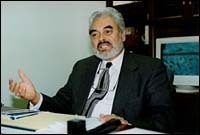
The idea of starting a Hispanic American Chamber of Commerce in Rhode Island isn’t a new one, but for some in the state’s business community there is no better time than now to make it a success.
Raymond Guzman, executive director of the new Hispanic Chamber of Commerce is so dedicated to the success of the organization that he’s already invested close to $50,000 of his own money to get it off the ground.
Beyond Cash Donations: How New Forms of Giving Are Transforming Not-for-Profit Accounting
Evolving Funding Landscape for Not-for-Profits Not-for-profit organizations are being asked to do more with less,…
Learn More
“Over the past 10 or 15 years there have been numerous attempts to start an organization like this,” Guzman said. “But many times the people that tried to start it weren’t business oriented and consequently This isn’t a part-time job, it’s from nine to five daily. You have to be available when businesses need you and that’s what we are aiming to do.”
Guzman believes this latest effort will be a success because of the growing number of Hispanic-owned business in the state and around the country
“There are more Hispanic people in the United States than in all of Canada,” Guzman said. “Hispanic American businesses are growing at a faster rate than any other group in the U.S.”
According to Guzman, it’s a group whose needs are not often met by traditional chambers of commerce.
“Even though many of these businesses already belong to a chamber in their area, we feel that this organization has the ability to go beyond that,” he said. “The standard chamber doesn’t have the ability to do things like bilingual programming.”
He said one of the organization’s main objectives is to help Hispanic business owner compete in the “main stream” business culture.
“Hispanic businesses in Rhode Island are fairly young,” he said. “Many of them are immigrant type businesses that try and cater to other Hispanics in the area. We need to give these businesses the extra push to say I can compete.”
Officially launched in September as a partner of the Greater Providence Chamber of Commerce, the HACC will represent Hispanic-owned businesses from around the state. Guzman organized the group with the help of the Rhode Island District Office of the Small Business Administration, selecting the first board members and setting up its headquarters out of his office on Broadway in Providence.
“We chose a diverse board, representing different nationalities and different businesses,” he said. “These members are all very familiar with the Hispanic community and the needs of that community.”
Juana Horton, owner of Horton Interpreting in Providence, and vice chairman of the HACC board said there is an emphasis within the organization to help Hispanic American business owners “reach out” to corporate America.
“They need to reach out in a sense that they need to have their services or
professional expertise showcased in a way that corporate America can be more
diverse in where they buy their products from,” she said. “It’s very important
that these business owners have a voice.”
In addition, Guzman said he hopes the HACC will open new doors for Hispanic business owners when it comes to financing and business planning.
“We want to be a business information center,” he said. “We want to enable business people to come in, use the computer, work on a business plan, or fill out applications with the help of our staff. Many applications require a lot of information that we want to help these business owners put together.”
Still, the organiza-tion’s biggest challenge will be getting Hispanic business owners to believe the organization will make it this time.
“We have to get the Spanish community to believe in us,” said Nelson Garcia, owner of Bouchard Hardware in Cranston, and a member of the HACC board of directors. “It’s going to be very difficult but we have to get to them.”
Norris Waldron, executive director of the Ocean State Business Forum, a minority business association also linked with the Greater Providence Chamber of Commerce said reaching members of the community is the hardest part of building an organization like HACC. His group, started five years ago, still spends a lot of its time on increasing membership.
But like Horton and Guzman, Waldron said the benefits or specialty organizations like these have far reaching effects.
“These organizations are needed in some instances to get a group of people together in a greater role,” he said. “They need to become more involved, start sharing information among themselves discussing the issues so they can move to the next level.”
Guzman said it’s also important for mainstream business leaders to understand the value of minority owned businesses both for local communities and for the state as a whole.
“There is a huge amount of buying power in the Hispanic community,” he said.