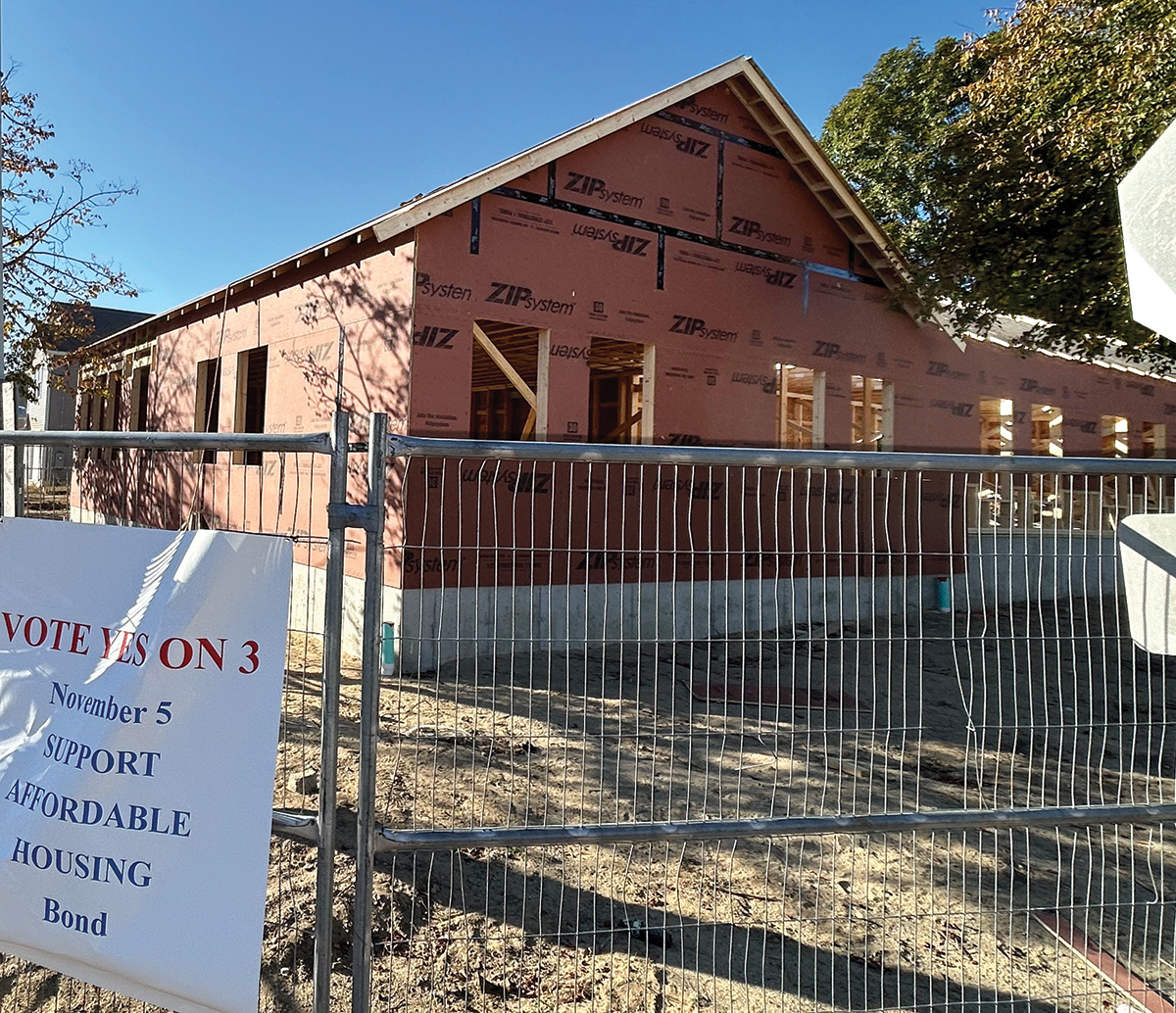
Over the last two decades, Rhode Island voters have approved five bonds totaling $310 million aimed at making housing more affordable, but now Gov. Daniel J. McKee is saying the state needs $120 million more.
Some say the state needs to work on spending the money more effectively.
McKee's $14.9 billion fiscal 2027 state budget proposal contains plans to seek a $120 million housing bond, 14 months after voters statewide approved a $120 million bond issue for affordable housing next November.
McKee administration officials insist the additional borrowing is desperately needed as the crisis persists.
“We are so far behind in addressing housing needs,” said R.I. Housing Secretary Deborah J. Goddard. “Every bit of investment counts.”
But Jeffrey Hamill, senior policy analyst at the business-backed, fiscal watchdog Rhode Island Public Expenditure Council, said these large investments have produced relatively few units.
“The state’s strategy has focused almost entirely on high-cost, heavily subsidized new construction for lower-income households,” Hamill said. “It hasn’t been an efficient way to address Rhode Island’s broader housing challenges. We’d like to see the state start thinking in terms of dollars in and units out.”
Brenda Clement, executive director of HousingWorks RI at Roger Williams University, a nonprofit advocating for affordable housing, acknowledged that borrowing another $120 million wouldn't be a cure-all, but called the proposed bond issue critical to easing the housing crunch.
“Even with the state’s $120 million housing bond and past bonds, we’re still underbuilding – these funds are crucial for matching federal dollars and getting projects off the ground,” she said.
There is no doubt that Rhode Island faces significant housing stress: just 47 affordable rental homes exist for every 100 extremely low-income families, according to a March 2025 report from the National Low Income Housing Coalition.
Despite voters approving multiple housing bond measures in recent years – including $65 million in 2021 and $120 million in 2024 – housing supply problems haven't faded.
Recent bond measures have been key to funding that construction, housing advocates said. Still, applications from developers looking for financial help for affordable housing projects already outnumber available dollars, according to Clement.
“Each bond helps, but the need keeps growing,” she said.
According to McKee's plan, the $120 million housing bond would be part of $600 million worth of general obligation bond initiatives put before voters in November. Those bond issues would be targeted toward higher education facilities ($215 million), economic development ($115 million), green economy and clean energy ($50 million), career and technical education ($50 million) and cultural economy ($50 million).
The General Assembly must approve the governor's plan before the proposed bond issues are put before the voters. In 2024, nearly two out of every three voters said "yes" to the $120 million housing bond.
This time, the McKee administration says the housing bond money will be used for redevelopment, new construction, property purchases and infrastructure improvements, with $25 million earmarked for initiatives to increase homeownership.
Hamill pointed out there are other options that could help meet demand without relying solely on new construction and redevelopment.
For example, the state could use bond funds to directly subsidize rents for families in the current housing stock, reaching more households quickly instead of relying solely on costly new construction.
“Mixing approaches can help meet demand more efficiently,” he said. “It’s just financially smarter.”
Goddard was firm about the bond’s focus on new construction, acknowledging that sustainable building standards can raise costs but noting they are essential for long-term, quality affordable housing.
“It’s not for luxury, and I won’t apologize for sustainability,” she said. “That’s our planet, our responsibility, and it’s part of what we require in constructing affordable housing.”
But judging the effectiveness of the spending is made more difficult by the fact that tracking where the millions of dollars have been allocated isn’t always straightforward. Hamill noted that bond spending can be tricky to parse.
“There isn’t a public, centralized accounting of the 2021 bond, for example,” he said. “You have to request project-level lists from Rhode Island Housing or the Executive Office of Housing, which makes it hard to evaluate effectiveness.”
Records of the bonds exist, Goddard said, but with applications still under review for the 2024 bond funding, there’s little to report so far. Awards for roughly $110 million of the $120 million are expected by May or June.
“These investments aren’t just buildings – they’re homes, communities, and they create construction jobs,” Goddard said. “We’re about to put these dollars to work, and how we deploy them now will shape housing in Rhode Island for years to come.”