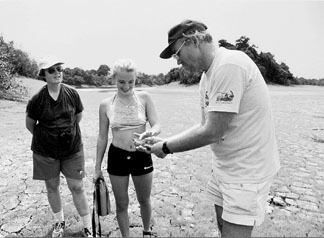
a lake in the Amazons.
Company: Ecotour Expeditions, Inc.
Location: Jamestown
Employees: 2 in Rhode Island and 14 in Brazil
Seifert Systems Invests in Energy Efficiency to Strengthen Operations
For manufacturers, energy is more than just another operating expense. It plays a critical role…
Learn More
Type of business: Tour boat company
The waters of Narragansett Bay are a far cry – in distance and habitat – from those along the Amazon River, but there’s a small tour-operating company in Jamestown helping link the two.
Ecotour Expeditions Inc., a 15-year-old company started by Jamestown residents Mark and Elisabeth Baker, specializes in ecologically oriented nature tours and is recognized as one of the most intensive and user-friendly nature explorations available.
Departing from the city of Manaus, Brazil (a city of over a million people) the company’s tour vessel, Tucano, travels 250 miles up the Rio Negro for eight full days and nights, deep into the remote, fragile rainforest. The excursion concludes with the vessel sailing to the “Encontra das Aquas,” where two of the largest rivers in the world, the Amazon River and the Rio Negro, meet.
In the 1970s, Mark Baker spent several years in New England as a wooden boat builder. In 1980 he shifted careers and started a company that imported wood from the Amazon used in building boats. For eight years he and his wife, who had worked in the international travel industry, built the company. During those years Mark Baker made extended trips throughout the Amazon region acquiring intimate knowledge of its culture, economics and resources.
“In the ’70s and ’80s, it was not uncommon to think that the forests and the imported wood business were compatible,” Baker explained. “However, as time went on I realized that it was absolutely incompatible!”
Something had to change. The Bakers had an epiphany.
“We just shut the imported wood company completely down. We didn’t sell it. We didn’t move,” he said. Instead the Bakers started a whole new company, Ecotour Expeditions Inc. in 1988 with the same office and same phone numbers, but a very different philosophy toward the resources of the rainforest.
“There’s an important distinction between nature travel vs. eco-travel,” Baker said. “Nature travel goes back hundreds of years. That’s nothing like what we began, (which is a) very intensive programs with only local employees.”
Ecotour provides an opportunity for its clients – at a cost of approximately $1,950, not including airfare – to experience the fainforest’s fauna, fish and wildlife up close and undisturbed by the modern world.
At the same time, Baker stresses that Ecotour is committed to preserving the ecological integrity of the rainforest. There is no hunting, no collecting and very limited fishing (except for Piranhas). Instead, participants are lead by experienced, eco-sensitive guides on intimate walks into the rainforest and nighttime mini-boat launches along the mysterious riverbanks. There they utilize special nightlights to observe nocturnal sloth, snakes and various marsupials.
“There can be a conflict between the perfect observation and the disturbance of wildlife,” he said. It is something Ecotour is constantly concerned with.
If it sounds like experiencing this primeval world with Ecotour means sacrificing civilized comforts that is not the case.
“This is not like Survivor (the television show) where you have to suffer. We make it very accessible to get out there and experience the primitive forest,” he said.
The tour vessel Tucano is custom built for maximum comfort. There are nine cabins with private baths, all air-conditioned. Each cabin has mahogany walls with many windows located on the outside of the boat for privacy.
With three decks, the Tucano can spaciously accommodate 25 guests, but Baker limits the number to eighteen for optimum comfort and intimacy. The crew of eight includes two cooks who are “constantly cooking, eight to 10 hours a day.” Native cuisine is served which includes beef, chicken and many varieties of local fish.
There is an abundance of exotic fruits and vegetables along with rice and beans at every meal. Baker points out “we’ve worked very hard to adapt our diet with traditional Portuguese-Brazilian foods. Basically that means adjusting the salt, sugar and spices. They use a lot of all three.”
A typical day starts with sunrise coffee (most wildlife activity is at sunrise, sunset and after dark) then right into the launches. Each of the three sturdy launches has five passengers and two guides. After observing the jungle morning rush hour, it’s back to the Tucano at 8:00 a.m. for breakfast. Launches leave again at 10:00 a.m. for jungle walks or more cruising. At 11:30 a.m., the Tucano resumes travel up the river until about 4:00 p.m.. This is the hottest part of the day, so you relax with lunch, maybe a lecture and then a pleasant air-conditioned siesta. Hors d’oeuvres and cocktails are served at 6:00 p.m., followed by dinner at 7:00 p.m. as the boat resumes travel.
Baker said he is often asked about snakes and mosquitoes. He said there are actually very few mosquitoes due to the high acidity of the Rio Negro and, contrary to popular belief, there are really not many snakes. He added that over the last 15 years, no one has ever been bitten or seriously injured on the trips.
The tour will pass by – but no disturb – tribal longhouse villages that have chosen not to accept Brazilian customs or visitors. They are sovereign states similar to Native American reservations. These villages reflect a 12,000-year-old culture that turn-of-century Brazilian Indian preservation laws protect and respect. Chiefly responsible for these protection policies was the great Brazilian conservationist, Candido Rondon, the man who first brought America’s stalwart conservationist President Theodore Roosevelt into the Amazon.
When asked about Ecotour’s role toward conservation, Baker said, “What we do not do is proselytize. (In fact), at the beginning of the trip we explicitly ask passengers not to think about conservation.” Baker wants his guests to draw their own conclusions about the frailty of the region.
“Our clients see the complexity and inter-relatedness of the creatures and the environment. It indicates there is an absolute necessity to conserve.”
Ecotour offers five other trips to South American countries and soon will add Alaska to its list of destinations.
For information contact: Web site: www.naturetours.com
David Long is a contributing writer to PBN.
For the complete current issue, visit our subscription Web site, or call (401) 273-2201, ext. 227 or 234.