You know your age. But do you have lungs to match? Or are you, say, a 40-year-old breathing with a 60-year-old’s lungs?
If you’re a smoker – even if you quit years ago – that could be the case. Or maybe your job exposed you to a lot of smoke or fumes, or you’ve had serious illnesses. Either way, you may have irreversible tissue damage, the beginnings of chronic obstructive pulmonary disorder.
At this point, it may feel like mild asthma, or like a consequence of gaining weight. Without treatment, however, you might need an oxygen tank by age 60.
The National Heart Lung and Blood Institute says more than 12 million Americans are currently diagnosed with COPD, but another 12 million undiagnosed cases may exist. A new project at Memorial Hospital of Rhode Island aims to help find them and intervene at the earliest stage possible, to avoid or at least delay the worst of the disease.
The project is one of two major initiatives recently launched by the Brown University Center for Primary Care and Intervention, based at Memorial, with funds from the National Institutes of Health. The center got a five-year, $3.58 million grant for the COPD study, plus another $3.45 million over five years to test an individually tailored, home-based program to support weight loss, exercise and healthy eating habits.
Both projects involve translational research – taking scientific advances and finding ways to apply them to improve people’s health. Both involve a great deal of patient education and outreach, often using online tools, and both rely on partnerships with primary care doctors.
And in both cases, said Dr. Charles B. Eaton, director of the center, the goal is to develop easy-to-use, low-cost materials and strategies that can be implemented nationwide.
COPD encompasses two major conditions: emphysema and chronic bronchitis. It’s the fourth-leading cause of death in the United States and a major cause of disability, estimated to have cost the country $42.6 billion in 2007 in medical costs and lost productivity.
The earlier that COPD is caught, Eaton noted, the more patients can be helped. Realizing the urgency, they may be quicker to quit smoking. They can exercise more, so their bodies are better able to compensate for weak lungs. If needed, they can start using a long-term bronchial dilator, like the drug Advair. In the long run, they could stay far healthier for far longer, and avoid disability and costly hospitalizations, Parker said.
So how to find these early-stage COPD patients? Parker and Eaton want to use a strategy that’s already proven effective with cardiovascular disease, a consumer-friendly “heart age” quiz. Develop a similar quiz, perhaps with animated characters, and put a computer terminal in doctors’ waiting rooms, they say, and it will raise people’s awareness of their “lung age” and lead them to talk with their doctors and take action if needed.
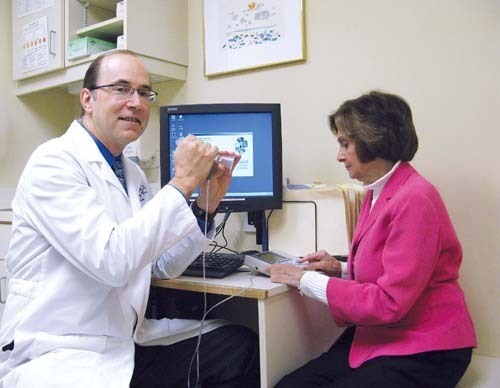
Doctors, in turn, can ask basic questions to identify at-risk patients, and then they can use a device called a spirometer to test them.
Spirometers aren’t very expensive, and insurers pay for the tests, but doctors who don’t have a lot of older patients – say, a family practice – don’t have much use for them and don’t own them. So part of this project, Eaton said, will involve putting spirometers in more practices.
In addition, Eaton said, the project will educate doctors about the latest COPD guidelines, so they do a better job of treating and supporting their patients at every stage of the disease. And for those using electronic medical records, Eaton hopes to incorporate the guidelines in the “decision supports” built into the software.
The other project, meanwhile, is an attempt to pull together the findings of three previous studies that looked at how overweight people could best be helped to lose weight, keep it off, exercise and adopt generally healthier lifestyles, Eaton said.
Those studies, for which Memorial researchers developed a slew of educational materials such as culturally tailored DVDs, were very successful, he said. But given the extent of the obesity epidemic, and the scarce resources at most doctors’ offices, the strategies would be hard to implement on a large scale, to reach everyone who could benefit.
So the new study will take the work out of the doctors’ hands. They will still play a crucial role, seizing on “teachable moments” to talk with patients about weight loss, exercise, etc., and monitoring their progress, but Memorial will handle the rest, almost entirely remotely.
Eaton expects most motivated participants to lose some weight. But if providing all those extra resources at home, without constant face-to-face support, makes a substantial difference, that model could be applied on a large scale at an affordable cost.
The prospect doesn’t just appeal to the NIH; major insurers have signed a letter of support, Eaton said, saying that if the Memorial protocol is shown to work, they will incorporate it in their wellness and health-promotion programs. •