The housing stock in Olneyville, in the heart of Providence, is dominated by multifamily tenements and its population is mostly blue-collar, working families. Hispanics are the most populous ethnic group. Residents know there are nicer, wealthier neighborhoods in and around the state.
Yet this neighborhood west of Federal Hill, just one-half square mile in area, is a beehive of commercial activity. Olneyville is home to more than 200 businesses of just about every kind, ranging from jewelry stores and beauty salons to eateries and working factories.
To keep that commercial activity thriving, to bring in more businesses and do whatever needs to be done to create an enhanced business climate, the newly re-established Olneyville Merchants Association recently met for the first time in at least 10 years. No one can quite recall when the group held its last meeting, but all agree it was a long time ago.
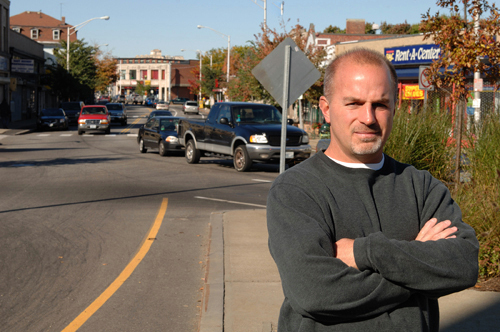
Gregory P. Stevens, owner and operator of the Olneyville New York System on Plainfield Street at Olneyville Square, is working with the city of Providence Neighborhood Markets Program to resurrect the long-dormant merchants association. More than 200 notices were sent to local businesses, inviting them to the Oct. 19 meeting. Other business owners closely involved in the initiative include Miguel Buren, of All Star Photo Shop, and David Dubois, of Hardware on the Square.
“Seeing all the activity in the area, we decided it [was] time to meet,” Stevens said during a recent interview with Providence Business News, “to communicate with each other and to find out what economic resources are available.” The Olneyville Merchants Association recently incorporated as a nonprofit and Stevens said work is progressing to revamp the group’s Web site (www.olneyvillemerchants.org).
Once considered little more than an urban blight full of barrooms and vacant mills, Olneyville since about 2000 has been undergoing something of a minor resurgence, due in part to the state historic tax credit program and a zoning change that allowed residential use in industrial zones, city planners say.
Both factors led to the redevelopment of dormant industrial complexes into office and residential space, affordability of which appealed to independent small businesses, nonprofits, artists and artisans. The United Way of Rhode Island, for example, in mid-2008 moved from the East Side to the rehabbed Calender Mills complex on Valley Street in Olneyville. Small signs of resurgence include new wrought-iron tree guards and lime-green, decorative trash cans along Olneyville Square.
The second phase is scheduled to go through Olneyville in 2010, according to the Bay Commission. The commission’s Web site said an interceptor to reduce discharge from untreated sewer overflows will be constructed along the Woonasquatucket River, which runs through Olneyville. The interceptor will be 19,150 feet long, the Bay Commission said, and will convey flows to the main tunnel built in the first phase last year.
Another initiative would see the return of the Olneyville Temperance Cadets, a semi-professional baseball club that won the state league championship in 1889. The team played at Merino Park in the 1880s for a 15 cent admission fee, drawing crowds of more than 1,000 spectators.
In 2008, local players led by team captain Patrick Reilly revived the Cadets, who finished at the top of their division with a 7-2 record in 2008 in the New England Vintage Baseball League and had a full 2009 schedule. The 20-member team now plays its home games in Warwick and follows 1886 baseball rules, including taking seven balls for a walk and not counting a foul ball as a strike.
But Olneyville certainly needs more than an old-time baseball team to revitalize it.
Stevens said he would personally like to see one or two large retail chain stores, such as a pharmacy and a brand-name gasoline station, locate on the main thoroughfares of Olneyville to function as anchors for the commercial district. “Everything would follow,” Stevens suggested, with anchors that “would bring in activity from far and wide.”
“It is critical that the city work with the Olneyville businesspeople,” she said. “The city has to become more involved with these businesspeople, and the neighborhood needs economic-development money.” One improvement she would like to see is the location of a supermarket in the area because she noted many Olneyville residents, especially the many elderly residents who live there, do not own cars.
City Councilman Michael Solomon, owner of Wes’ Rib House in Olneyville and the last president of the former merchants association, said the area needs traffic improvements, particularly at Olneyville Square where vehicle congestion “can be a nightmare,” especially on weekends.
“The traffic pattern has to be studied,” he said, calling it a “major obstacle” to further economic development. After Smith Hill, which abuts eight other city neighborhoods, Olneyville has the most abutting neighborhoods with seven, resulting in what Solomon said are seven major traffic arteries leading into Olneyville from other parts of Providence.
Stevens, who also owns and operates New York Systems in North Providence and Cranston, is the fourth generation of his family to run the Olneyville hot wiener eatery, which opened in 1946. Stevens recalls that, back in the 1980s, he would go with his now-retired father, Peter Stevens, to the Olneyville businessmen’s meetings. Greg Stevens is a former member of the board of the Olneyville Housing Association.
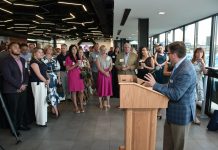
Stevens said about 25 people attended last week’s merchants’ association meeting, which he called “mostly informational.” The main point stressed, he said, was the need for merchants to communicate with each other on such upcoming matters as extension of the commission’s sewer-overflow system. •