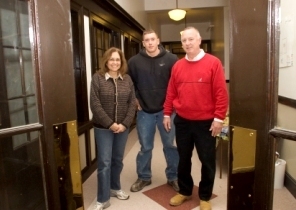
ALL IN THE FAMILY: Robert Jensen, right, bought the former Pascoag Grammar School from the town of Burrillville for $1 and worked for three years with his wife, Denise, and son, Erik, to transform it into 19 condominiums, all priced to be affordable.
By Rebecca Starcevic
Contributing Writer
When a small town handed over a historic but empty grammar school for redevelopment into affordable housing, the result was an unusual combination of urban loft-style living and mill village history. And it’s selling.
Beyond Cash Donations: How New Forms of Giving Are Transforming Not-for-Profit Accounting
Evolving Funding Landscape for Not-for-Profits Not-for-profit organizations are being asked to do more with less,…
Learn More
The Historic Pascoag Grammar School condominium project on Sayles Avenue in Burrillville recently opened its doors to prospective buyers, after two years of renovations, and 12 of its 19 units are already reserved, said Linda Bessette, owner/broker of Bessette Realty.
The combination of loft-style condominiums tucked away in a small town makes the development unusual, but not as unusual as its prices: 100 percent of the units are considered “affordable” by Rhode Island income standards.
The units range from a 250-square-foot studio, selling for $70,000, to 1,400-square-foot, three-bedroom condominiums, some of them handicapped-accessible, priced at $169,000. A typical two-bedroom unit is priced at $159,000.
The school was built in 1917. Once a high school, but more recently operated as a grammar school, it closed in 1995. Then, having no further use for the building, the town tried to find someone to take it over.
“We had a situation where one of our town-owned buildings was in serious disrepair, and we could not afford to repair it for any municipal use,” said Burrillville Town Manager Michael Wood.
Meanwhile, Town Planner Tom Kravitz was drafting a document required by a 2004 state law, which said every city and town must develop a plan to make at least 10 percent of its housing affordable. Burrillville’s plan included the reuse of existing structures.
In 2004, the town put out a request for proposals to renovate the school.
The one submitted by Excel Management, run by Robert Jensen of Lincoln, had the right combination of affordability and historic preservation, Wood said. Jensen has been developing real estate for more than 20 years. And many of his projects, including the Globe Mill in Woonsocket, have involved the rehabilitation of historic buildings.
So, the town sold the building to Excel Management for $1. Then, Jensen and the company’s two other employees – his wife, Denise Jensen, and his son, Erik – set out to work on the project, subcontracting the work they didn’t do themselves.
“We took a municipal building that was failing precipitously, and we gave it away as incentive,” Kravitz said. “We were cognizant of the town’s rural character,” he added, and “it was the right thing to do.”
Acquiring the building for just $1 allowed the Jensens to privately finance the entire project, for about $2.5 million.
Robert Jensen estimates he spent $130,000 per unit in renovations, allowing the 19 units to all be sold at “affordable” standards for the area. “This really levels the playing field for residents who want to buy in the area they grew up,” he said.
In Burrillville, more than 40 percent of the town’s residents earn less than the area’s median income, and thus qualify for housing designated as affordable, Kravitz noted.

The units at the renovated grammar school will be sold to buyers in a combination of income brackets, Kravitz said. A few of them will be made available to people making 115 percent of the median income, but most will be sold to people making less than 80 percent of the median income.
At the end of 2005, the median family income in the Providence-Fall River metropolitan area was $64,000, according to the U.S. Department of Housing and Urban Development. The median price of single-family home in the same area was $282,900, and the average rent for a two-bedroom apartment was $1,147.
“People were spending more on rent and mortgage payments than ever before,” said Chris Barnett, spokesman for Rhode Island Housing, a quasi-public agency devoted to helping low- and moderate-income people. “That left less money at the end of the month to go out to dinner, go to the movies or buy curtains – and all of that was having an effect on Rhode Island businesses.”
Addressing that problem, however, can raise other issues for communities. Higher-density development is more affordable, for example, but it also puts more pressure on municipal services and schools. And large-scale projects can change the character of a town.
To avoid those pitfalls, Kravitz said, towns increasingly are working to shape their own growth in ways that protect their historic and, in some cases, rural character. Burrillville has been recognized by the state, housing leaders and Grow Smart Rhode Island for doing that particularly well.
The Pascoag Grammar School project was already being discussed when the town developed its affordable-housing plan, and was built right into the plan. In exchange for the $1 price, Jensen was required to work closely with the town manager, the town planner and the Burrillville Historic District Commission, and meet strict guidelines on preserving the history of the building.
The solid but inflexible brick building proved to be both a blessing and a curse, Jensen said.
The two largest units are three-bedroom lofts, each taking up half of what were once the school’s gym and library, and one unit’s master bedroom is the former principal’s office. The two-story wall of windows is left exposed in each unit.
The smaller units also have classroom touches: a strip of blackboard preserved in the wall, an old supply cabinet. Many doors still have elementary-student-height doorknobs.
Any project that includes this much historic preservation could only be completed with the help of town officials, Jensen said.
Many of the construction materials were purchased at local hardware stores, he added. And one Burrillville resident, when he saw the renovations in progress, offered to retrieve the building’s original front-entrance light fixture from the depths of his barn.
The night the building was completed and opened to the public, “it was like a big neighborhood gathering in here,” Denise Jensen recalled.
Was privately financing a project like this risky for the Jensens?
“Everything is a risk,” Robert Jensen said. “But we felt comfortable going into it. The community really wanted this to happen.”