
At Nordstrom in Providence Place a pair of men’s jeans sells for $198. Down two escalators Old Navy sells a different-style pair for $29.50. At the Cheesecake Factory, grilled pork chops go for $18.95. Upstairs in the food court, Popeyes Chicken and Biscuits offers a chicken bowl for $3.89.
Variety in style, price and offerings is part of the plan at Providence Place that helps set it apart from other retail centers struggling to survive the down economy. A diverse splattering of shops and options helps pull in the roughly 10 million people a year that truck through the 1.3 million-square-foot center spread across 15 acres in downtown Providence.
“You’ve got to give them all the different options: shopping, dining and entertainment,” said Will Malone, the mall’s general manager.
The mall counts roughly 160 shops, six sit-down restaurants, a Dave & Buster’s with an arcade, an IMAX theater and a 16-screen movie theater among its tenants. Chicago-based owner General Growth Properties (GGP) declined to release the mall’s sales per square foot, but Malone said foot traffic has remained steady and occupancy near 100 percent despite the poor economy.
That performance stands in contrast to many malls in America sagging under the weight of the recession. The International Council of Shopping Centers reported last month that as of August, year-over-year sales remained down 9 percent. In the Northeast, sales plummeted 11.4 percent, behind only the West, where sales fell 12.3 percent. Household spending in September fell half a percent, the first decline in five months, the U.S. Commerce Department reported.
Even GGP, which owns or manages more than 200 shopping malls across the county, is hurting. Earlier this year the company filed for Chapter 11 reorganization bankruptcy, saying it was laden with debt after going on a shopping center buying spree.
Last week a spokesman for Simon Property Group Inc. confirmed the mall giant hired two firms to advise the group as it explores bidding for all or part of GGP.
Malone said other mall operations, including staffing, remain normal.
And unlike some U.S. malls that remained committed to luxury goods, Providence Place over the years has shown a willingness to allow shops targeted at lower-income consumers. Providence Place has a consignment shop. There’s also a Payless ShoeSource, along with a Toys ’R Us Holiday Express.
“Those malls that haven’t changed and have stuck with the strictly luxury tenants are really not doing as well as they were,” said Erin Hershkowitz, a spokeswoman for the International Council of Shopping Centers. “Most of the shopping centers that are doing well are the ones that have drugstores and items that people need every day.”
The CVS/pharmacy at Providence Place recently expanded and moved to the street level, where it draws street traffic. And Malone said he worked hard to fill the vacant stands in the food court so people coming from downtown offices for lunch had more dining options.
The ability of the mall to draw foot traffic also sets it apart from many urban malls that customers must drive to. As an example of how important foot traffic is, Malone pointed to the skybridge that connects The Westin Providence and the mall. Estimates show more than 1 million people a year cross the bridge.
To serve that foot traffic Malone said the leasing team at GGP looks for stores that will attract people from all walks of life. Even teenagers without the income to shop at a Nordstrom are welcome because, Malone said, they might be tomorrow’s customer.
“We try to cater to everyone,” he said.
The strategy can help during a down economy when consumers hold on tighter to their wallets, said Elaine Notarantonio, a professor of marketing at Bryant University. But malls that move away from a single theme, whether it is luxury or discount, risk confusing customers.
Customers with deep pockets who learn of a consignment store at Providence Place may stay away, thinking the mall sells only cheap goods. On the flip side, customers at the opposite end of the income spectrum who see a store lineup that includes Tiffany & Co. may stay home, believing the mall offers nothing they can afford.
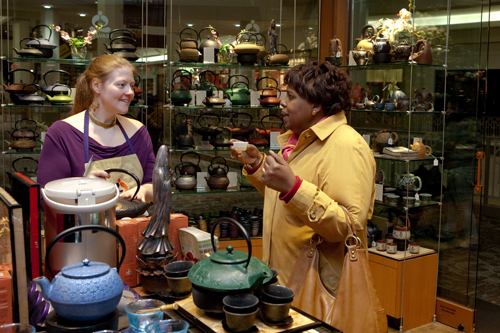
Some retailers look at it differently. Teavana Vice President for Real Estate Robert Shapiro said the national chain decided to open a store at Providence Place last August because of the center’s reputation as the region’s premiere fashion center. Shapiro sees lower-end stores such as the mall’s Old Navy not as a detriment but as a potential source of new customers, as middle-age women – identified by the company as its target customer base – bring their children to Old Navy to shop.
“Foot traffic is very important to us because tea is a product that is just now gaining some real strength in the U.S.,” Shapiro said. “So, as a result, the more people we have walking by the store, the greater opportunity we have to get them in the store.”
Malone said the ability to introduce new customers to new stores removes any worry that the mall’s changing tenant base will lessen its luster. And Notarantonio agreed the strategy could prove effective, as shoppers are increasingly showing a willingness to engage in what the industry terms cross-buying, or darting into an upscale retailer one moment and then snacking on a Subway sandwich the next. If Providence Place can keep that customer while not confusing others, Notarantonio said the mall and GGP could fair well.
“I think they’re probably trying to ride out the recession,” she said. “They have the potential to emerge” intact. •












I would like to have read a bit less P.R. here, and more independent reporting and analysis.
1. Anyone who walks through the mall can see several vacancies on every level of the mall. What’s the actual occupancy rate, based upon independent analysis or a reporter’s estimate? It’s certainly not near 100 percent.
2. Three years to make a decision about filthy, ragged carpeting? What does that say about the parent company’s difficulties and their impact upon the local mall?
3. Last time I checked the food court a few weeks ago, Regina Pizzeria had been quickly replaced — but two other vacancies remained where the Chinese and salad-bar stands had been located.