
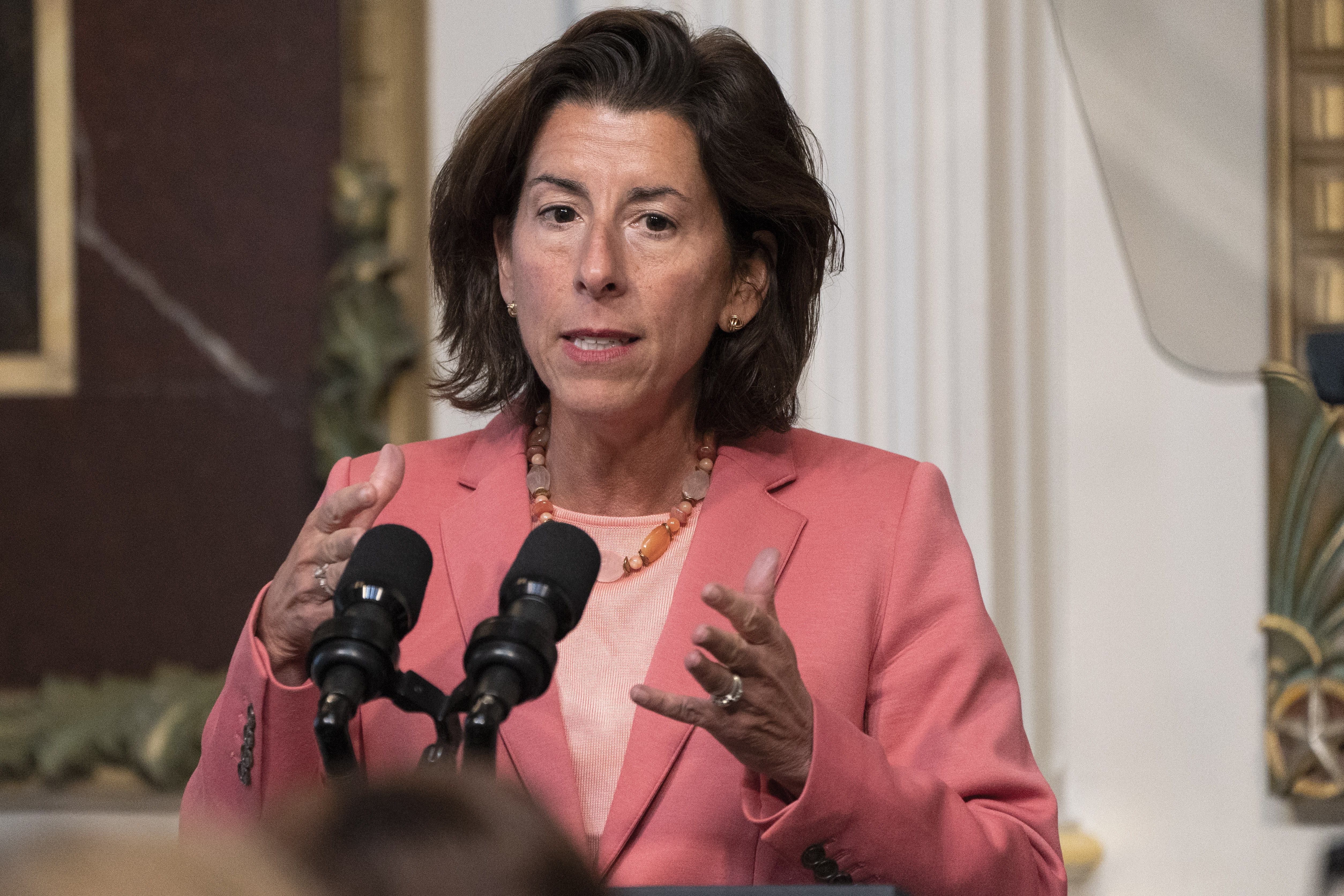
WASHINGTON (AP) – Ambitions to jump-start the state’s biotech and blue economies with multi-millions in federal funding were dashed on Friday after neither Rhode Island finalist was named as a winner of the Build Back Better Regional Challenge.
President Joe Biden and Commerce Secretary and former R.I. Gov. Gina Raimondo announced Friday $1 billion worth of federal grants for manufacturing, clean energy, farming, biotech and other sectors that will go to 21 regional partnerships.
ISO 9001:2026: A Practical Opportunity to Build for What’s Next
For Rhode Island manufacturers, ISO 9001 has been much more than a certificate on the…
Learn More
The winners were chosen from 529 initial applicants vying for grants that were part of last year’s $1.9 trillion coronavirus relief package. The Biden administration has repeatedly laid out a vision for the economy that is more self-sufficient and driven by high-tech manufacturing and the development of renewable energy.
“The whole point of this is we’re not going to let you get left behind as we transition to a more digital economy, to a more technical economy, to a green economy,” Raimondo told The Associated Press. “People want to work where they live. People want to know there is a place for them in the changing economy.”
Unlike much of the pandemic aid that was meant to address immediate needs, the $1 billion in grants is part of a longer-term effort to revitalize parts of the country that have needed an economic jolt for existing industries and capital for new ventures. The mission is personal for Raimondo, whose father lost his job at a watch factory in Rhode Island. She said the grants are the largest ever for local economic development provided by the Commerce Department.
Two groups with Rhode Island connections had been named among the 61 finalists.
One, the University of Rhode Island Research Foundation, sought funding to help grow the state’s “blue economy” including developing Narragansett Bay into a “smart bay” where undersea and maritime technologies can be invented, prototyped and tested; a “blue innovation technology center;” improved aquaculture operations and increased job training.
A second finalist, a multistate biotech coalition called BioConnects New England, a multistate biotech coalition, aimed to start life science training and education hubs and lab spaces across the region, including in Rhode Island. R.I. Commerce Corp. and URI both signed on to BioConnects’ proposal, and have already issued a request for proposals on a shared wet-lab space in the I-195 Redevelopment District
A third finalist that also could have benefited the state, Southeastern Connecticut Enterprise Region’s proposal to build offshore wind workforce training programs that might eventually tie to Rhode Island, was also not named as a winner.
“While we are disappointed our proposal was not selected in the final round, the projects outlined in the Blue Economy Technology Cluster and BioConnects New England applications remain priorities, and we have already begun the work of looking for alternate streams of funding to make them realities,” Adam Isaacs-Falbel, a spokesperson for R.I. Commerce said in an emailed statement.
Matthew Sheaff, a spokesperson for Gov. Daniel J. McKee, pointed to funding in the state budget that will ensure Rhode Island remains a leader in the blue economy even without the federal grant.
“Rhode Island’s blue economy is ripe for growth and we will continue working with our federal delegation to apply for additional grant opportunities to invest in a number of fields such as ports and shipping, defense, marine trades, ocean-based renewables, and aquaculture and fisheries all with the goal of creating jobs, raising Rhode Islander’s incomes and tackling climate change,” Sheaff said in an email.
Peter Snyder, vice president for research and economic development at URI said the university remains committed to our shared vision to establish Rhode Island and southern New England as a leading global hub for the Blue Economy.
However, the school refused to comment on what key areas has URI made progress in helping build the state’s blue economy or how it plans to move forward in developing a blue economy.
Through a strong coalition with industry, government, philanthropic, non-profit, community, and academic partners, and with the support of our elected leaders, we already have made great progress in several key areas. We will continue to aggressively pursue opportunities to build and diversify a Blue Economy that will spur job creation and economic development for Rhode Island and the region.”
The grants include $65.1 million in California to improve farm production and $25 million for a robotics cluster in Nebraska. Georgia gets $65 million for artificial intelligence. There is $63.7 million for lithium-based battery development in New York. Coal counties in West Virginia would receive $62.8 million to help with the shift to solar power and find new uses for abandoned mines.
Raimondo said the winners were chosen based on merit rather than politics. She estimated that the investments, which will be provided over five years as reimbursements, will result in at least 100,000 jobs.
Solidly Republican states such as Oklahoma and South Dakota received funding, and money also is going ahead of November’s midterm elections toward political battlegrounds that could decide control of Congress. There is $44 million for regenerative medicine in New Hampshire, where Democrat Maggie Hassan is defending her U.S. Senate seat. Pennsylvania, which has an open Senate seat, is set to receive $62.7 million for robotics and artificial intelligence.
The massive amount of coronavirus aid at the start of President Joe Biden’s tenure helped to accelerate job growth as the U.S. recovered from the pandemic. But accompanying the hiring was a burst of inflation that hit a 40-year peak this summer, crushing consumer sentiment and putting the administration on the defensive to show how its policies are helping the economy.
Even as much of the coronavirus money has been disbursed, the administration has said it still needs more money to contain the disease and its variations. Biden unsuccessfully sought to get $22.5 billion from Congress to address and prevent outbreaks, a figure that lawmakers reduced to $10 billion in negotiations. But additional funding was never passed by Congress despite confirmed cases that are now averaging about 90,000 daily.
White House press secretary Karine Jean-Pierre tried to minimize the lack of funding after the Food and Drug Administration on Wednesday approved modified booster shots of the vaccines. Jean-Pierre said booster shots would be available after the Labor Day holiday as the administration has worked with local partners.
Still, the grants for economic development indicate that the relief package could have a multi-decade impact that goes beyond the COVID-19 pandemic. The New Orleans area will receive $50 million to use hydrogen produced by wind power that does not cause carbon emissions, a meaningful change in Louisiana, a state that has long depended on fossil fuels.
“With clean hydrogen, we can remain an energy state — but become an energy state of the future that has less impact on the environment,” said Michael Hecht, president and CEO of Greater New Orleans Inc., an economic development nonprofit. “When money and morality come together, you get stuff done.”
(Update: Sheaff’s comments added in 11th and 12th paragraphs)
(Update: Comment from R.I. Commerce added in 10th paragraph)
(Update: Comments from URI added in 13th and 14th paragraphs)
PBN staff writer Nancy Lavin contributed to this report.











Surprise!
Except for OK and SD sounds like the grants were based on politics.
Nothing beats buying votes with taxpayer dollars.
Thanks, Gina and Joe.
So we had our former governor in line to at least make sure RI had its case heard, and our state ended up with $0.
Just wouldn’t happen in RED States….Called CYA