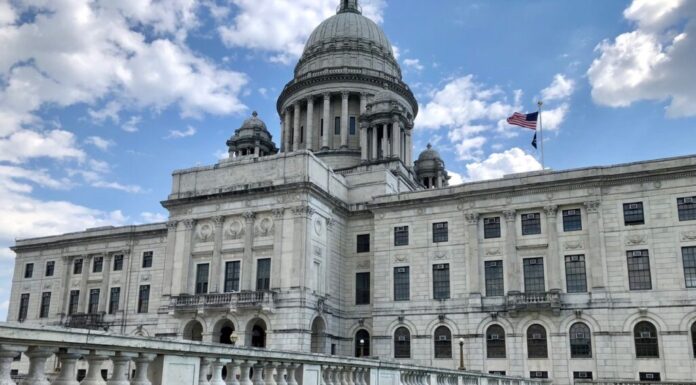
“Underperforming” is how Emily Mandel, senior economist at Moody’s Analytics, characterized Rhode Island’s economic forecast through the end of the decade.
Her words of caution during the biannual Revenue and Caseload Estimating Conference at the Statehouse Wednesday, were underscored by the conclusion of a new report released hours later by the Rhode Island Public Expenditure Council.
ISO 9001:2026: A Practical Opportunity to Build for What’s Next
For Rhode Island manufacturers, ISO 9001 has been much more than a certificate on the…
Learn More
The tax policy group’s inaugural economic prosperity scorecard found that Rhode Island is “losing ground” relative to other states. The scorecard measured the Ocean State’s growth across six key indicators from 2014 to 2024, all but one of which has fallen compared with other states and the national average, according to the report.
The pair of gloomy conclusions come as state budget analysts and lawmakers race to finalize a fiscal 2027 budget based on the most recent state and federal data about labor market conditions, consumer spending and tax revenues.
The long-term picture for Rhode Island was already grim, with state budget officials projecting a $537 million deficit by 2031 due to federal funding cuts under the One Big Beautiful Bill Act. But they also thought there might be short-term relief, with unspent money from fiscal 2025 contributing to a $65 million surplus for the approaching fiscal year, according to a Feb. 13 report by the state budget office.
Fifteen days later, the U.S. and Israel launched air strikes on Iran, sending energy and oil prices surging.
“This has contributed an additional factor to the economy which is just this pervasive uncertainty,” Mandel said of the Iran War.
Surging gas prices have abated slightly, down to $4.09 a gallon on average as of Friday, but Moody’s expects elevated interest rates and oil prices will continue into next year. And that assumes the Strait of Hormez reopens fully to shipping traffic within the next few weeks, a geopolitical uncertainty on which Mandel acknowledged she was unqualified to comment. If the strait responsible for transporting 20% of the world’s oil supply does not reopen soon, an alternative recession scenario emerges, sending prices soaring and plunging GDP.
All this as the impact of Trump’s reciprocal tariffs and stringent immigration policies still ripple through the economy, nationally and locally. Like the rest of the country, Rhode Island has seen job growth slow to a standstill, with year-over-year losses in nearly every industry, except healthcare, transportation and hospitality. Meanwhile, housing remains too expensive and too scarce, even relative to Massachusetts. Since 2025, housing in Rhode Island has become just as unaffordable as in Massachusetts based on median household income relative to median sales prices for single-family homes, according to Moody’s Analysis. Both states remain significantly above the national average.
New permits for multi-family homes in Rhode Island are expected to ease the crisis slightly in the coming years, but future supply of single-family homes remains elusive.
The Iran War’s impact on energy prices will also hike mortgage rates, further contributing to the affordability crisis, Mandel said.
A few silver linings: employment and personal income are both expected to grow slightly faster though the end of the decade than previously expected when analysts last met in November. The unemployment rate, previously expected to hit 5.2% in fiscal 2027, is now projected to remain below 5% through fiscal 2030.
Even through recent economic pressures, household wealth nationwide has soared, cushioned by investors’ optimism in artificial intelligence. However, the success of stock market investments and retirement accounts is concentrated in the top 20% of households, cementing a K-shaped economy marked by disparate outcomes of different socioeconomic classes, according to Moody’s.
Hindsight offers little comfort on Rhode Island’s economic growth over the last decade relative to other states. The Ocean State fared poorer than peers nationwide on five out of six economic indicators considered by RIPEC in its analysis.
Most alarming to Michael DiBiase, president and CEO of the business-backed group, the state’s 6% GDP growth relative to a 20% national average.
“That trajectory is the most surprising, and also the most concerning,” DiBiase said in a briefing with reporters Wednesday.
Other measures considered were:
- Median household income: Rhode Island ranked 17th among states in 2024, up from 18 in 2014.
- Personal income per capita: Rhode Island ranked 23rd in 2024, down from 21 in 2014.
- Real personal income per capita (adjusted for inflation and regional price differences): Rhode Island ranked 30th in 2024, down from 24 in 2014.
- Real disposal personal income per capita (includes all federal, state and local taxes): Rhode Island ranked 36th in 2024, down from 28 in 2014.
- GDP per capita: Rhode Island ranked 35th in 2024, down from 28 in 2014.
- Labor force productivity: Rhode Island ranked 25th in 2024, down from 21 in 2014.
The 27-page report does not contain any recommendations, reflecting the need for more information and analysis, DiBiase said.
“It’s a chicken and egg thing,” he said. “Are states more prosperous because they have more educated people, or do they have more educated people because they are prosperous?”
DiBiase also punted on specific policy measures that lawmakers should consider, or avoid, to bolster Rhode Island’s economy.
“Really, to be fair and to really help the state, we should have some more specific economic strategies,” DiBasie said. “That is going to take a much larger effort.”
Broadly, he emphasized investments in higher education and large employers in “higher productivity” industries like life sciences and the blue economy as potential, partial answers.
“State policies matter, but it’s not about a governor necessarily or the legislature or the municipal leaders,” said DiBiase, who formerly worked as administration director under Gov. Gina Raimondo. Raimondo led the state for over half of the decade encompassed in RIPEC’s lookback.
But, DiBiase couldn’t resist a short reprise of the case against a millionaires tax, a hot topic on Smith Hill and a provision of Gov. Daniel J. McKee’s proposed fiscal 2027 budget. Proponents say increasing taxes on top earners, paralleling a move made in Massachusetts three years ago, would bring in much-needed state revenue while balancing the scales in favor of lower-income households. RIPEC and other opponents argue higher taxes will suppress economic growth and cause high earners to leave the state.
“There’s a strong correlation between states losing population and higher taxes,” said Justine Oliva, RIPEC’s policy and research director.
Laura Hart, a spokesperson for McKee’s office, pointed to alternative data points and benchmarks as signs of economic improvement under McKee’s tenure, such as the 10% increase in private sector jobs from 2021 to 2026 and 2.67% increase in labor force in that same time.
“It is also worth noting that under the McKee Administration, Rhode Island jumped 10 places in the latest US News & World Report’s Best State Rankings, ranking 24th in the nation in 2025 compared with 34th in 2021,” Hart said in an email Wednesday. “In that same analysis, Rhode Island’s ‘economy’ ranking climbed 12 places, from 28th to 16th. In fact, in the latest Federal Fund Information for States State Policy Report dated April 2026, Rhode Island is ranked the highest of all New England states for economic momentum.”
Spokespeople for House Speaker K. Joseph Shekarchi and Senate President Valarie Lawson also did not immediately return requests for comment.
Nancy Lavin is a senior reporter for the Rhode Island Current.