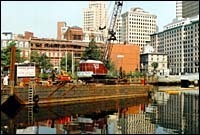
in Providence waits for work.
(PBN file photo)
A new bill introduced late in the legislative session is gaining momentum, and could, if passed, become the foundation for the first statewide dredging plan in nearly three decades.
Addressing in-water and upland disposals, as well as de-watering regulations, possible reuses for dredge material, and the declassification of the dredge itself, many people are calling the legislation, introduced by Rep. Peter Ginaitt, D-Warwick, the most comprehensive solution to the growing problem of silt build up.
Beyond Cash Donations: How New Forms of Giving Are Transforming Not-for-Profit Accounting
Evolving Funding Landscape for Not-for-Profits Not-for-profit organizations are being asked to do more with less,…
Learn More
“Laws put in place 30 years ago that dealt with wet dredge material were good for the time,” Ginaitt said. “It’s a totally different issue today, and we need to address that.”
It’s estimated more than 1.5 million cubic yards of material needs to be dredged from local marinas and the Providence River – and that estimate is almost a decade old.
“The problem is fairly serious,” said Grover Fugate, executive director of the Coastal Resources Management Council. “This is a very important step in terms of us outlining the steps for dredge disposal. Without a plan in place people are wondering what will happen.”
But even if the bill is passed, it could be almost two years before the state and local marina owners see any benefits.
“There are different timetables for everything in the bill,” Fugate said. “Some are specific and others are more open-ended. Until the regulations are developed under this act and those things are in place we are still going to see a trickle of dredging applications. Once those protocols are adopted it will open the process. Right now there is a backlog of maintenance activity.”
Called the Marine Waterways and Boating Facilities Act of 2001, at the heart of the bill is a series of steps aimed at making it easier for marina owners and the state to do maintenance dredging.
“One of the things this bill does is remove the stigma of dredge material being a solid waste,” said J. Michael Keyworth, director of the Rhode Island Marine Trade Association. “With the solid waste title there, there were things that we definitely couldn’t do and this attempts to remove that obstacle.”
According to Ginaitt, the creation of a specific dredge material category instead of solid waste results in a huge cost reduction for those embarking on a dredging project.
“There is a real liability in being a solid waste, and therefore it has to be treated as such,” he said. “That meant bringing the material to Rhode Island Resource Recovery at a cost of about $57 per cubic yard and that was just the beginning. By declassifying the material, the cost goes down substantially.”
The bill also calls for the creation of a de-watering site – or a place where the removed material can be transformed into dry soil. According to Ginaitt, Quonset Point has been named as a possible site because it already has a facility that could handle de-watering, but other areas like East Providence and along the Allen’s Avenue waterfront in Providence have also been discussed.
“Several years ago we didn’t have the opportunity for a de-watering facility, but today we have avenues like Quonset and the Providence/Worcester railroad site in East Providence,” he said. “The idea is to make it into dry soil and then use it for construction projects, beach revitalization, and ball field cover.”
What’s still unclear, Ginaitt said, is who will run the de-watering operation.
“We don’t know yet,” he said of the ownership. “At this point we would be willing to talk to anyone who wants to deal with the material, the state doesn’t want to be in the business of being a vendor of dried dredge material. We are willing to negotiate with anyone.”
What’s also unclear is how marina owners and others doing dredging will get their material to the de-watering site. Currently, many cities and towns in the state have zoning laws that prohibit the transportation of dredge material by truck. Ginaitt said the hope is to transport dredge material by barge.
“We know that we are going to have blockades, but something needs to be done,” he said. “Towns and cities need to be pleased with this process. If we don’t have an avenue to take it out, it will continue to paralyze us.”
Many agree that getting towns and cities to cooperate is only a part of an education process that needs to reach many of Rhode Island’s citizens.
“If this was an activity that was going on on a daily basis then we wouldn’t need the level of education that we are getting into,” Fugate said. “But it’s not, so we do. The public is anxious to hear what the options are and where it will go.”
The legislation itself is the result of a collaboration between legislators, state officials, environmentalists, and business organizations.
“This has been two months of Save The Bay, DEM, CRMC, both the House and Senate, as well as the governor’s office and the marine trades industry, getting to the table and talking about the issue,” Ginaitt said. “Our goal was to get all the players to the table and endorse one plan, and we did that.”
“This is the first time in the 14 years that I have been working on this issue that there has been a consensus of all the interested groups,” Keyworth said. “I see this as an opportunity for Rhode Island to achieve a number of goals when it comes to dealing with dredging and dredge material.”
And while there is consensus among those who participated, Keyworth said some in his organization are waiting to see what happens before endorsing the proposal.
“There is a concern about cost,” he said. “We run businesses and aren’t subsidized by the government, so if it’s affordable there will be consensus.”
Keyworth said he is also unsure that the state can avoid in-water disposal, which is put on the back burner in this bill.
“I don’t think we can escape it,” he said. “I think that if there are enough safeguards built in and there is material that is of the cleanest nature that it should be disposed of in water.”
Ginaitt said the bill doesn’t eliminate in-water disposal, and in fact it is a consideration that will be looked at in the coming years.
“We need to base our decisions on science,” he said. “The concerns of many are valid. We need to find the safest way to go that will have no temporary or permanent impediment on the habitat.”
The bill, which was filed earlier this month was scheduled to be heard last week in the Joint Committee on Environment and Energy. Ginaitt said he is confident that it will pass by the close of the legislative session.
“This bill goes one step further to correct a wrong of not having an updated plan,” he said. “It’s environmentally friendly and I feel very confident that it will be passed.”