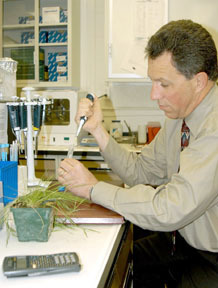
The University of Rhode Island’s partnership with biotechnology research company HybriGene Inc. is the beginning of what officials said they hope is a long and fruitful friendship between URI and biotech companies, one that will bring technology, knowledge, money and jobs to the state.
“The university has an important role to play in the research and development that supports economic development in the state, and biotech is one,” said Jeff R. Seemann, dean and director of the College of the Environment and Life Sciences at URI, who negotiated the partnership. “Universities and particularly URI have the potential for being tremendously strong research and development for biotech companies. We are making an investment at URI.”
HybriGene will work with URI to develop new types of turf grass from its research lab in West Kingston, in the College of the Environment and Life Sciences laboratory building, the most advanced biotech lab at URI with more than $1 million worth of equipment in use. HybriGene uses molecular techniques like gene transfer to create improvements in turf grass species, and is owned by Bill Rose, who also owns Turf-Seed Inc., Pure Seed Testing and Roselawn Seed Inc.
Beyond Cash Donations: How New Forms of Giving Are Transforming Not-for-Profit Accounting
Evolving Funding Landscape for Not-for-Profits Not-for-profit organizations are being asked to do more with less,…
Learn More
“Right away we will have an impact on education at URI, and the company already has,” said Dr. Albert Kausch, vice president and director of research at HybriGene. “And we will bring in new jobs as we grow.”
Although the partnership must still get the official approval from the full Board of Governors on April 21 and the state, Seemann said URI President Robert Carothers has approved the partnership, as has the governor. HybriGene will use lab and office space rent-free and have access to equipment, researchers and students, and in turn, URI will share in the revenues from any resulting products.
“We’re playing catch-up here; universities all over the country have been doing this for years,” Seemann said. “This represents the first I hope of many in terms of the university making a foray into university and industrial partnerships.”
Grass reproduction was an often-tedious process, Seemann said, before the use of gene transfer. Even at URI’s turf farm – the nation’s oldest turf research center – the staff had to manually manipulate the grasses, crossing them and gradually eliminating undesirable gene traits through reproduction. Now the process is much faster, but nonetheless very difficult.
“This is really important to the state; it’s state economic development and work force development in a way that can measure up to Massachusetts” and other states, Seemann said.
Having the established partnership, as well as the governor’s proposed $50-million biotech research and development center at URI will show other companies that the state is serious about investing in biotechnology, he said.
“It makes us attractive to other companies that are concerned with quality of life, our research institutions and of course our trained work force,” Seemann said. “I think this represents our opportunity to continue to grow the research side of the institution here.”
For HybriGene, this partnership means involving URI students in the production process and also increasing the biotech company’s efficiency.
“It’s increased our resources, with the help of the students and using the facility and equipment,” Kausch said. “To build up the program in association with the university makes sense business-wise because the research built up around the company works well here. It’s a tried and true method for increasing the basic research for the company.”
This, and hopefully other partnerships, will also attract students and highly respected researchers and scientists as faculty, the dean added.
“We do need to attract more people with expertise in this area,” Seemann said. “In the next few years, I hope to target some major people in biotech and molecular biotech. We’ll also grow in terms of being appealing to undergrads.
“Why is Harvard so famous,” Seemann said. “It’s the experience students have there” and all of the prize-winning laureates who have gone before them. “As our reputation continues to grow in one particular area, it will continue to grow in all areas.”
Kausch said HybriGene wants to grow with URI. The company currently employs seven full-time employees and 15 interns, but is currently seeking first-round financing and hopes to employ 20 to 60 full-time employees in the next couple of years.
For the complete current issue, visit our subscription Web site, or call (401) 273-2201, ext. 227 or 234.