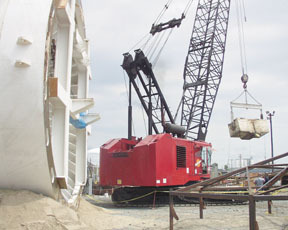
Giant tunneling device focus of
historic sewer project
It’s the largest earthworm ever seen in Rhode Island.
At 225 feet long, roughly 30 feet high and weighing 290 tons, the tunnel boring machine designed for Providence’s combined sewer overflow project is a dirt-eating machine.
Seifert Systems Invests in Energy Efficiency to Strengthen Operations
For manufacturers, energy is more than just another operating expense. It plays a critical role…
Learn More
The $9.3 million steel monster will call the capital city home the next four years, slowly grinding earth to create a tunnel for sewer and storm overflow.
The machine, a fusion of a number of large parts, was designed by Shank/Balfour Beatty – started in Colorado, but now based in Rhode Island – for the $314 million project that will create a 3-mile-long tunnel from Fields Point to the Foundry complex off Promenade Street.
The machine is fitted with a cutter head with 60 rock-cutting wheels; a main body, on which the cutter will be mounted and will accommodate the driver and other workers; a tail and tail shield; and trailing gear, which will transport workers and concrete to the tunnel and chewed-up rock to the surface.
Mike Shank, managing partner of Shank/Balfour Beatty, said the machine will grind up rock and other material four feet at a time – taking anywhere from 15 to 45 minutes. After every four feet it will retract, pushing the 10-inch thick concrete liner pieces into place. Then it will continue on its way, grinding for four more feet, then stopping again.
“It moves like an inchworm,” said Shank. “It pushes ahead four feet and retracts the (shield) jacks” that push it forward.
“That allows us to put the concrete in and move ahead,” he added.
The Shank/Balfour Beatty tunnel contract is worth $165 million.
Rubble will be taken through the inside of the machine on a conveyor belt which will be dumped into muck buckets that travel on tracks to the opening of the vertical shaft at the beginning of the tunnel. A vertical conveyor will then take the materials to the surface.
For a new tunnel boring machine, it has some extensive international roots. The cutter head, the main body and the tail shield are made by Hitachi and come from Japan. The cutters on the cutter head are made by Herrenknecht in Schwanau, Germany and the main bearing is made in Aurora, Ohio by Rotek. The trailing gear, which moves the material out of the tunnel, was custom-built by Shank/Balfour Beatty, and the entire machine was designed by Shank.
“We designed the whole thing, and sent the drawings to Hitachi and asked them to build it,” Shank said. “At first they said no, it exceeded the dimensions of their shop.” But after Shank requested they take another look, the Japanese company said they could do it.
“It was shipped directly from Yokohama to Providence, right to the port,” Shank said. A special heavy-transporting company brought the pieces to the site.
“It took one day to bring it over. We did it in January. The ground had been frozen for one or two months before that and then it rained, turning the ground into muck.” The truck got stuck in the mud, and workers hurried over with rock and other fill to place over the mud. “What should have been a well-thought-out piece of cake we got done at 9 that night.”
Shank/Balfour Beatty is the only contractor in the world that designs and builds its own tunneling machines, according to Shank and the Narragansett Bay Commission.
Right now workers are putting as much of the machine together as possible, without actually putting it together, Shank said. Each piece must be lowered down the 280-foot shaft and into the tunnel, where it will then actually be assembled.
“As we start the assembly, we push (the machine) into the tunnel, and we put more pieces onto the main body – like the jacks that push it forward. The decks and the tail go on last,” Shank said. Once the pieces are lowered, it will take four to six weeks until the machine begins boring a hole. Right now workers are blasting the entrance to the tunnel, which will make room for the machine.
“It will be two shifts a day with the third for maintenance,” Shank said. The third, or graveyard shift, will be reserved for replacing worn cutter rings, doing any necessary welding and other mechanical tasks.
At one time, 10 workers will be stationed in the machine, one mechanic, one operator and others who will be there to help push the concrete liner into place, a process Shank said he pioneered. Others will be working to load the trains that remove the materials, and more work at the shaft opening to put the materials on the vertical conveyor.
The cutter head is powered by 20 hydraulic motors, in turn driven by 12 hydraulic pumps and electrical motors pumping out 3,400 horsepower. The forward motion of the jacks puts pressure on the cutter head, Shank said, adding that he’ll be happy with tunneling 100 feet a day once it begins.
“I’m not sure what we’re going to do,” he said. “Maybe it’s going to be 100 feet a day. The project depends on the strength of the material.” In this case, weaker ground is actually better, Shank said. “The stronger it is, the slower we go.”
He said that once the pieces are lowered into the tunnel, it would take four to six weeks for the machine to be assembled and for it to begin its journey.
Shank/Balfour Beatty migrated to Rhode Island a few years ago with the prospect of work, including the Providence CSO.
Shank said he was also eyeing two other projects, one of which includes the Fall River CSO, for which the company did not win a bid. The tunnel-building company has brought engineers, mechanics and other tunnel workers with it, but has also hired a number of local workers. The problem is, however, that there seems to be a shortage of qualified miners and tunnel workers here.
“We’ve hired some from Massachusetts who have experience working on other projects, but there hasn’t been a tunnel project here for 50 years,” Shank said. Many of those workers from the Bay State had experience on the Big Dig.
So what kind of person signs up for tunnel building on career day?
“We need people who are mechanically inclined, like to build things, and like to learn new things and don’t mind putting in a hard day’s work,” Shank said. Twelve of the local laborers attended a mine-training school in Arizona, where they went underground.
“They want to work underground,” Shank said of the ideal worker. “Some things about this project require some experience, like knowing good materials and knowing which ones could come down on your head; what’s hazardous and what’s not” that only the Massachusetts workers have. “We’re weaving (the locals) into the crew.”
These workers are a somewhat superstitious bunch, as Shank and Ric Cook, a master mechanic for the machine, will admit. No one brags about the machine or the project, and no one favors publicity, recognition or pats on the back until the project is finished.
“We don’t care to talk about the project before it starts,” Shank said, adding his comments were an exception. It’s bad luck of sorts. “No one likes to claim responsibility (for a project) before it’s successful. Success has many fathers, like JFK said.”
Those working inside the machine will be dry, warm and have plenty of light, in comparison to the wet, cold gloom of the tunnel shaft.
“It’s like being in a completed tunnel,” Shank said. It will be warm – quite hot, actually – because of the hydraulic motors and electricity running. “It’s like being in a factory.”
For Cook, a Utah native who has been in the business for 25 years, working in the machine is not something for the faint of heart. Cook will work on the machine, making sure everything runs smoothly and making repairs when necessary.
“I’m so used to it,” Cook said of working underground. The hardest part is “the inconvenience of not having everything you need. You need to make sure you have enough to get you through the day,” and that includes having the right tools in case something needs to be repaired.
“You have to have a bit of a gung-ho attitude; you can’t be scared,” Cook said. “If you’re jumpy, you’ll jump into something. You have to wait until something makes a noise and then find out what made it.”
Once this phase of the CSO project is completed – sometime in 2007 – Shank expects the machine will be dismantled and brought back to the surface. The cutter head will come out at the end of the tunnel, while the main body, trailing gear and tail will be broken down in the tunnel and hoisted up in pieces. Only the outer steel ring of the body will remain, where it will become part of the tunnel lining.
“It depends on the circumstances,” Shank said of the machine’s fate. “On our jobs it seems we frequently leave most of the machine in the tunnel.” Shank/Balfour Beatty just finished an 8-mile-long tunnel in California and took the entire machine out. Shank said he’d lose a couple hundred thousand dollars by leaving the shell in.
“The labor to take it out would be the same as the cost of the thing itself,” he said. The other parts, though rescued, have an uncertain fate. Sometimes they are reincarnated into other machines, but some are scrapped.
“What do you do with it anyway?” Shank asked. “We can bring the cutter head out in one piece but what do you do with it? You can’t load it onto a truck and take it somewhere.”
For now it will sit ready at the wait above ground before it is lowered below – where it will always have a worker caring for it.
For the complete current issue, visit our subscription Web site, or call (401) 273-2201, ext. 227 or 234.