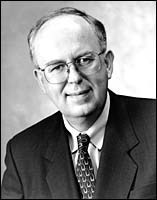
(Photo courtesy of
Excelon Corp)
Name: John Rowe
Position: President and chief executive officer of Exelon Corp. in Chicago,
one of the nation’s five largest electric utilities.
Background: Rowe oversaw Exelon’s merger with PECO Energy, and is a former
head of the New England Electric System, which he guided through the introduction
of competition. He chairs the electric utility industry trade association.
Education: B.S. and J.D. degrees from the University of Wisconsin.
Rowe was in Rhode Island last week to receive an honorary doctor of human letters degree from Bryant College, which he received at the graduate school commencement.
Beyond Cash Donations: How New Forms of Giving Are Transforming Not-for-Profit Accounting
Evolving Funding Landscape for Not-for-Profits Not-for-profit organizations are being asked to do more with less,…
Learn More
PBN: You’re right at the center of what is really a volatile industry.
ROWE: Things in Illinois and Pennsylvania are calm at the moment. The tensions
that are afoot, with the debacle in California and increased tensions in places
like Rhode Island are real ones.
What tensions in Rhode Island?
It’s my understanding in the trade press that because of the high wholesale
markets for power the rate decreases that originally accompanied (Rep. John B.)
Harwood and (former Rep. George D.) Caruolo’s legislation have been reversed,
so costs are rising again. But there was never any guarantee that a wholesale
market would provide lower prices every year. Also, an underlying issue in Rhode
Island and Massachusetts is that while wholesale competition is moving forward,
many of the people who thought they could bring retail competition to the market,
couldn’t.
Why is that?
They all planned to buy power cheaply from utilities that five years ago had
excess capacity. But that capacity has been used up and brokers could not buy
from utilities, or whoever operates them today.
What can we expect in New England?
Expect declining wholesale market prices in New England over the next several
years. You get excess capacity again because the market is working and new plants
are being developed. Natural gas prices will come down again.
Why did natural gas prices spike?
I think the basic answer is prices were so low by historic standards there
was no economic incentive to build new pipelines and less economic incentive to
drill. Much of the natural gas situation was rising demand, as more and more was
used in generation with some increases in residential uses at prices that were
so low it wasn’t economic to add capacity. As prices spiked enough, it was enough
to add capacity. Natural gas prices were very very low through the ’90s. While
$10 is a huge spike, maybe $4 is a more normal price than $2.50.
There are some people who suggest that in California one of the problems is that people have generally said they prefer rolling blackouts to higher prices.
That’s a bluff. Generally one finds that people value reliability even more
than low cost. Obvious the combination of the rolling blackouts in California
and a 40 percent price spike have people furious. California is a debacle. Rolling
back that price increase makes no sense.
A whole bunch of things went wrong in California. There are not enough plants. There’s a shortage of water in the Northwest. They designed the market in the wrong way. You really have a situation where all the other problems were compounded because the utilities have been on the edge of bankruptcy, so people who rely on utilities don’t know when they will get paid.
Can they get out of the mess in California?
Yes, it can take a couple of years. They are now moving in the right direction.
Because they have so many problems, they have done too little too late. They are
doing some things right — the retail price increase, an expedited licensing process
(for new plants). They are working more on total usage measures. They are trying
to help encourage the installation of new gas pipelines. Yes, they are moving
in the right direction, with one exception. I think having the state become the
power broker between the generator and the customers has probably cost them, rather
than keeping the utilities solvent to do it themselves.
I’ve heard from some experts that New York City can expect blackouts this summer?
I’ve heard that too. The Con Ed (Con Edison) people say that is not a great
risk.
Are there threats of problems in other areas of the country?
Some of the areas in the south and southeast are tight this year. We have
fundamentally said the market is responsible for providing generation. If you
have an area where it is too difficult to build there could be problems. New England
is a little tight this year, but will loosen out next year.
How does it look for the future in New England?
I think New England has large enough margins and they are getting larger.
In Illinois and Pennsylvania, we look like we’re in better shape this year than
in the last three years. But as a utility we need to make certain the new plants
continue. No state has a guarantee that you can’t face some of the California
issues.
In New England competition statutes are working in wholesale market. When you transfer that to retail, I think you’ll see lower wholesale prices.
It used to be that energy was considered a real deterrent to business growth in New England. Are we still at a large price disadvantage with much of the nation?
Not as bad in price as it was. The cost disadvantage in New England is smaller
than it was five years ago. Supply is greater. There’s still some very low cost
states. New England has certainly come closer to the pack. New England’s modern
prosperity is based on service industry, which is based on electricity. A lot
of the new industry is much more reliability driven than price driven.
What about alternative energy sources?
What really gave us all a break was that natural gas was cheap so long in
the 90’s and the new gas combined cycle technologies like Manchester Street Station
in Providence burn very efficiently. You have the chance to make power both cleaner
and cheaper in prior technologies. Renewables have made only a modest impact.
Wind being the one that is most successful at the moment. Compared to gas, renewables
have made only a very small dent in the market.
How big a player is nuclear power?
In most areas it is huge. Their value is much greater today than it was three
years ago, because in large part we are operating them infinitely better. You
make a lot more money in a nuclear plant. In 1997 the Maine Yankee nuclear plant
was shut down because it didn’t appear economic to operate. Now it would have
a long life ahead.
What can we expect from the current administration in terms of energy policy?
It’s clear that Bush and Cheney want to push all forms of supply — coal,
gas, nuclear, particularly gas and renewables. They also want to come up with
a program that says we can have this supply and a cleaner environment too. We
haven’t had a chance to see how all the pieces come together. Cheney has made
it clear the Bush administration wants more supply and cleaner supplies.
More and cleaner supplies usually translate to higher prices.
I think so, but I would say that modestly. We had a 10-year period when the
wholesale market dropped every year. We had a spike this year. I think we’ll see
electricity prices higher than they were three years ago, but generally not as
high as they are now. That’s sort of my reading of the tealeaves. The long-term
downward trend is probably over, but you wouldn’t want to draw assume a higher
trend either.
Looking forward what do you see as the greatest potential development ahead in your industry?
The greatest development in the last decade was the gas combined cycle machine.
In the next few years, I think we’ll see new advances in energy efficiencies,
such as the Pebble Bed modular reactor, which we are developing. It is a much
smaller nuclear plant that’s designed to be standardized, a more passive safety
apparatus, so it is easier to operate. It’s still on paper.
The global warming threat has enough reality to it. We will continue to see moderate decreases in the use of coal. Most near term we’ll see additions will be gas fired. In some point in next decade we will see renewed legitimacy of new nuclear plants, only as part of power supply and environmental protection package.