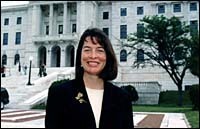
commission chairperson.
(Tom Croke)
There is a child in Providence in pain today.
He is suffering from severe tooth decay and he needs to have two teeth extracted. His appointment to have the procedure is scheduled for some time in August.
Seifert Systems Invests in Energy Efficiency to Strengthen Operations
For manufacturers, energy is more than just another operating expense. It plays a critical role…
Learn More
Perhaps the saddest thing is that he is not alone. There are other little boys and little girls and their teeth and their mouths are hurting so badly they probably are not paying a whole lot of attention in school.
How could they?
A special legislative commission that has spent a year looking into access to dental care has uncovered some disturbing findings – representing tangible evidence that when our health care and insurance industries collide, people get hurt.
The commission has found that children from Rhode Island’s poorer families are demonstrating less dental care, and as a result are sometimes living in pain because a necessary procedure has been either put off – or not scheduled.
The news is no better for adults.
For example, only 38 percent of people of all ages on Medicaid in Rhode Island have received dental care within the last year, according to a special Senate Commission on Access to Oral Health, headed by Sen. Elizabeth Roberts (D-Cranston).
Roberts formed the commission after hearing the story of a constituent’s granddaughter who needed dental surgery.
The five-year-old was insured through the state’s Medicaid Managed Care program, RIte Care, said Roberts, and was suffering from tooth decay.
“It was very difficult for the child to get treatment,” said Roberts.
The little girl’s experience left Roberts frustrated. So she formed a 19-member commission.
Members of the commission included Elizabeth Burke Bryant, executive director of Rhode Island Kids Count, a child policy organization, and Beth Kalunian, a social worker in Providence.
Kids Count had issued a report in January showing that poor children endure pain and unnecessary illness because their teeth and gums are not cared for on a regular basis. That report pointed out that a recently released report from the U.S. Surgeon General on oral health calls the problem of dental disease a “silent epidemic in America.”
According to Kids Count, one in three preschoolers who have family incomes below $10,000 have untreated tooth decay compared with one in ten preschoolers who have a family income above $35,000.
The report also points out that low-income families entitled to dental care through special programs are often more likely than others to have difficulty making and keeping appointments due to a lack of access to transportation, language barriers, and child care problems.
“We’re trying to focus on the children with the least access to dental care in Rhode Island – that’s the children on Medicaid,” said Burke Bryant.
Kalunian recently worked with a student suffering with two “extremely decayed teeth.”
“This young child is in pain and there is concern for infection,” she said. “Clinics turned him away because he was a RIte Care patient. The child must wait an additional three months to have the teeth extracted, in August.”
Roberts said the problem is not that dentists do not want to help, it’s that they can’t always afford to under reimbursement rules now in place.
Medicaid, said Roberts, is paying 40 percent below what commercial insurers pay.
“Dentists want to help, but they can’t always afford it,” she said.
Compounding the problem, said Roberts, is the fact that the number of dentists retiring is outpacing those entering the field.
“Dentists don’t need more business,” she said.
In Rhode Island, as of the end of 2000, there were 70,000 children under age 19 enrolled in RIte Care. An additional 11,268 children were enrolled in Medicaid fee-for-service – primarily, children in the care of DCYF, children receiving SSI, and children with disabilities who do not qualify for SSI.
All children enrolled in RIte Care and Medicaid fee-for-service are entitled to comprehensive dental prevention and treatment. But that doesn’t mean that care is necessarily available.
There are about 630 dentists in Rhode Island. A 1997 survey of dentists in Rhode Island found that 15 percent served clients with public insurance through Medicaid. And while many dentists in the state do not accept such public assistance for payment and/or limit the number of such clients they will treat, private dental practices continue to be the largest provider of dental service to the Medicaid population.
In the state’s fiscal year 2000, private dental practices accounted for 77 percent of all Medicaid dental expenditures for children up to age 21.
Kathryn Shanley, vice president of external affairs at Delta Dental of Rhode Island, was also a member of the commission. Delta Dental of Rhode Island is the state’s largest dental insurers, with approximately 500,000 members.
Shanley said Delta Dental is willing to help with educational outreach programs, for example, spreading the word that allowing babies to bring bottles into their cribs is a major cause of tooth decay.
But so many issues, said Shanley, must be addressed at a federal level.
“Medicaid reimbursement has not been adjusted in a long time,” she said. “There are no easy answers. You have to start with the reimbursement. But it’s not a magic bullet. We have to look at other ways for people to have access to care.”
Shanley applauded programs like Providence Smiles and Pawtucket Smiles that go directly into classrooms. In fact, Delta Dental had a successful program this past school year called “Teeth-on-the-Go,” a traveling book bag program featuring a five-day oral health lesson plan for teachers.
“These are things that can be done, to get started,” said Shanley.
Members of the legislative commission hope that its report is just that – a start.
Among the findings of the commission:
- Fewer than 75 percent of adults (18-64) receive dental care annually and less than two-thirds receive annual check ups.
- Children on Medicaid experience twice the rate of untreated dental disease that higher income children experience. About 30 percent of children insured through RIte Care have access to a dentist in a year, compared to 60 percent for commercially insured children.
Among the recommendations:
- Increase the rates of Medicaid reimbursement for dental providers both to increase access to community dentists and to sustain the hospital based clinics that provide a large amount of care for low-income children.
- Request that the state Department of Health prepare a plan to promote the fluoridation of community water systems in Rhode Island that are currently untreated with fluoride.
- Seek increased funding at the state and federal levels for dental professional practice incentives including tuition assistance and including loan repayment.
- Study the feasibility of establishing a pediatric and general practice dental residency program.
- Develop a public education effort aimed at eradicating baby bottle tooth decay.
Clinics at capacity
Roberts realizes the commission is asking for a lot — asking for substantive changes to a system that does not easily change.
“Our goal is to promote accessibility and to insure that children and adults do not go untreated, but receive the treatment and care they deserve,” she said. “There are just more and more people that need care.”
Burke Bryant reviews statistics and concludes that there is no time to waste. The public facilities – like those at St. Joseph Hospital or several community centers throughout the state – are already overloaded.
“The dental clinics are full to capacity,” she said. There are more people coming to them than they can possibly see. It’s a problem that is going to get worse.”
It’s the numbers that have Burke Bryant so troubled. She points out that in Rhode Island, 80 percent of cavities are found in 20 percent of the children. And those are the children with so little access to dental care.
Like the boy in Providence waiting in pain for that August appointment.