Ten years ago, most social media marketing education focused intensely on controlling a brand’s messaging.
Today, it’s been reimagined to prepare students for “a creator economy,” says Sharmin Attaran, a professor and director of the digital marketing program at Bryant University.
“Social media is not just about posting content anymore,” she noted. “We’re looking at strategy. We’re looking at data. We’re looking at psychology and technology.”
Throughout the U.S. and Rhode Island, more colleges and universities are putting stronger emphasis on social media marketing coursework in general, sometimes with social-specific degree programs or certifications.
At Bryant, for instance, Attaran teaches a 10-week digital and social media marketing course, and the department strongly integrates social media into a digital communication degree that launched in 2022.
In 2018, Johnson & Wales University established a Bachelor of Science degree program in digital marketing and social media. The University of Rhode Island, meanwhile, began offering a social media graduate certificate in 2023.
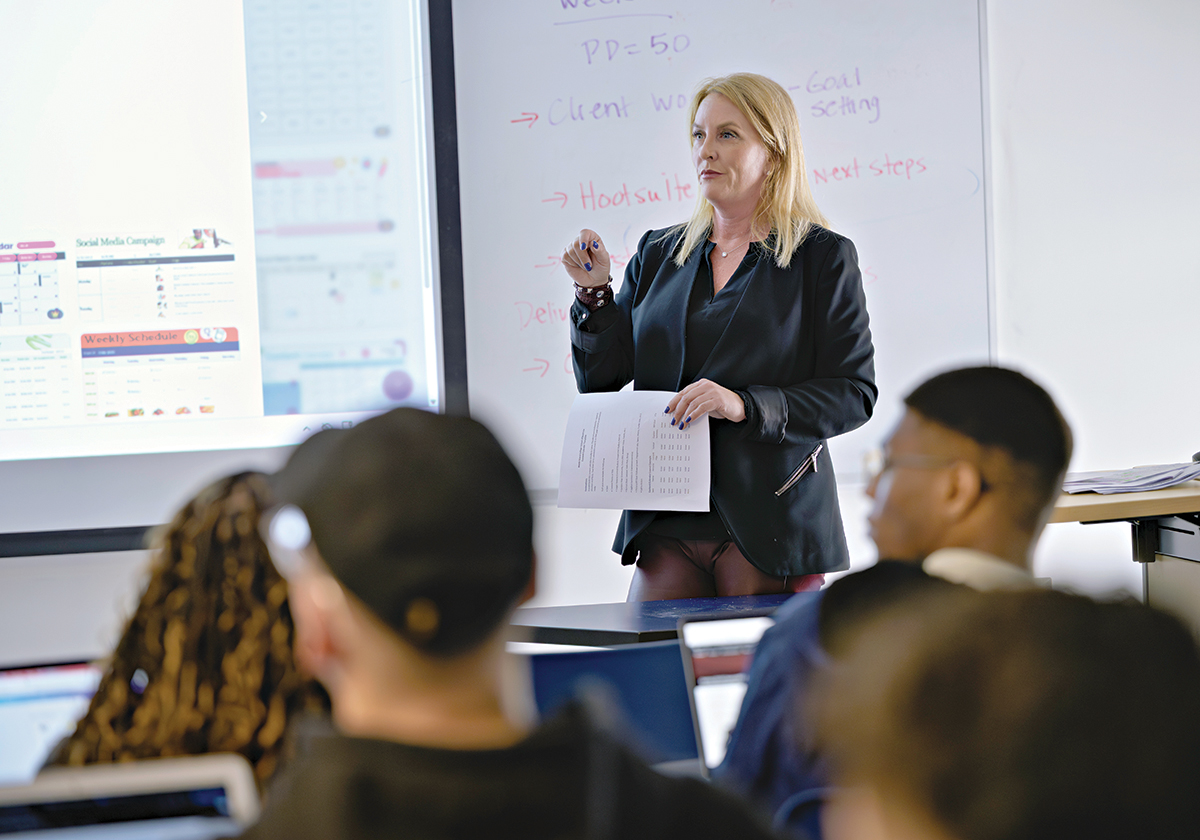
Regardless of whether a university offers social media-specific degree programs or certifications, marketing coursework involves a growing focus on social media across the board, said Kristen Regine, a professor of marketing at Rhode Island College.
In addition to instructing students on social media marketing at RIC, Regine previously taught courses under JWU’s social media degree program.
“A lot of colleges have adapted,” Regine said. “They’re adding more data courses under their marketing courses, so you’ll see changes to data analytics and marketing analytics,” with a focus on software such as Salesforce, Hootsuite and Sprout Social, as well as general dashboard management.
Regine and Attaran both make heavy use of hands-on work in their courses, the educators say, including work with real-world clients and their projects. At Bryant, Attaran said, students make extensive use of a lab developed specifically for the digital marketing degree programming, which includes technology such as a digital display wall, augmented reality and virtual reality headsets, professional-level content creation equipment and Adobe Creative Suite software.
Artificial intelligence has also reshaped the industry since large language models such as ChatGPT exploded in popularity in late 2022.
“We don’t think AI is replacing marketers as a whole,” Attaran said. “It’s replacing marketers who don’t know how to use AI.”
Mastering AI means not just using the technology to maximize efficiency, Attaran said, though it’s an essential skill for marketing students. But especially as audiences become more wary of AI-generated content, students must learn to generate content in a way that’s ethical.
In addition to staying on top of technology, students need to stay on top of behavioral trends. With the rise of influencer culture, marketers are directing more focus toward fostering consumer trust around personalities, Attaran said, not just brands.
“Influencers are completely driving purchasing decisions,” Attaran said.
“Hype from the company is obviously biased, but buzz coming from users. It’s like a friend telling you to buy something,” she said, with users seeing influencers they follow as more trustworthy and credible.
If the goal is for these interactions to feel organic and personal, the reality, of course, is far more crafted.
“Influencer culture has been more professionalized,” Attaran said. “There are now so many agencies that work with influencers, so they become kind of middlemen between the brand and the influencer.
“It’s no longer this casual, ‘Hey, if I send you this, will you post about it?” conversation, she added. “Now [agencies] are tracking analytics closely. It’s more formalized.”
And with many influencers using short-form video content to generate engagement, educators are also emphasizing video editing skills in marketing coursework.
“They say content is king,” Regine said, “but beyond that, you have to have the right content. And that content right now is video.”
In addition to shooting and editing skills, students must also learn to understand what type of video content will click with their audiences. That could be a three-second clip, Regine said, or it might run for a minute.
Like Attaran, Regine also emphasized the ability to connect with audiences on a human level.
“The skill [students] have to have now is being a digital storyteller,” Regine said.
While the digital landscape and its trends evolve rapidly, Attaran said, many of the concepts behind a social media education are evergreen.
“It changes so quickly,” Attaran said, “but we’re not [just] teaching the platforms. We’re teaching the principles and the frameworks, the concepts of human psychology and persuasion.”
These concepts also extend beyond marketing-specific careers, Regine said.
“You don’t need to be a marketing student to take a social media class,” she added. “Social media is a class that I think all business students should take,” even if they’re just using it for personal marketing on their LinkedIn profiles.
“You always have to market yourself,” Regine said, “even if you’re not a marketing professional.”