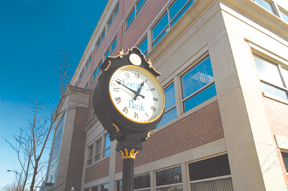
New Bedford
S.E. Mass. officials concerned about job cuts, philanthropy
Sovereign Bancorp’s $1.1 billion deal for Compass Bank parent, Seacoast Financial
Services Corp., will give the Philadelphia-based bank a foothold in the high-growth
area of southeastern Massachusetts – a banking market caught in a whirlwind
of change.
Seifert Systems Invests in Energy Efficiency to Strengthen Operations
For manufacturers, energy is more than just another operating expense. It plays a critical role…
Learn More
With the recently announced acquisition, the region loses its largest local bank, as well as a major employer with a track record of strong philanthropy and corporate leadership. The acquisition comes three months after the news that Webster Financial Corp., based in Waterbury, Conn., plans to buy FirstFed America Bancorp Inc., of Swansea, southeastern Mass-achusetts’ second biggest local bank.
Sovereign officials said some of the 750 Compass employees will lose their jobs and branches could be closed as the bank merges the operations.
“It’s a concern to a lot of people,” said Robert J. Luongo, executive director of the New Bedford Economic Development Council. “The loss of jobs will be a big issue and we don’t know exactly what Sovereign has in mind in terms of its downtown (New Bedford) location.”
The all-stock purchase by Sovereign, which has had a New England presence since 1999, came as many in the banking community anticipated that Sovereign would be on the other end of an acquisition. It also came as Compass was in growth mode: completing an acquisition of Bay State Bancorp Inc. in June and now closing a deal with Abington Bancorp Inc., which is expected to be completed this April.
“I woke up in New Bedford in the unique position of being a (bank) seller other than a buyer,” said Seacoast Chairman and CEO Kevin G. Champagne. When the deal is completed, Champagne will become a member of Sovereign’s board of directors.
Seacoast will have $5.3 billion in assets upon approval of the Abington acquisition, which is expected well before the closing of the Sovereign deal in about August.
In all, Sovereign will gain 67 branches in the transaction, including the three branches of Nantucket Bank owned by Seacoast.
“If you looked at our geographic footprint in Massachusetts before today, this is the one area where we should build our presence,” said Jay S. Sidhu, Sovereign’s chairman and CEO.
The acquisition will give Seacoast shareholders a 1.461 to 1 exchange ratio in the all-stock deal. That’s a premium 3.3 times the tangible book value and 20.6 times Seacoast’s expected earnings in 2004.
According to analyst Jim Ackor with the New York City-based RBC Capital Markets, the $1.1 billion price tag may look pricey but makes sense given the market conditions in the Bay State.
Sovereign will gain access to new and contiguous markets, particularly on Cape Cod. In addition, Seacoast is the largest-remaining financial institution based in Massachusetts, a title it gained after the acquisition of FleetBoston Financial by Bank of America.
“Acquisitions are largely a game of availability,” said Ackor. “If you look at Massachusetts, there is a short list of sizable banks headquartered there.”
Bill McCrystal, an analyst with McConnell, Budd, Romano in Morristown, N.J., said the deal comes at an active time in the acquisition market.
“Champagne has done well to take advantage of a very active market and got a premium price for Seacoast shareholders,” he said.
Sovereign said it expects to save 35 percent of the cost of running Seacoast through synergy and back-office consolidation.
John Hamill, president and CEO of Sovereign’s New England division, said there would be layoffs at the Seacoast organization, mostly in areas where redundancy exists, including duplication of branches. He added that due diligence has already occurred.
Hamill did not say how many jobs would be lost. Sovereign spokesman Carl Brown said it is uncertain what will happen to a Seacoast call center located in New Bedford.
Sovereign will move into Seacoast’s corporate headquarters across the street, leaving its current building to the real estate marketplace of downtown New Bedford.
“Downtown has gone through a transformation in the last five years,” Hamill said. “We know there is interest in the site and it is our intent to explore in finding a new tenant.”
Champagne said the size of Sovereign could mean those left unemployed could see new positions available.
“Sovereign offers a considerably larger number of products and services,” Champagne said. “There is significant opportunity.”
Corinn Williams, executive director of the Community Economic Development Center of Southeastern Massachusetts, said the acquisition means she loses a connection with a bank and possibly its contributions under the Community Re-investment Act.
“This could reduce the funds available that go back into the community,” she said. “The acquisition needs to be monitored by the banking committee in Boston.”
Hamill did say Sovereign expects to keep the re-investment allocation status quo.
The charitable contributions given by Seacoast – approximately $450,000 a year – will remain for the next five years.
Sidhu said in a conference call that he expects merging the two banks should be relatively easy. He said Seacoast is an institution run on fundamentals and has many of the same technological systems in place.
He also said Sovereign would retain Compass’ auto-lending program, which has been seen as one of Seacoast’ strengths.
Laurie Hunsicker, senior analyst at FBR Ramsey & Co. Inc. in Arlington, Va., said the acquisition puts Sovereign where they want to be.
“This transaction is a really good strategic fit,” she said. “It creates a leading share in many important markets in southeastern Massachusetts.”
That’s a message touted by Sidhu as well. He said acquiring Seacoast will give Sovereign a top four market share in each of the five fastest-growing and largest counties in Massachusetts.