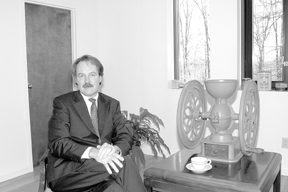
fourth-generation owner of the Lincoln company.
Lincoln’s Autocrat sees marked three-year growth
Richard M. Field Jr.
Seifert Systems Invests in Energy Efficiency to Strengthen Operations
For manufacturers, energy is more than just another operating expense. It plays a critical role…
Learn More
Position: Chairman and president of Autocrat Inc., a manufacturer
of coffee and coffee extracts in Lincoln.
Background: Fourth-generation owner of the company, became president
in 1991. Changed Autocrat’s direction in 1980 to focus on food service and then
again in 1993 to focus on coffee flavorings. Field has served on numerous boards
for private and civic organizations and is a founding member and vice president
of the Self-Insured Manufacturers Association.
Education: Bachelor’s degree in marketing from the University of Rhode
Island
Age: 53
Residence: Barrington
Founded in 1895, Autocrat has undergone significant growth in the past three years, raising its work force by one-third and expanding its operations last year into a new 3.3-acre distribution center in Woonsocket’s Highland Industrial Park.
Perhaps best known locally as suppliers of the syrup essential to the official state drink of Rhode Island, coffee milk, Autocrat is the nation’s leader of coffee extracts for iced cappuccinos, ice cream and other products. Now overseeing 150 employees, coffee roaster and extractor Field is continuing to seek out growth opportunities for the company. In recent years, Autocrat has experienced a 20 percent growth per year in what is otherwise a relatively flat industry.
Q. Around here, many people think of Autocrat as only coffee milk. But the company had some problems getting the concept of cold coffee into the wider marketplace.
A. We actually did try to market coffee milk on numerous occasions outside this market, to no avail for a variety of reasons. It was sort of a challenge for us, wondering, ‘How can we get this product, we know is loved, outside this area?’ We sell enough syrup, just in Rhode Island, to make about 20 million servings of coffee milk alone. So if you can sell 20 million in Rhode Island with a population of a million, how many can you sell to a population of 260 million, or even beyond that? … But it was never really embraced on its own. What came up in the early ’90s was to sell cold drinks beyond coffee milk. With the influx of the fancy coffees and gourmet coffee shops like Starbucks, people were buying into cold coffee beverages and all of a sudden, everyone wants iced cappuccinos. … Now our No. 1 strategic goal is to become the leader in coffee flavorings and coffee extracts, not only in the United States, but also throughout the world.
Q. What other divisions is the company divided into?
A. Our retail division is where we’re most known on the local basis – that’s both Autocrat and Eclipse syrups, canned coffee and we’re also marketing our gourmet coffee line, which is called Newport Coffee Traders. We now have a food service division and sell to about 1,500 restaurants in the southern New England market that vary from white tablecloth to local hamburger places. That division is really where the main growth of the company was in the late ’70s and the ’80s. We have also what we call a distributor division, which is mostly private label, but not all. We specifically target that division to go after custom accounts. While I can’t mention the names we package for, for confidentiality reasons, we do a lot of roasting for custom, high-end, gourmet companies with both organic coffees or products from specific countries. The volume on those products has increased dramatically. … And then the final division is what we call food ingredients, and that has really been the main growth and our No. 1 strategic focus. And that’s really where the majority of growth has come within the company recently. We were already doing the coffee flavoring, and we saw the opportunities that cold coffee was coming along.
Q. Now that you’ve broken into the cold coffee craze, what might be the next big line of products?
A. Another growth market that has potential is referred to as LCC, or liquid coffee concentrate. It’s a market that is developing much like hot chocolate or soda fountains, where you take a liquid coffee concentrate and mix it with water and end up with a final cup of coffee. You eliminate the fact that you have to brew the coffee and have the grounds and have the mess. And one gallon of the liquid concentrate will make 30 gallons of the final product. … It’s great for large-demand audiences, where you’ve got to serve 1,000 – or 3,000 or 5,000 – cups of coffee in a very short period of time and where the coffee brewers otherwise couldn’t keep up. And there’s no mess. Hospitality and self-serve industries are interested in the concept.
Q. Does the extract Autocrat produces differ from product to product? How much refining of your recipes do you still have to do?
A. It varies widely. Our target accounts are dairies, most times the extract is mixed with milk for ice cream. The extract we produce varies dramatically from something like an iced cappuccino to a frozen yogurt or a low-fat ice cream or a regular, higher-fat ice cream. So depending on what it’s going into, it varies quite a bit. Flavor profiles, what kind of coffee you’re dealing with, how you’re extracting the flavor, it varies to the point where the volumes we’re getting into, we invested in and just installed a $3.5 million extracting facility that was custom-made for us by a European company.
Q. Do you get into problems dealing in efficiencies of that production?
A. We have about 250 different formulas at this point in time. Some
of them are very close and some of them may vary in the final product but not
in the extracts, maybe from adding different amounts or different types of sugars
– whether it be burnt sugars or chocolate-flavored sugars. But we’ve got the
formulas down pretty pat.
Q. How do you sell these extracts? Do you rely heavily on conventions?
A. In the dairy industry, there’s really one main convention, called the International Institute of Food Technologists. And the IFT show, where all the dairy companies go, is also where all the flavoring companies go. … We also market at some international and local food shows and all of our advertising and promotional work are in dairy magazines, like Dairy Foods and Dairy Fields. So it’s targeted to those specific audiences. What’s a little different in sales is that many of our targets are not necessarily purchasing it, so much as they’re using it for R&D – where they’re developing products and requesting a certain flavor profile. And it’s not just dairies, we work with liquor companies, candy companies, cereal and candy bars, a pretty wide range.
Q. Are there any big coffee flavoring competitors out there?
A. We started intensely going after the coffee extract business about four years ago. And our goal, within three years, was to become known as the leading supplier of coffee extract in the country. And at this point in time, if you were in the dairy business, you would know Autocrat as your coffee-flavoring expert. There are many flavoring companies out there, however, most of them carry, literally, thousands of flavors. As far as I know, we are the only coffee company that makes only coffee extracts.
Q. Where does Autocrat’s beans actually come from?
A. Many sources from around the world. All coffees come from between the two tropics, coffee trees can’t take any frost whatsoever. It’s not like an orange tree or some grapes that can take a little bit of frost. … I’m particularly fond of some Costa Rican coffees, we do quite a bit of business with Colombia, from the Popayan region and we do a lot with the higher-end Brazil coffees. Now, outside of that, there are a variety of lower-ends. We do some business with Tanzania on a smaller line, Kenya, some from Mexico … I used to actually spend more time in the coffee-growing regions, but frankly, what’s amazing about the coffee business is that it’s such a close-knit business and there’s those instances of where everybody knows everybody. Once the contacts have been made, and especially with the Internet and cell phones, communication is so much easier today with Central and South America, the real need to go down there is not what it used to be. … Most everything is verbal.
Q. You still perform daily cupping (taste testing) at Autocrat. What exactly are you looking for?
A. In a pre-shipment sample, I want to make sure it meets our standards for taste profile, size, body, acidity, flavor, aroma. After that, you accept that coffee and give the approval for the export or the import of that coffee. When I taste it a second time, I’m just making sure it compares to the first. At that point since we’ve already proven the coffee is fine, we’re just looking for defects. And while that can sound pretty bad, a defect can be a variety of things, it’s not necessarily a taste. It could be that the coffee was in a bag on a freighter and got wet and therefore have a funny taste to the profile. So you’re making sure that you’re not getting any defects coming through. Some people don’t realize one tree produces about 1,000 beans or cherries. And it takes about 1,000 cherries to make one pound of coffee. So every time you buy a pound of coffee, you’ve essentially bought the production from one tree somewhere in the world. …
Q. Did you ever consider moving any piece of the business out of state?
A. When we were looking to put up a distribution center, we did look all around a variety of different areas to where that might go. And frankly for tax purposes and for other reasons we asked, ‘Might we want to move out of state?’ And then Woonsocket actually opened their arms to us and we’re grateful and we’re happy to be in Woonsocket.