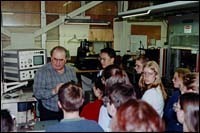
students is Phil D'Ercole, facilities
manager.
The month-long unit on seals was probably what gave it away.
When Christine Long, human resources manager at PerkinElmer in Warwick, asked a group of South Kingstown students at the company for a tour if any of them had any ideas about what the company did, they knew right away.
Beyond Cash Donations: How New Forms of Giving Are Transforming Not-for-Profit Accounting
Evolving Funding Landscape for Not-for-Profits Not-for-profit organizations are being asked to do more with less,…
Learn More
“Do you make seals?” called out one.
“Yes, we do,” said Long, clearly impressed.
A group of 20 middle school students visited the plant as part of the SMILE Program (Science and Mathematics Investigative Learning Experiences), an after school program with the goal of exposing students to careers in science and mathematics.
The program was introduced to the state in 1994 by its director, Carol Englander, who is also a seventh grade science teacher at South Kingstown Junior High School.
“I went to Oregon on a sabbatical and got introduced to the program and got involved with them there,” she said. “I got to see a whole year’s cycle there. I knew that if it could be done in a state that is so much bigger than Rhode Island, it could definitely be done here.”
West Kingston-based American Power Conversion (APC) was the first SMILE sponsor.
“Rodger Dowdell was very supportive of the SMILE program and said, ‘Let’s just do it,'” Englander said. “It doesn’t hurt to have the world headquarters of a business in your backyard.”
SMILE has toured APC as well as the facility of another longtime supporter, Toray Plastics, with students and teachers several times over the years.
“They’re very gracious,” Englander said. “They realize that our kids are their future workforce.”
It is the business-education partnership that is at the heart of the SMILE Program.
Tours such as the one of PerkinElmer enable “students to see where some of the academic work that they are studying is applied,” said Englander. “Some of them had heard about titanium – it’s on the periodic table – but they had never held it. It’s enough to make them realize that this would be something interesting or cool to work in. If you don’t have a parent who does that, you have no idea what it’s like.”
According to PerkinElmer’s Long, it’s a two-way street – the program’s benefits extend to more than just the students.
“Our future as a business is very much linked to what students are doing now,” she said. “They’re our future employees. We need these kids to stay in school. We need them to get a degree. This is where that linkage occurs.”
Prior to the SMILE students’ visit to PerkinElmer, students spent four weeks studying seals at their weekly meetings. They began by looking at everyday examples, like coffee cup lids and shampoo bottles. The club even attempted its own version of a seal.
A seal for an insulin pump, a brush seal for a power generator and a featherweight titanium seal for a rocket were just a few of the examples of PerkinElmer’s seals the group saw on their tour. They learned that — despite the deceptively simple appearance of some of the seals the company produces — it can take as long as six hours to produce a single seal, which can cost anywhere from $300 to $12,000, depending on the seal type.
“Don’t underestimate the work it takes to make that,” said Phil D’Ercole, facilities manager at PerkinElmer, and tour guide for the afternoon. “It takes a lot of skill, it takes a lot of time, and as you can see, there’s a lot of scrap.”
Currently, there are eight SMILE clubs in three school districts: South Kingstown, West Warwick and Woonsocket. The program serves fourth through twelfth graders. Members must maintain a “C” average to remain in the club, which Englander calls “purely academic. All the kids are doing well in school.”
All seniors who have participated in the program have graduated from high school; 85 percent go on to college, many with scholarships.
Englander estimated the cost of running a club is $14,000 per club per year, because of the travel involved, and the cost of special annual events such as the organization’s Challenge Weekend, held each spring on the University of Rhode Island campus.
Long said her company found out about the program through the Chamber Education Foundation in Warwick, with which PerkinElmer has been associated for nine years.
“As a business, it is important to support the local education community,” Long said. “The future of the company depends upon many factors, including the availability of workers in our area. SMILE has helped to establish an understanding between the local school systems and the business community. We’ve learned a lot, and I think the teachers have learned a lot. We use what they produce, and they need to produce students with the skills that we need.”
“After the tour at PerkinElmer, one of our kids asked the question, ‘How do you get a lot of brushes to create a seal?’ What a great thing for a 12-year-old to ask,” Englander said.