to reinvent itself due to a changed industry.
Manufacturers shift product focus
Concordia Manufacturing has a history in Rhode Island – the company started
here in 1920 as a synthetic yarns and fibers manufacturer. But history couldn’t
save CEO and President Randall Spencer from having to make a decision: conform
to an increasingly global marketplace and leave, or carve out a local niche.
Seifert Systems Invests in Energy Efficiency to Strengthen Operations
For manufacturers, energy is more than just another operating expense. It plays a critical role…
Learn More
Until the late 1970s to early 1980s, the majority of Coventry-based Concordia’s business came from a contract with Velcro. When production expenses rose, Velcro’s business declined, forcing the manufacturer to re-focus a few times until it found a niche.
Now it is a specialty manufacturer producing synthetic materials for companies like C.R. Bard/Davol, Genzyme, Edwards Life Sciences, Acromed and Velcro Industries.
“Concordia has had to re-invent itself a couple of times,” Spencer said. “We’re constantly trying to look outside the box.”
It’s difficult and costly to be a manufacturer in Rhode Island; many companies decide they can’t compete with China or Mexico and move operations overseas. Others, however, decide to stay, and expand into emerging markets like the biomedical and biotechnology industries in Rhode Island.
“It’s hard to see the demise of manufacturing in this country and I believe we’re going to pay the piper at the end of the day,” said Steve Fielding, president of Fielding Manufacturing in Central Falls. “When manufacturing is gone, what next? What will we do in this country 10 years from now?”
Fielding Manufacturing started its transition into more specialized production of zinc dye-cast and injection molding about nine months ago, Fielding said.
“We’re really trying to re-focus around the niche of small component parts manufacturing,” he said. “Since 1968 we’ve done plastic molding and we’re trying to transition to small manufactured component parts now” with plastic and zinc. “We’re not creating a new business; we’re sticking to mold-making and precision parts manufacturing. We’re just making it more of a focus.”
Fielding said his company is focusing on the electrical and medical industries. Concordia – which had dabbled in specialty and unique manufacturing for years – now makes fibers and synthetic yarns for power transmission belts, home-furnishing trims, filtration fabrics and filaments for medical uses. Spencer decided to transition to biomedical and technology applications in 1999-2000.
“We were somewhat oriented in this type of shift,” he said. “We had a reputation for doing unique work and that’s what got us into biomed.”
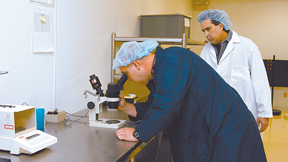
Concordia got the attention of Cranston-based Davol through a referral from Italian manufacturer Ratti, which was working with Concordia at the time. Davol, a manufacturer of medical products, was looking for a company to make a special filament for medical purposes, and Concordia got the job.
“We had been asked to develop yarns for other companies in small volumes, but (with Davol) we had to design and build the equipment to make it happen,” Spencer said. “Because we had done it in the past, we were able to do it quickly.”
Moving overseas was never an option for Concordia or Fielding, both owners said. Most of the manufacturers that remain in Rhode Island are small- and medium-size companies.
Making a transition from Velcro to synthetic tissue was one that Spencer thought about in-depth; the Rhode Island Economic Development Corporation and the Slater Center for Biomedical Technology have helped.
Despite having the resources available to make the transition, being a manufacturer is difficult, Spencer and Fielding said.
“There were days when we felt we were trying to force a square peg into a round hole,” Spencer said. “It’s very frustrating and I don’t know if we would be able to do what we did without the EDC and Slater.”
“The cost of doing business – and it’s not just in Rhode Island – is very high,” Fielding said.
Fielding said the state of manufacturing forced him to change his focus, or go out of business. His new approach to business, he said, looks like it will be successful.
“I think the niche we’re going after – engineering and precision tooling – is involved and not going to go overseas any time soon,” he said.
“It’s difficult. I see some manufacturers falling by the wayside because they’re not becoming high-tech,” said John Grady, executive director of the Rhode Island Manufacturers Association. “Rhode Island is tough right now for manufacturers, between the economy and government regulations.”
Can the state slow manufacturers from leaving Rhode Island?
“I think it would be very hard to stop,” Spencer said. “Manufacturers are hard-pressed because of the very low cost of producing materials (overseas). If the state’s business environment was more pro-business” it might be better.
“I don’t think there will be much manufacturing done in the Northeast in the next 10 years,” Fielding said, adding that if there is any, it is specialized and in the health and technology sectors.
“The state is trying to do the right thing – focus state resources and talent in the medical and high-tech fields,” Fielding said. “The state needs to do a better job of supporting the small- and medium-size businesses. We can’t help all manufacturers. We have to help the ones doing things for themselves.”
Grady said it’s a “do-or-die” situation here for manufacturers: if they don’t change their customer base and focus, they won’t survive. But change is happening.
“There’s a lot of cutting-edge technology here,” he said. “I don’t think manufacturing
will ever be what it was (here) years ago, but we can keep the manufacturing
we have here. I really think we can turn it around, but it’s going to take a
lot of work.”