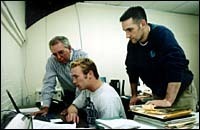
Michael Sisson, seated, and Michael
Woronoff. (Tom Croke)
It was time to call the bank.
“Say ‘Buy 60 shares TYC at 44.’ She should repeat it back to you,” said University of Rhode Island Professor Keith Moore to student Anne Chau.
Seifert Systems Invests in Energy Efficiency to Strengthen Operations
For manufacturers, energy is more than just another operating expense. It plays a critical role…
Learn More
Then he made the call.
After a few words with the broker on the other end, Moore handed Chau the phone, and kept one eye on the computer.
“The reason I’m watching is because I can get her to change the price if it goes up too much,” Moore explained to the visitor.
Chau and the broker continued to talk, about the way these stock transactions should take place from now on – by fax.
In the meantime, Tyco’s price went up.
Chau hung up the phone.
“Uh oh,” said Moore.
They tried to call back. The line was busy.
Kingston, Rhode Island might be a long way from Wall Street, but Keith Moore is helping bridge the gap for students at the University of Rhode Island.
A 23-year veteran of The Street with a specialty in arbitrage, Moore, a Ph.D. candidate at URI, is the faculty adviser for the RAM Fund, a $100,000 fund backed by the URI Alumni Association.
“The students are acting as a brokerage firm,” said Moore.
The program started last September, when a group of 10 students from URI’s business school were selected to generate the RAM Fund’s 35-page operational manual and business plan.
“The idea is that they get to do something that they haven’t done before,” Moore said. “Almost a year ago, I got called into a meeting. (URI Finance Professor) Dennis McLeavy had an idea where we would get a chunk of money for the undergraduate students to run in a real portfolio.”
Officers of the fund were named, as in an actual brokerage, and it was decided that half of the money would be invested in a value fund, the other half in a growth fund.
The group was expanded to 20 students in the spring semester, after an evaluation by a panel consisting of faculty and Alumni Association members who took into consideration grades, faculty recommendations and prerequisites.
“We’ve had two presentations from the RAM Fund, and at the end of each meeting, the people who received the presentation all looked at each other and said ‘These cannot be college students,'” said lawyer and URI Alumni Association President Alan Wasserman.
As a result of the program, Wasserman hopes the real-life experience will help students emerge better prepared for careers in finance. “This separates them from students at other universities who haven’t had this experience,” he said.
The students are taking their time and choosing their investments carefully: “There were a number of presentations that didn’t result in a vote of ‘buy,'” said Wasserman.
For their first investment, the group chose to invest 5 percent of the money — $2,500 — in manufacturer and service company Tyco International Ltd.
“You would think that if you gave a group of young people the opportunity to invest $100,000, they’d jump,” Moore said. “Not this group. They’re not taking their time, but they’re taking a close look.”
To decide where the money should be invested, each member of the group has an industry he or she must research and make regular reports to the team.
To prepare the group, Moore asked an investor relations representative from American Power Conversion come to address the group as if they were stockholders.
“We also contacted a couple of other student-managed funds around the country, just to have an idea where to start,” said Chau, a senior finance major and the RAM Fund’s growth fund manager.
Chau, who will start at UBS Warburg in the fall, said the biggest lesson she’s learned from the experience is “that things definitely don’t go as planned. There’s always something coming up that you didn’t think about – that’s a real-life experience right there.”
John Newsome is a senior finance major who will graduate after fall semester. An analyst for the RAM Fund specializing in transportation, he was one of the 10 students added to the group this spring.
“It’s real life,” he said. “We go through school and it’s so textbook, but working with the RAM Fund is real life. It’s the best class I’ve ever had. It’s amazing.”
“In the long run, we will be able to measure investment success, but I think everyone views this as a multi-dimensional situation,” Moore said. “If our students get an experience they would not have normally had or get a job they might not have gotten — but you can’t put a number on that.”
Thirty minutes later, the broker calls back.
“Okay – oh, you did?” said Moore, on the phone.
The broker was able to purchase the stock for $43.99 a share, “a bargain,” joked Moore.
By the time the visitor leaves, the stock is continuing to go up.
“We’re making 26 cents” said Moore.
“Multiply that by 60,” smiled Chau.