NORTH KINGSTOWN – In the past year, the University of Rhode Island has had much to celebrate, says school President Marc B. Parlange, from new programs and facilities to welcoming one of the largest enrollments in the institution’s history this school year.
But it’s far from smooth sailing, he cautioned – for URI, or for U.S. higher education as a whole.
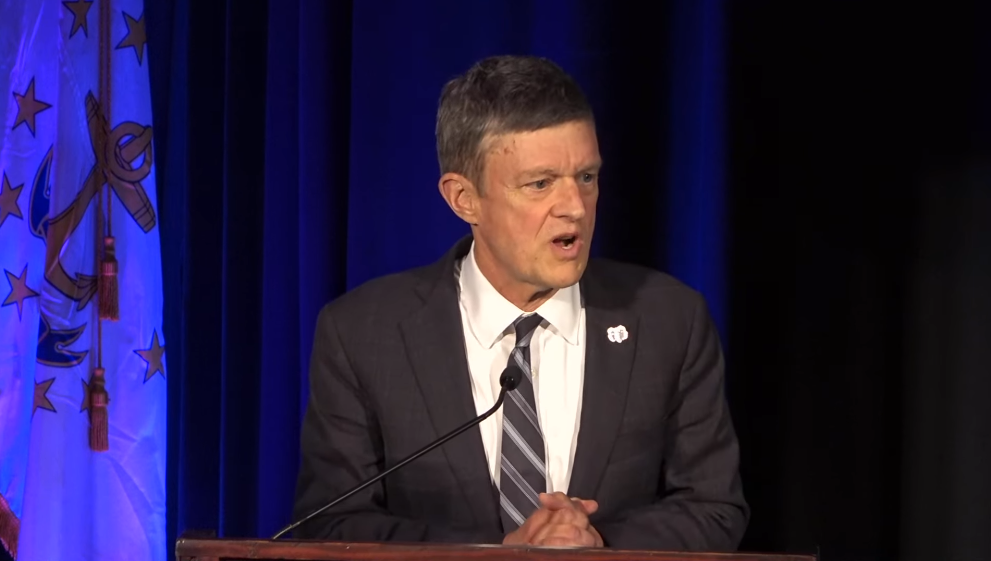
"This past year has reminded us of just how much is at stake," Parlange said on Friday afternoon, speaking at URI’s annual State of the University address.
“When universities falter, the consequences are not confined to the institution,” he continued. “Patients go untreated. Communities lose access to vital resources. Life-changing research comes to a halt. But when universities thrive, the reverse is true: Students climb higher, communities grow stronger and innovation flourishes."
While Parlange didn’t delve into the specifics of threats facing higher education, news headlines have identified the challenges: Since taking office in January, President Donald J. Trump has issued orders that slash research funding, threaten student visas and dismantle diversity initiatives on college and university campuses throughout the U.S.
Though Ivy League universities, including nearby Brown University, are often at the forefront of national news throughout these developments, Parlange has stressed the importance of extending support to public research universities such as URI.
On Friday, Parlange highlighted research initiatives and developments that Rhode Island’s flagship university credits as evidence and engines behind URI’s impact, as well as the “why” of the university’s mission.
This fall, URI welcomes more than 17,000 new and returning students, Parlange said. These students have access to new resources such as the Schilling Scholarship, a merit-based award granted to 26 STEM students; new master's programs in public health, educational leadership and policy, engineering management and leadership, mental and behavioral health, and management.
The university also launched a doctor of nursing practice program and is pursuing a proposal to establish the state’s second medical school.
Additionally, the university’s Ocean Robotics Lab is nearing completion on URI’s Narragansett Bay Campus, where other projects approved by R.I. voters in past bond measures are also in progress.
Parlange went on to highlight contributions in areas such as coastal resilience; artificial intelligence research; public health; education policy; extracurricular opportunities; and individual student and faculty accomplishments.
Collectively, these experiences create “something here that feels like home," Parlange said, "A place where (studens) belong, a place where they can build a future, and a place to find their purpose."
Parlange also doubled down on the university’s commitment to diversity, as related initiatives come under attack from the federal government.
"One of URI's defining traits is that we are not an ivory tower," Parlange said. "We are deeply embedded in our community, and in fact, we were founded on the promise of the land-grant mission – to democratize education for immigrants, farmers and working families, to expand opportunity beyond the privileged few and to serve the people of Rhode Island through teaching, research and service."
Looking forward, Parlange emphasized a need to continue strengthening graduate education programs and modernize university facilities.
"Here at URI, we cannot just survive the moment," Parlange said. "We must continue to move through it with purpose. And we are doing it."
Jacquelyn Voghel is a PBN staff writer. You may reach her at Voghel@PBN.com.