Providence firm dabbles in different mediums for architectural drawings
Advanced Media Design Inc.
Beyond Cash Donations: How New Forms of Giving Are Transforming Not-for-Profit Accounting
Evolving Funding Landscape for Not-for-Profits Not-for-profit organizations are being asked to do more with less,…
Learn More
Founders: Richard Dubrow and Jon Kletzien
Type of Business: Digital architectural illustration, animation and virtual-tour creation studio
Location: 14 Imperial Place, Providence
Employees: Seven
Year Founded: 1992
Annual Sales: WND
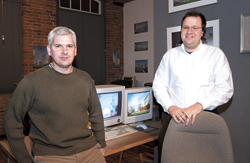
Advanced Media Design, founded by two Rhode Island School of Design graduates, prides itself on portraying the hard angles of modern architecture in a softer, more aesthetically pleasing light.
“Within the industry of doing renderings digitally, they range from very slick to very soft, and we’re on the soft end of things,” said co-founder and architectural illustrator Richard Dubrow. “We can render it in a way that’s more sympathetic and less hard-edged, because most of the buildings we’re working on are very hard-edged and cube-like.”
What makes AMD unique from the sea of competitors, he said, is the firm’s adaptation and derivation of traditional art mediums – charcoal and watercolors for example – which are implemented in every computer illustration. The effect is easier on the eye and more artistic than the standard computer rendering, said Jon Kletzien, co-founder and architectural illustrator.
“We’re taking lessons from traditional illustrators,” he said. “We resist the temptation to think that whatever the computer spits out is reality.”
“We focus on the illustration instead of the simulation” of data fed into the computer to produce the image, Dubrow said.
After graduating from RISD with dual degrees in fine art and architecture, Dubrow and Kletzien decided Rhode Island would be a good place to start their business.
“We liked it here and 1992 was a particularly bad economy, so we decided to stay,” Dubrow said. “It was also a new industry here.” It was also a logical decision, Kletzien added.
“We knew more architects here because of school, and we figured we could start a business and have it fail or go and bag groceries,” he said. “The other big reason was that at the time, the cost of living was so much cheaper here than in New York or somewhere else.”
In the last 12 years, the business that began as an illustration firm has expanded to much more, to what Dubrow calls “collateral materials” – marketing packages for some major development projects all over the world that include movie-like virtual tours, renderings and in some cases, Web sites. While most of AMD’s work is now outside Rhode Island, the firm is and has worked on a number of notable Rhode Island developments.
“A lot of our clients are in the major architectural centers; we’ve done high-rises in China,” Dubrow said. “We’re doing a lot of residential; corporate high-rises somewhat declined after Sept. 11. It’s a scale issue (in Rhode Island). Most of the projects aren’t large enough to hire a company like ours.”
In addition to providing computer illustrations for projects all over the country – the new New York Jets stadium, 7 World Trade Center, New York Stock Exchange, WGBH headquarters – AMD has also provided renderings for major developments in Korea, China, Norway, Kuwait and Singapore. The firm has also worked on many projects in New York City. Rhode Island architectural illustration projects include the master plan for Quonset/Davisville, Providence Place’s Wintergarden, the RISD Center (Chace Center), and parcel 11 in Capital Center, planned to be a hotel.
The relationship between architects and the computer illustrators who turn their concepts into a presentation for developers and the public is a symbiotic one, Kletzien said. Architects tend to be so focused on the design of the building that they are unsure of how to present a total package to developers. Illustrators have a better eye for pulling elements together, and take on the responsibility of understanding what the developer and investors want to see, he said. They provide an objective perspective.
“Sometimes we take out detail,” Dubrow said.
“Architects have enough on their plate,” Kletzien added. “The idea that when they sit down, (the rendering) should be a beautiful piece of art” is difficult for them. “We’re designing the canvas” for them.
Technology has played an integral part of making the illustration process faster, easier and more lifelike. The industry has taken leaps and bounds, the men said, even in 12 years.
“The industry is becoming much more competitive,” Dubrow said. “Everything is faster and cheaper. There is also more acceptance of computer illustrations. When we started, it was tough to get anyone to accept a computer drawing.”
“Our charge is to update our talent and software, but keep a look that is AMD,” Kletzien said. “It’s about having a person behind the computer knowing where we want the image to go, instead of letting the computer call the shots. We want the artist’s hand to come through.”