Rhode Island has had a seller’s market for several years in single-family and multifamily homes, particularly for entry-level or median-priced houses. In the past two months, however, that imbalance has become even more exaggerated.
Through the darkest days of the COVID-19 crisis in March and April, more than 1,000 potential sellers pulled their houses from the spring market, says James Luth, a real estate agent and principal broker of Cranston-based Here Realty Group LLC.
But there are still plenty of buyers, many spurred on by rock-bottom interest rates.
“We’re dealing with a market right now that’s being driven by scarcity and uncertainty,” said Luth.
The dynamics are pumping up prices while lowering the number of transactions. It’s also making buyers do things to close a deal that in another year might seem rash. In his last two sales, Luth represented out-of-state buyers who purchased homes without stepping onto the property – one a newly hired Brown University scientist, the other a tech worker from Texas. In the absence of open houses, they relied on video tours.
“The reality for buyers right now is the likelihood, even the guarantee, that they will not get the first three houses they see,” Luth said. “Right around the median price, of $300,000, anywhere from 10 to 20 offers are submitted for some of these properties.”
As a result of the frenzy, home prices have risen quickly through the pandemic – not falling as they did in the Great Recession.
What’s driving this intensity? Wouldn’t a global health crisis and record unemployment cause people to be more concerned about their job security or the sputtering economy enough to delay large purchases?
For some people, yes, unemployment has knocked them from consideration in a home purchase, Luth said. Either they’ve lost their jobs, or have had their income reduced, or are no longer able to find a lender who will allow them to purchase a home without a high credit score and a healthy down payment.
But there are many potential buyers who were already hunting for homes in Rhode Island, and whose jobs are not threatened, to more than make up for it. Add the removal of listings from the spring market, and the demand far exceeds supply, according to numerous real estate agents.
The number of sales of Rhode Island single-family homes declined this spring, but real estate professionals attribute that to the reduction of inventory. In May, listings fell by 33% while transactions dropped by 31% from the previous May. In June, listings were down 36% while transactions dropped 14.6% from a year before.
“We slowed down, but we picked right back up,” said Shannon Buss, president of the Rhode Island Association of Realtors. “I can tell you now, in both the single-family and the condo market, I am seeing almost every property with multiple offers.”
In a stable market – where the number of listings is sufficient to satisfy buyers – there is a six-month supply of homes, based on the median number of sales per month. Rhode Island in June had only 2.4 months of inventory, down from 3.2 months in May.
What that means is bidding wars over homes that are well-kept and well-priced. Across the state, the scales are tipped in favor of people selling homes.
For the buyers, there is a silver lining: historically low interest rates, which means their money can travel further on a loan. Buss said several former clients have taken the opportunity to refinance their mortgages, lowering their monthly payment by hundreds of dollars.
[caption id="attachment_337785" align="aligncenter" width="1024"]

WINNER TAKES IT: Ashley Avina is pictured with Here Realty Group LLC broker-owner James Luth in front of the home Avina bought in East Greenwich in June. Avina, a single mother, says she included a “buyer’s letter” explaining why she wanted the house and a photo of her daughter with her offer to the seller, which she believes helped her get the house. / PBN PHOTO/RUPERT WHITELEY[/caption]
READY TO COMPETE
What does super-slim pickings mean for buyers? They need to have their finances in order and be proactive. That means looking for houses as if it’s a new part-time job, moving quickly and being willing to overlook minor problems, such as dated wallpaper or appliances.
Preapproval for a mortgage is critical, Buss said, because everyone making an offer will have that. “If a property has five, 10 offers on it, and you don’t even have your approval in hand, there are nine other people who do,” she said.
Realtors say so-called “buyer’s letters” can strike a chord in a competitive market. Like a cover letter on a job application, these personalized statements explain why the buyer wants the property, and they can be persuasive with sellers who are choosing among multiple offers.
Ashley Avina, who bought a three-bedroom home in East Greenwich in June, thought her letter was one of the reasons why she got the house. The seller mentioned it several times, Avina said.
Avina, a single mother of a toddler daughter, wrote in her letter that she had seen the house while walking with her daughter and dog in the neighborhood. When she saw the house was for sale, Avina thought it would be a wonderful place for her to live.
“My main focus was a good school district,” said Avina, who had been house hunting for months. “A yard for my daughter and dog to play in. And at least three bedrooms.”
Although the property already had an offer, Avina made an offer above the asking price and included in the letter that she was a single mother by choice. She tucked in a photo of her child into the letter, too. As it turned out, the seller had also been a single mother when she bought the home, Avina said
“It was the story that got her,” Avina said.
Previously, Avina had been a disappointed also-ran in her search. She remembered the sinking feeling of driving up to another open house and seeing a line of people outside.
“You see people standing in the driveway, that just came out of seeing it,” she recalled. On that first house, she put in a bid $15,000 over the asking price and was still beat out.
“It was deflating,” Avina said.
When she saw the house in East Greenwich was listed as a “for sale by owner,” she called Luth, her agent. After some negotiation, the house was hers. She closed on June 26.
Her advice? Don’t sleepwalk through a house hunt. “Keep looking and keep your eyes open.”
FAST-ACTING
Nicole Tickner started looking for a house in February. When the COVID-19 pandemic first struck, she saw the number of listings decline sharply in her range of $300,000 to $500,000.
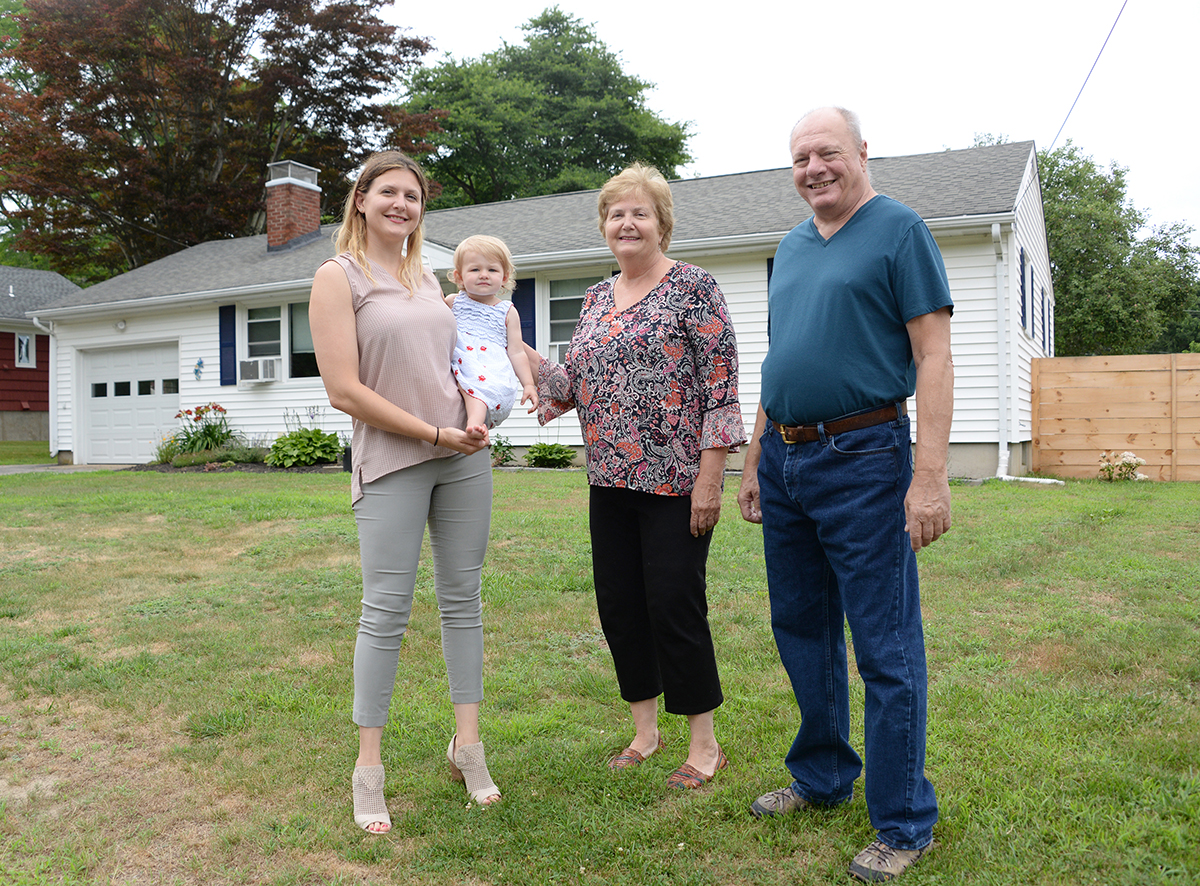
Still, she was motivated. The house was intended to be a retirement gift for her parents, who had moved to Rhode Island from out of state to be near their grandchildren. “I had been looking at properties all along. I had my eye on the lookout,” Tickner said. When a South Kingstown house in her price range was listed, she went to the first open house. Already, she was in competition.
“I think, that day, there were four offers,” Tickner said. “So, you really had to move quickly from that point on.” She also shared her story with the sellers and eventually closed the deal. Tickner said she felt a little bit of concern about whether this was the right time to buy, but after searching for months, she knew this was the right home.
She kept it a secret from her parents, until they visited Rhode Island in May, and on the pretext of a trip out for ice cream, she drove to the new house.
Her 3-year-old daughter was the one who explained to her confused grandmother why they were there.
Tickner credited her preparation for her successful house hunting. “It’s not like you can just walk in and think about it,” she said. “You have to do your research and be in a position where you can make a decision.”
[caption id="attachment_337787" align="aligncenter" width="1024"]

SUNNY OUTLOOK: Leann D’Ettore, president-elect of the Rhode Island Association of Realtors and owner and president of Homistic Real Estate Inc. in Cranston, says she expects buyers who were initially scared off by COVID-19 will reenter the market and sellers who are feeling more confident in their security will relist their properties in the months ahead. / PBN PHOTO/MICHAEL SALERNO[/caption]
SELLER SHORTAGE
With such a lopsided market, why have so many prospective home sellers stayed out of the 2020 market? Uncertainty, according to those in the real estate industry.
When the pandemic arrived, people pulled their homes off the market, worried about strangers traipsing through their homes and feeling anxiety about whether they’d be able to find a new place to live, according to those in the real estate industry.
As part of a statewide stay-at-home order, real estate activity came to a near standstill. Even before the order, real estate agents stopped holding open houses.
To ease the shortage of house listings, the state Realtors association has focused on reducing the jitters of sellers, according to its incoming president, Leann D’Ettore.
It has now become much more common for sellers to require that buyers agree to a contingency clause that allows the homeowner to back out of a sale if they cannot find a home themselves.
Called a “suitable housing” clause, it typically gives the seller a few weeks to get their next house under contract. Chris Whitten, the broker-owner of Premeer Real Estate Inc. in Smithfield, estimated that about 20% of his sales now have that clause as part of the deal.
The buyer can extend that window, or sometimes the deal falls apart. But it has become a way for sellers to have some assurance that they won’t be left homeless, a strategy to get more sellers comfortable with listing their properties, Whitten said.
“Even though there may be not as many buyers as we had pre-COVID, there’s also a lot less sellers putting their homes on the market,” he said. “There is even less inventory from a year ago, to today.”
While in-person open houses have resumed, showings have safety restrictions. No more than one person is allowed inside a house for every 100 square feet. So a 1,200-square-foot home could have 12 people inside.
Everyone must wear a mask, and only the real estate agent can touch doors or knobs. So if a prospective buyer wants to see how big the closets or cupboards are, the agent opens those doors. And after the showing, they are wiped down.
The reopening plans were coordinated with state officials and industry experts, said D’Ettore, who is owner and president of Homistic Real Estate Inc. in Cranston.
“We were able to launch our open-house plans. That has a direct correlation to housing inventory,” D’Ettore said. Even so, sales volume is down significantly this spring because of the pandemic.
“Sales are down and that’s related to low inventory,” she said. “Sales are down significantly.”
[caption id="attachment_338447" align="aligncenter" width="1024"]
Where have all the houses gone?
Rhode Island’s residential market, already a seller’s market for several years, has had a sharp drop in listed properties through the
spring and early summer, compared with last year, which is increasing competition for available homes. Listings of single-family
houses dropped 36% in June, compared with a year prior. Condo listings are down 22%, while multifamily listings have fallen by 25%.
Source: Rhode Island Association of Realtors data[/caption]
How significantly? In the month of April, closings were down 9.5% from the same month a year earlier. In May, the figure dropped 31% from a year ago, and in June, closings were down 14.6%.
On the flip side, she said, the decreased volume has resulted in rising home prices for sellers. The median sale price for a single-family in Rhode Island rose 7.5% in April to $295,500, then rose another 3% to $309,500 in May. While the median price dipped to $309,000 in June, it was still 3% higher than it was a year ago.
The spring market, D’Ettore said, was essentially stopped by the pandemic. Sellers who have school-aged children, who often do not want to move them in the middle of an academic year, likely won’t list again until next spring.
But plunging interest rates have pulled in more buyers.
A similar trend is happening across the country. The pandemic resulted in lost sales and higher prices in April and May, according to published reports by the National Association of Realtors. But the market appears to be rebounding. Pending sales – which are properties under contract – increased by 44% from April to May, the association reported. That’s an indication that sales closings will start to increase in the summer months.
The market is starting to recover from the shock of the pandemic and stay-at-home orders, says the association’s chief economist, Lawrence Yun. He predicted annual, existing-home sales, as opposed to new construction, would be down by just 10% for the entire year as a result.
D’Ettore expects that in the months ahead, buyers who were initially scared off by COVID-19 will reenter the market. And sellers who are feeling more confident in their security will relist their properties.
“It’s like somebody hit the pause button,” she said. “All of these real estate needs, people still have those needs. We’re just going to see a delayed effect.”
Mary MacDonald is a PBN staff writer. Contact her at Macdonald@PBN.com.