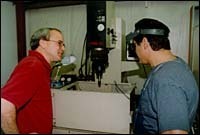
left, talks to one of his employees.
Company: Tri-Mack Plastics
President: Edward J. Mack II
Location: 66 Tupelo Street, Bristol
Year founded: 1974
Type of business: Manufacturer of high performance plastic parts
Employees: 100
Annual revenues:$10 million
The theory that every cloud has a silver lining seems to be true for Edward J. Mack II, second generation owner of Tri-Mack Plastics in Bristol.
Beyond Cash Donations: How New Forms of Giving Are Transforming Not-for-Profit Accounting
Evolving Funding Landscape for Not-for-Profits Not-for-profit organizations are being asked to do more with less,…
Learn More
When a recession in the early 1990s forced his company to “hunker down” and even lay off some workers, he realized that changes needed to be made.
“A lot of pain comes with laying off workers,” he said. “We made a commitment to our workers when we hired them not to let them down. In my opinion we did just that. And though we weren’t alone and a lot of other companies were doing the same thing, I knew that I never wanted to be in that situation again.”
Started by Mack’s father in 1974, the company, then known as Mack plastics, had fewer than 20 employees and focused primarily on custom manufacturing. Mack quickly learned the future success of the company was heavily dependent on diversity.
“We diversified and grew in terms of technology and in the types of materials that we used as a company,” he said. “What we did was develop the technology to support the programs for our existing custom manufacturing base, start creating the tools our outside customers need and are currently developing custom materials for application.”
The new three-pronged approach was so significant members of the company’s board felt Tri-Mack a more befitting name for the company.
“There are three legs to this stool,” Mack said. “We wanted our name to reflect that.”
Though the name was only officially changed this year, Mack said many of his customers have been using it a lot longer.
“Our customers got used to it before we did,” he said.
Mack said, because the company doesn’t sell to the “mainstream” market, changing the name didn’t mean a loss of recognition among customers.
“Name recognition was not as big for us,” he said. “We had never really invested in any type of advertising so we weren’t really concerned that people wouldn’t know who we were. Even still, we decided to keep Mack in the new name.”
The new strategy included a five-year plan that would grow the company both physically and financially. It worked.
The company, which had under 20 employees in the early 1990s, now has 100 and more are expected. Annual revenues have jumped from a mere $3 million to over $10 million, though Mack is reluctant to release the exact numbers.
“We are quite thrilled,” he said. “We have seen a tremendous amount of growth, especially this year.”
Still, Mack points out, the company is somewhat limited in its capacity to continue growing.
“This kind of growth puts some pressure on cash,” he said. “If you want to become a $20 million company you have to invest close to $4 million, and in a company like ours that is hard to do.”
Mack doesn’t overlook the possibility of partnering with a larger company with a bigger cash flow and more market access, but wants to make sure any partnership is right for the company and its employees.
“We do wish to continue to grow,” he said. “And we are ultimately going to need a partner but I would prefer to maintain a majority share in the company.”
Mack is slow to take credit for all the company has accomplished in the past decade, quickly pointing out that it’s his employees that have made it possible. Often found on the plant floor, Mack likes to work side by side with those employees and not behind a desk.
“We have a tremendous group of people here,” he said. “We have a great middle management team, strong supervision of the shop floor and a tremendous labor force that is extremely dedicated. I think that we are pretty fortunate.”
Mack, who graduated from the University of Rhode Island with a degree in mechanical engineering, also realized early on that his skills were more technical, and not so management oriented. As a result he took an executive master’s in business administration course offered by the University of Rhode Island to learn more about that side of the business.
“I really learned how to put an education structure in place,” he said. “It’s been extremely helpful and it gives me the freedom to work where I want to work.”
Running a business started by his father doesn’t intimidate Mack. Though he and his sister Mary Mack Popham, might be “in charge” today, they have always been a part of what was happening at the company.
“Since day one we have been included,” he said. “My father was amazing. He listened to our input and didn’t feel any strain. I believe we have seamlessly continued what he started.”